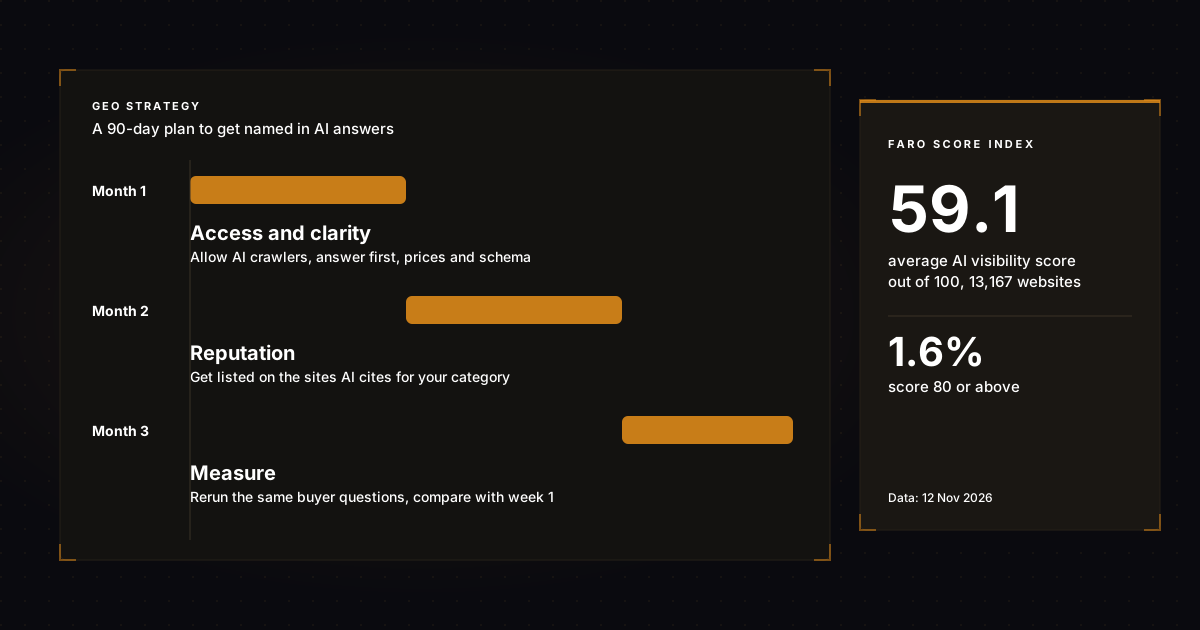
A GEO strategy is a plan to get your business named, quoted and linked in answers from AI tools like ChatGPT, Gemini, Perplexity and Google's AI Overviews, built in four parts: make your site readable to AI crawlers, make your pages easy to quote, earn mentions on the sites AI trusts, and measure who gets named for your buyers' questions every month.
Most businesses skip the first and last parts and jump to rewriting content. Start with a baseline instead: our free AI visibility checker shows in about 30 seconds whether AI tools can reach and understand your site. Then use the 90-day plan below, which tells you what to do each week and how to know it is working.
Key takeaways
- GEO (generative engine optimization) is about being the source AI answers name and quote, not about ranking in a list of links.
- A working GEO strategy has four parts: access, clarity, reputation and measurement. Most plans miss measurement.
- Across 13,167 sites in the Faro Score Index (12 Nov 2026), the average AI visibility score is 59.1 out of 100 and only 1.6% score 80 or more.
- The most common gaps are basic: 55.8% of sites have no prices an AI can read and 54.4% have no sameAs links that tie their brand to its other profiles.
- Give it 90 days: fix access and clarity in month one, earn mentions in month two, and judge results on month three's prompt test.
What is a GEO strategy?
A GEO strategy is your plan for how AI search tools find, understand and recommend your business. It sets which buyer questions you want to be named for, what has to change on your site and around the web to get there, who does the work, and how you will measure progress each month.
The term GEO comes from a 2023 research paper on generative engine optimization. The authors tested content changes on a large benchmark of search queries and found the right changes could lift a source's visibility in AI answers by up to 40%. They also found that what works differs by subject. That is why a strategy beats a list of tactics: you test against your own buyers' questions.
GEO overlaps heavily with SEO and AEO. Our guide to SEO vs AEO vs GEO covers the labels. In practice a GEO strategy keeps everything that helps you rank in Google and adds three jobs SEO plans usually ignore: AI crawler access, quotable answers, and tracking what AI tools actually say about you.
Why does a business need a GEO strategy now?
Buyers now ask AI tools for recommendations before they visit any website, and those tools name only a handful of businesses per answer. If you are not one of them, you never get the visit. A GEO strategy matters because most competitors have not fixed even the basics, so early work still moves results.
The Faro Score Index shows how wide that gap is. Across 13,167 business websites we have scanned (12 Nov 2026), the median AI visibility score is 61 out of 100, 17.1% score under 50, and only 211 sites, 1.6%, score 80 or more. Most of the failures are fixable in a week: missing prices, missing organization details, blocked crawlers.
| Common gap | Share of sites failing | Fix time |
|---|---|---|
| No prices an AI can read | 55.8% | An hour to a day |
| No sameAs links to other profiles | 54.4% | Under an hour |
| No Organization schema | 40.2% | Under an hour |
| No About page an AI can read | 25.7% | A few hours |
| Homepage does not say what you do in the opening lines | 20.5% | An hour |
| GPTBot blocked in robots.txt | 14.7% | Minutes |
The four parts of a GEO strategy
Every working GEO strategy covers access, clarity, reputation and measurement. Access means AI crawlers can reach your pages. Clarity means each page answers a real question in plain words. Reputation means other trusted sites mention you. Measurement means you check the answers themselves every month, using the same questions, so you see real movement.
1. Access: can AI tools reach your site?
Each AI tool uses its own crawlers. OpenAI's crawler documentation says sites that block OAI-SearchBot will not be shown in ChatGPT search answers. Perplexity's crawler guide recommends allowing PerplexityBot and its IP ranges, including in firewalls. Check robots.txt, your CDN and any bot protection. Our guide to AI crawler user agents lists which bots to allow.
2. Clarity: can AI tools quote you?
AI answers lift short, self-contained passages. Put the answer to each page's main question in its first two sentences, state prices and service areas in text, and use structured data that matches what the page says. Add sameAs links from your Organization markup to your LinkedIn, Wikidata and directory profiles so AI tools can confirm who you are.
3. Reputation: who else vouches for you?
AI tools lean on what other sites say. Reviews, industry directories, comparison articles, forums and local press all feed the answer. List the five to ten sources that AI cites for your category, then work on being in them: claim profiles, pitch a data point, answer questions where buyers ask them. Our guide to getting recommended by ChatGPT covers which sources matter.
4. Measurement: are you named more than last month?
Pick 10 to 20 questions your buyers ask, run them in ChatGPT, Gemini, Perplexity and Google every month, and record who is named, who is linked and how you are described. Rankings in Google do not tell you this. Our guide to AI citation tracking shows how to set it up by hand or with a tool.
How do ChatGPT, Gemini, Perplexity and Claude differ?
They draw on different sources, so a GEO strategy has to cover each. Google's AI Overviews and AI Mode use Google's own index. ChatGPT search relies on its OAI-SearchBot crawler. Perplexity runs its own crawler and fetches pages live. Claude searches the web when asked and reads pages through its own user agents.
| AI tool | Where answers come from | What to check first |
|---|---|---|
| Google AI Overviews and AI Mode | Google's search index | Indexed in Search Console, snippet allowed |
| ChatGPT search | OAI-SearchBot crawl | OAI-SearchBot allowed in robots.txt and firewall |
| Perplexity | PerplexityBot crawl plus live fetches | PerplexityBot allowed, IP ranges not blocked |
| Claude | Web search plus live page reads | Claude user agents allowed, content in plain HTML |
| Gemini app | Google search and its own models | Same as Google, plus Google-Extended policy |
Google is clear that you do not need anything special for its AI features. Its guide to AI features and your website says a page must be indexed and eligible for a snippet, with no extra technical requirements, and that AI Mode can use "query fan-out" to search subtopics. Good SEO is still the base layer. Our AI Overviews guide goes further.
A 90-day GEO strategy plan, week by week
Spend the first month on access and clarity, because nothing else works until AI tools can read and quote you. Spend the second month on reputation, where most of the lift comes from. Use the third month to measure, fix what did not move and set the next quarter's questions.
| Weeks | Focus | Tasks | Done when |
|---|---|---|---|
| 1 | Baseline | Pick 10 to 20 buyer questions; run them in four AI tools; scan your site; note who is named | Baseline sheet and score saved |
| 2 | Access | Allow AI crawlers in robots.txt, CDN and firewall; check pages render without JavaScript | Scan shows no blocked bots |
| 3 to 4 | Clarity | Rewrite homepage, pricing and top service pages answer-first; add Organization schema with sameAs; publish prices | Each key page answers its question in two sentences |
| 5 to 6 | Content gaps | Write one page per unanswered buyer question; add FAQs in real headings | Every baseline question has a page |
| 7 to 9 | Reputation | List the sites AI cites for your category; update profiles; pitch one data point or guest answer a week | Listed on 3+ cited sources |
| 10 to 11 | Competitors | Compare your scan with the businesses AI names instead of you; close the biggest gap | Gap list worked through |
| 12 to 13 | Measure | Rerun the same questions and scan; compare with week 1; pick next quarter's questions | Report with before and after |
Week 1 is where most strategies go wrong, because people skip it. Without a baseline you cannot tell whether week 12 is better. The free AI visibility checker gives you the technical half of that baseline in about 30 seconds; the prompt test gives you the other half.
How do you measure a GEO strategy?
Measure what AI tools say, not just your Google rankings. Track how often you are named, how often you are linked, where you appear in the answer, and whether the description is accurate, across the same questions every month. Add AI referral visits from your analytics and the leads they bring, so the report ties back to revenue.
| Metric | Where to get it | How often |
|---|---|---|
| Share of answers that name you | Monthly prompt test or a citation monitor | Monthly |
| Share of answers that link to you | Same | Monthly |
| Accuracy of how AI describes you | Same, read by a person | Monthly |
| AI visibility score | Site scan | After each site change |
| Visits from chatgpt.com, perplexity.ai and similar | Your analytics referral report | Monthly |
| Leads or sales from those visits | CRM or analytics conversions | Quarterly |
Running 20 questions across four tools by hand takes about an hour a month. If that is too slow, the AEO citation monitor runs your buyer questions on a schedule and shows who was cited, mentioned or left out. Our post on proving AI visibility drives revenue covers the reporting side.
A one-page GEO strategy template
Write the whole strategy on one page so the team can act on it. It needs your target questions, the gaps from your baseline, the fixes in order, the sources you want to appear in, the owner of each task, and the three numbers you will report every month. Copy the outline below and fill it in during week 1.
- Goal: Be named in AI answers for [10 to 20 buyer questions] by [date].
- Baseline: Named in [x] of [y] answers; AI visibility score [n]; top named competitors [list].
- Access fixes: [blocked bots, firewall rules, JavaScript-only pages].
- Clarity fixes: [pages to rewrite answer-first, schema, prices, About page].
- Reputation targets: [5 to 10 sites AI cites for your category].
- Owner and hours: [name, hours per week].
- Monthly report: share named, share linked, AI referral visits.
If you run this for clients, keep the same questions and template for every account so the reports compare. Use competitor intelligence to score a client against the businesses AI already names; that comparison makes the case for the work faster than any slide.
Five GEO strategy mistakes to avoid
The mistakes that waste the most time are skipping the baseline, buying tools before fixing access, rewriting every page at once, ignoring other sites, and judging results on one week of answers. AI answers change from run to run, so only a repeated test on the same questions tells you whether the strategy works.
- No baseline. Without week 1 numbers, nobody can say whether week 12 improved.
- Tools before access. A blocked crawler or a firewall rule undoes every content fix. Check access first.
- Rewriting everything. Start with the homepage, pricing and the pages that match your buyer questions.
- Only fixing your own site. AI tools trust what others say about you. Reputation work is half the plan.
- Chasing one answer. Answers vary between runs. Look at the share of answers that name you over a month.
Frequently asked questions
What is the best generative engine optimization strategy?
The best strategy fixes access and clarity first, then builds reputation, and measures the same buyer questions every month. Tactics like adding statistics or quotes help, but research on GEO found results vary by subject, so test against your own questions instead of copying a list.
How does generative engine optimization work?
AI search tools find pages, pull short passages that answer the question, and write a summary that names some sources. GEO makes your pages easy to reach, easy to quote and backed by other sites, so the tool picks your passage and names your business.
What is GEO vs SEO?
SEO aims to rank your pages in a list of search results. GEO aims to get your business named and quoted inside AI-written answers. They share most of the groundwork, such as crawlable pages and helpful content, but GEO adds AI crawler access, answer-first writing and tracking of the answers.
How do you implement generative engine optimization?
Start with a baseline: run your buyers' questions in four AI tools and scan your site. Then fix crawler access, rewrite key pages to answer first, add Organization schema and prices, earn mentions on sources AI cites, and rerun the same questions after 90 days.
How long does a GEO strategy take to work?
Access and clarity fixes can show up within weeks, once AI tools recrawl your pages. Reputation work takes two to three months. Judge the strategy on a 90-day before and after comparison of the same questions, not on any single week's answers.
What to do next
Write your 10 to 20 buyer questions today, then run your site through the free AI visibility checker to get the technical baseline. If you want the first audit done step by step, our GEO audit guide walks through it in 30 minutes. In short, a GEO strategy is a baseline, four fixes and the same questions asked every month.