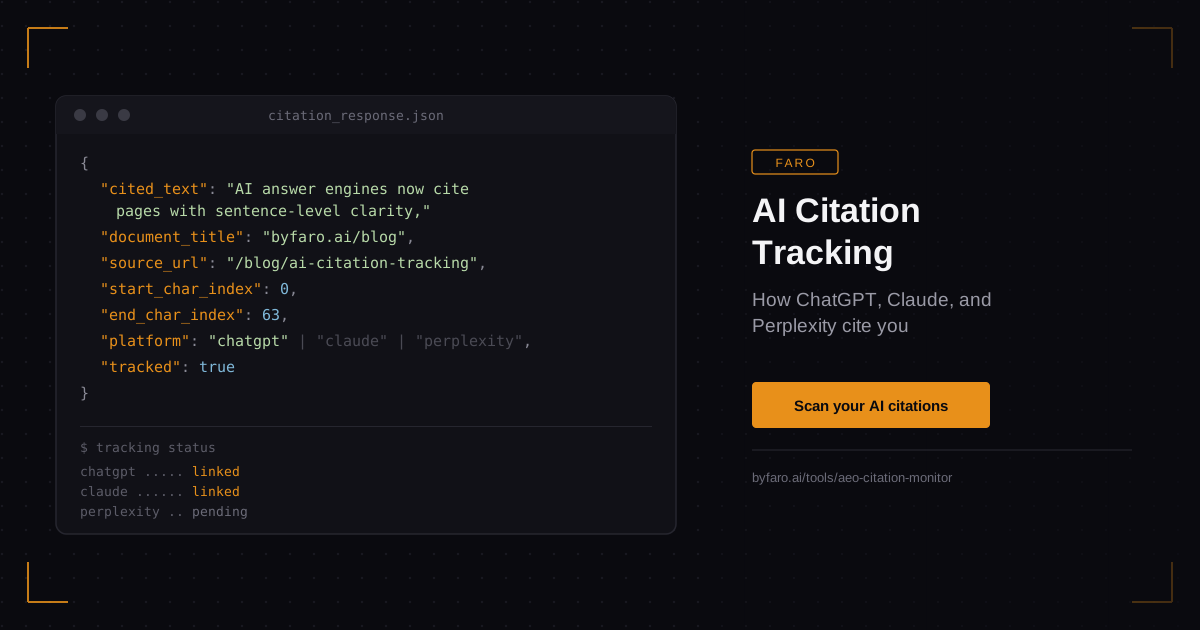
AI citation tracking means checking every week whether ChatGPT, Claude, Perplexity and Google's AI Overviews name your page as the source of a claim and link to it. Each platform builds citations through a different mechanism, so you run the same prompt list on each one, logging whether you appeared, were linked and which URL was cited.
Ask ten marketers whether ChatGPT, Claude, or Perplexity cited their brand last week, and most will guess. There is no AI Search Console, no verified export of every prompt where your product showed up as a source. That gap is a problem, because AI citation tracking is quickly becoming the only way to know whether your content is doing anything at all in the channels that now sit between a search query and a click. Each major AI platform builds citations differently, with different rules for what gets pulled, how it is structured, and what a page has to do to qualify. Understand those mechanics and you can build a real tracking method today, without waiting for a vendor to hand you a dashboard.
Key takeaways
- ChatGPT, Claude, Perplexity, and Google's AI Overviews each generate citations through a different technical mechanism, not one shared standard.
- Claude chunks source text into sentences and cites by character or page location; OpenAI returns URL annotations with exact character positions; Perplexity returns up to 20 ranked source objects with snippets and dates.
- Google says plainly that no special schema markup or AI text file is required to appear in AI Overviews, standard indexing and crawlability requirements apply.
- You can build a manual AI citation tracking process this week with a fixed prompt list, four accounts, and a spreadsheet.
- Structured data still matters, but for consistency and machine parsing across platforms, not as a magic switch that turns on AI citations.
What does it actually mean when AI cites your brand?
An AI citation is an attributed reference: the answer names your page as the source of a claim and links to it. A mention names your brand with no link, and a recommendation tells the user to use your product. You track citations, mentions and recommendations separately because each one calls for a different action.
A citation is a specific, attributed reference: an AI answer names your page as the source of a claim and links to it, the way a footnote works. A mention is looser, your brand name appears in the answer text with no link and no attribution. A recommendation goes further still, the model tells the user to go use your product. Marketers often collapse all three into "we got cited," which makes tracking useless, since the actions you'd take for each are different. If ChatGPT mentions your brand without linking, that is a training-data or reputation signal, not a traffic signal. If Perplexity links your page as a source with a snippet, that is a live retrieval event you can trace to a specific page and query. Track the three separately from the start, because conflating them is the fastest way to draw the wrong conclusion from a good result or a bad one.
How does ChatGPT decide what to cite?
ChatGPT cites the sources its web search tool retrieves, and each citation comes back as a structured annotation rather than a footnote the model invents. Per OpenAI's documentation, the annotation carries the source URL, the page title and the exact character span in the answer where that source was used, so every citation is auditable.
ChatGPT's web search tool runs one of three modes, non-reasoning search that passes a query straight to the tool, agentic search where the model plans and re-queries, or deep research that can pull from hundreds of sources over several minutes, and in every mode the citation itself is returned as a structured annotation, not a stylistic footnote the model invents. According to OpenAI's web search documentation, each citation carries the source URL, the page title, and the exact start and end character position in the response text where that source was used, and OpenAI explicitly requires that inline citations be "clearly visible and clickable" wherever the response is shown to a user. That means the citation is not cosmetic, it is a data object tied to an exact span of the answer, which is exactly what makes it possible to audit later if you know what to look for in an API response or a browser session.
How does Claude generate its citations?
Claude generates citations from the documents attached to a request. Anthropic's documentation says plain text and PDF sources are chunked into sentences, and each citation returns the exact cited text, a document index, a title and a location range. Claude's citations work at sentence level by default, so short, self-contained sentences are easier to cite cleanly.
Faro's own scans point the same way: of the 2,081 sites in the Faro Registry with a result for this check (scanned August 2026 to October 2026), 25% answer their key question in the opening lines of their key pages. The registry is the set of sites Faro has scanned, not a random sample of the web. On the other 3 in 4, the answer sits further down the page.
Claude's citations feature works from documents you or a tool attach to the request, and Anthropic's own documentation lays out the mechanism in detail rather than treating it as a black box. Per Anthropic's citations documentation, plain text and PDF sources are automatically chunked into sentences, and each citation in the response includes the exact cited text, a document index, a document title, and a location, a character range for text, a page range for PDFs. Custom content blocks skip the automatic chunking and use whatever segments were provided. The practical read for content owners: Claude's citation granularity is sentence-level by default, so a page with short, self-contained, factually dense sentences is easier for the model to cite cleanly than a page built from long compound sentences that bury the answer in a subordinate clause three lines down.
How does Perplexity choose and structure its sources?
Perplexity chooses sources through its search API, which returns ranked source objects rather than a single best answer. Each source carries a title, a URL, an extracted snippet and publish and last-updated dates, with 10 results by default and up to 20. Because Perplexity surfaces dates so prominently, a visible, accurate update date helps.
Perplexity's Search API returns ranked source objects rather than a single best answer, and each one carries a title, a URL, an extracted snippet, and publish and last-updated dates, which is more metadata per source than either OpenAI or Claude expose by default. Per Perplexity's search documentation, the API returns up to 10 results by default and accepts a max_results parameter up to 20, with a search_context_size setting that controls whether it pulls short passages or full page content around the matching text. Because Perplexity surfaces dates so prominently, freshness is a bigger lever here than on other platforms, a page with a visible, accurate last-updated date has a structural advantage in a system built to rank and timestamp its sources before it ever generates a word of answer text.
Does Google's AI Overviews need special markup to cite you?
No, and Google says so directly. According to Google's Search Central documentation on AI features, "there are no additional technical requirements" beyond standard search eligibility, and the same page states plainly that "there's also no special schema.org structured data that you need to add" and no need for "new machine readable files, AI text files, or markup." AI Overviews instead uses a query fan-out approach, issuing multiple related searches across subtopics to assemble a broader set of sources than a single query would surface, which is the same mechanism behind Faro's own query fan-out analysis. Google does layer in a separate preferred sources feature, where users can select a publication for priority placement, complete with a badge inside AI Overviews, but that is opt-in reader behavior, not a markup requirement. The takeaway is that being indexed, crawlable, and genuinely well-structured for humans covers most of the eligibility bar here; structured data still matters for the reasons covered below, just not as a switch that turns on Google AI Overviews eligibility by itself.
How the four platforms compare
Put side by side, the differences are less about ranking philosophy and more about what data structure each platform is willing to expose to a developer, which changes what a marketer can realistically verify.
| Platform | Citation unit | Metadata exposed | Default source count |
|---|---|---|---|
| ChatGPT (OpenAI) | URL annotation on a text span | URL, title, start/end character position | Varies by query and mode |
| Claude (Anthropic) | Sentence, page, or content block | Cited text, document index, document title, location range | Set by the documents you attach |
| Perplexity | Ranked source object | Title, URL, snippet, publish/updated dates | 10, up to 20 |
| Google AI Overviews | Linked result within a fan-out set | Standard search snippet, optional preferred-source badge | Not published, expands via fan-out queries |
Source: platform documentation from Anthropic, OpenAI, Perplexity, and Google, cited above by section.
How to track your own AI citations without buying anything
You do not need a tool to start; you need a fixed test set and the discipline to run it the same way every time, because inconsistent testing is what makes most citation "tracking" anecdotal rather than useful. Build a list of 15 to 25 real prompts a buyer would plausibly type into an AI assistant while researching your category, phrased the way a person actually talks, not the way you'd phrase a keyword. Run the same list weekly across ChatGPT, Claude, Perplexity, and Google's AI mode, logging four things every time: whether your brand appeared at all, whether it was linked or just named, which exact URL got cited if any, and the date. A spreadsheet with those four columns, refreshed on a set day each week, will tell you more in a month than a single spot-check ever will, because it turns a one-off "we got mentioned" screenshot into a trend line you can actually act on.
That manual process works, but it does not scale past a handful of prompts before the weekly logging becomes the job, which is the exact gap Faro's AI citation monitor is built to close, running the same discipline continuously instead of on whatever afternoon you remember to do it. The setup guide for the AEO Citation Monitor walks through building that prompt list inside the tool, so the weekly run happens whether or not you remember it.
What actually improves your odds of being cited?
Across all four platforms, a few patterns hold up regardless of which one is doing the citing, and none of them are exotic.
- Get the baseline right first. Every platform above depends on your page being crawlable and indexed before it can ever be cited; a page an AI crawler cannot fetch cannot be cited, full stop. Faro's AI visibility scan checks that baseline directly.
- Write sentence-level answers. Claude cites by sentence, OpenAI cites by character span, both reward a page that states the answer in one clean, self-contained sentence rather than spreading it across a paragraph.
- Keep dates visible and accurate. Perplexity surfaces publish and update dates prominently; stale, undated pages lose a structural advantage that costs nothing to fix.
- Match your structured data to your visible text. Google's own guidance says structured data should reflect what's actually on the page, not aspirational claims; consistency here is what keeps a page trustworthy to a model doing its own extraction, which is where Faro's AI schema tool fits.
- Don't chase a single platform's quirks. Optimizing narrowly for one citation format risks the other three; build for clarity and consistency, and every platform's extraction method benefits.
Frequently asked questions
Is there an official dashboard for tracking AI citations, like Google Search Console?
No single platform publishes a citation dashboard the way Google Search Console reports impressions and clicks. OpenAI, Anthropic, and Perplexity expose citation data through their developer APIs, and Google's AI Overviews performance is partially visible through Search Console's existing search-appearance filters, but there is no unified, cross-platform view. That gap is exactly why a manual weekly process or a dedicated monitoring tool is currently the only reliable way to see the full picture. If you're weighing a dedicated tool instead of the manual route, compare how platforms in this category differ in what they track. Faro's side-by-side against another AI citation monitoring platform breaks down the practical differences.
What's the difference between an AI citation and an AI mention?
A citation is a linked, attributed reference back to a specific page, the AI answer tells the user exactly where the claim came from. A mention is your brand name appearing in the answer text with no link and no source attribution. Citations are traceable to a page and a query; mentions usually reflect training data or general brand recognition and are much harder to act on.
Do I need an llms.txt file or schema markup to get cited by AI?
Not as a guarantee. Google states directly that no special schema.org markup or AI text file is required for its AI Overviews. Structured data still helps machines parse your page accurately and consistently across platforms that do use it for extraction, and llms.txt can help some agent tooling navigate a site, but neither one is a prerequisite for citation on any of the four platforms covered here.
How often should I check my AI citations?
Weekly is a reasonable baseline for most brands, since AI answers can shift with model updates, index refreshes, and even time of day for some retrieval-based tools. A weekly cadence, run against the same fixed prompt list, is frequent enough to catch a real trend without generating noise from normal answer variability.
Which AI platform is most likely to cite a small or mid-size brand?
There's no verified, published ranking of citation rates by brand size across platforms, and any number claiming otherwise should be treated skeptically. What the documentation does show is that Perplexity and Google's AI Overviews both surface a wider set of sources per query than a single best-answer model does, which structurally gives more pages a chance to appear, though appearing still depends on the crawlability and clarity factors covered above.
In short
AI citation tracking starts with knowing that ChatGPT, Claude, Perplexity, and Google's AI Overviews each build citations through a different technical mechanism, not a shared standard. OpenAI returns URL annotations tied to exact character spans, Claude cites sentence-level text with document and location metadata, Perplexity returns ranked source objects with snippets and dates, and Google needs no special markup at all, just standard crawlability and clear, well-structured content. You can start tracking this week with a fixed prompt list and a spreadsheet; scaling it past a handful of prompts is where a dedicated monitor earns its keep.
Ready to see where your brand actually shows up? Run Faro's AI citation monitor and get a real answer instead of a guess.