A prospect types "best project management software for marketing agencies" into ChatGPT. Your closest competitor's name appears in the first sentence of the answer. Yours does not. That moment costs you a lead you never knew existed — and it is happening thousands of times a day across your category. If you want to get recommended by ChatGPT, you need to treat AI systems as a distinct distribution channel with its own ranking logic, not a passive echo of Google search results.
The stakes are real. Industry research found that brands recommended first by AI are 389% more likely to be Googled afterward. When AI recommends a brand, users are 182% more likely to search for it and 117% more likely to visit its site directly. These numbers represent a compounding top-of-funnel advantage that builds every week you appear and erodes every week you do not.
How does ChatGPT decide which brands to recommend?
ChatGPT surfaces brand names based on training data, real-time web retrieval (via its browsing mode), and how frequently authoritative sources reference a business in a given context. It is not a search engine, so it does not rank by backlink count or page authority directly. Instead, it identifies patterns: which names appear repeatedly alongside a category term, which businesses are described in concrete, factual language by credible third parties, and which entities have structured signals that confirm what they do and for whom.
Three factors drive most recommendations:
- Co-occurrence frequency: How often your brand name appears alongside your category, use case, or target audience across the public web.
- Source authority: Whether the sites citing you are recognized as credible (trade publications, review platforms, government datasets, academic references).
- Entity clarity: Whether AI systems can unambiguously identify what your business does, who it serves, and where it operates — from your own site and from third-party data.
What does your website need to communicate to an AI reader?
AI agents parse your site differently from human visitors. They extract structured meaning rather than absorb narrative. If your homepage leads with a tagline like "Transforming tomorrow's workflows," an AI system learns almost nothing it can use. If your homepage says "Project management software for marketing agencies, starting at $49 per seat," the AI can confidently include you when a user asks about that exact category.
The practical fixes fall into three layers:
Structured data and schema markup
Schema markup from Schema.org tells AI crawlers the type of entity you are, your products or services, your pricing range, your target audience, and your location. Without it, an AI system has to infer all of that from unstructured prose — and inference introduces errors. Implementing Organization, Product, FAQPage, and Service schemas gives AI systems a clean, machine-readable summary of your business. Faro's AI Schema Creator generates the correct JSON-LD blocks for each page type, so you do not need to write schema by hand. The OKF Generator covers the same ground one level up, publishing your business description, services, and audience as a single machine-readable file.
Your llms.txt file is equally important. This emerging standard tells large language models which pages to prioritize and which to ignore. Think of it as robots.txt for AI agents. Without one, a model crawling your site may weight your legal disclaimer page as highly as your product overview. Faro's llms.txt Generator builds a correctly formatted file based on your site structure in minutes.
Which third-party sources matter most for AI citation?
Your own site is only one input. ChatGPT's recommendations rely heavily on what authoritative external sources say about you. The sources below carry the most weight, ranked by the type of signal they send.
| Source Type | Why It Matters to AI | Examples | Action Required |
|---|---|---|---|
| Industry review platforms | High citation frequency; structured data on use cases and ratings | G2, Capterra, Trustpilot | Claim profiles, add full category tags, respond to reviews |
| Trade and vertical publications | Domain authority signals credibility to AI training data | Industry blogs, niche newsletters, trade press | Pitch contributed articles; earn product mentions in roundups |
| Comparison and listicle pages | High co-occurrence with competitor names and category terms | "Best X for Y" articles on SaaS-focused blogs | Contact authors of existing roundups; build your own comparison content |
| Reddit and community forums | Real-time retrieval sources for ChatGPT browsing mode | Reddit, Hacker News, Indie Hackers | Participate genuinely; ensure brand mentions are accurate and positive |
| Podcast and video transcripts | Long-form entity mentions across varied contexts | Podcast interviews, YouTube transcripts | Guest on relevant shows; publish transcripts on your site |
| Government and academic databases | Highest-trust signals; used as grounding data | Companies House, SEC filings, university citations | Ensure official business records are accurate and current |
One risk to watch: the same community channels that build your reputation can also damage it. Research published on arXiv in 2025 demonstrated that a 13-word Reddit comment is enough to poison a ChatGPT deep-research agent's output. Monitor what is being said about your brand in public forums for both sentiment and factual accuracy.
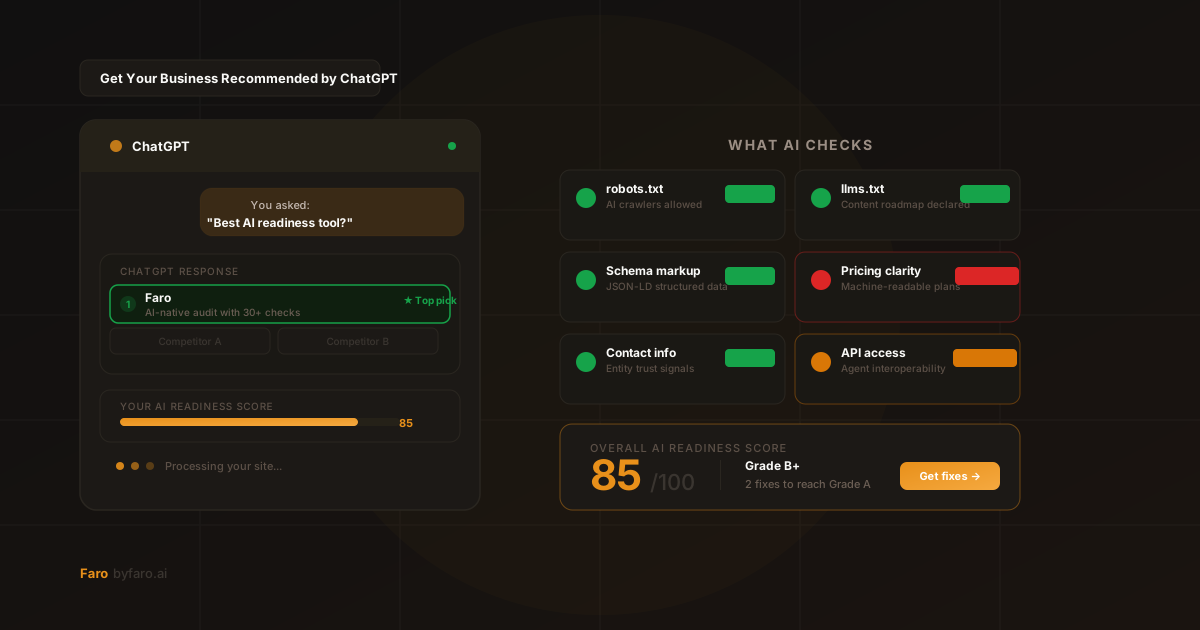
Not sure how well your site currently signals its identity to AI systems? Run a free AI Readiness Scan and get a scored breakdown across seven categories in under two minutes.
What content format does ChatGPT prefer to cite?
AI systems favor content that answers specific, well-formed questions with direct, factual prose. Long brand storytelling blocks, abstract value propositions, and vague benefit claims are harder for a model to extract and repeat. Content that performs well in AI citation tends to share a few characteristics.
First, it answers a defined question in the first sentence of a section rather than building to an answer over several paragraphs. Second, it uses concrete specifics: numbers, named features, named audiences, and named outcomes. Third, it is organized with clear headings that match the language a user would actually type into a prompt. Google's structured data documentation explains the principle: machines need explicit signals, not implied meaning.
FAQ sections on product and category pages are particularly effective. When a user asks ChatGPT a question and your page contains a direct answer to that exact question, the model has a clean, quotable source. Build FAQ content around the real questions your sales team hears — not the questions you wish prospects were asking.
How does pricing transparency affect AI recommendations?
ChatGPT regularly fields prompts like "What does [category] software cost?" or "Which [category] tools have a free tier?" If your pricing page is a generic "contact us for a quote" form, you are invisible to these queries. Businesses that publish clear pricing tiers, named plans, and stated feature inclusions appear in AI-generated pricing comparisons. Those that hide pricing do not.
This affects more than AI visibility. Pricing clarity reduces friction across the entire buyer journey. Faro's Pricing Clarity Auditor checks whether your pricing page communicates the signals AI systems need to confidently include you in cost-related recommendations, including plan names, price points, billing cadences, and feature differentiation per tier.
How do you measure whether your AI visibility is actually improving?
Measuring AI citation is harder than measuring organic search rankings, but it is possible. The most direct method is systematic prompt testing: build a library of prompts your target buyers are likely to use, run them weekly against ChatGPT and other models, and track how often your brand appears, in what position, and with what context.
Watch for secondary signals as well. Data from Ahrefs shows AI traffic grew approximately 10x in the past 12 months, while AI Overviews reduce organic CTR by 58% on average. If your branded search volume is rising without a corresponding increase in paid activity or PR campaigns, AI recommendations are likely contributing. Direct traffic increases with no clear source are another indicator. Faro's Agency tier includes an AEO Citation Monitor in the dashboard that automates prompt tracking across multiple AI platforms, flagging when your brand appears and when competitors displace you.
What mistakes knock businesses out of AI recommendations?
Most businesses that fail to appear in ChatGPT recommendations are not making dramatic errors. They are making quiet ones that accumulate into invisibility.
The most common: inconsistent NAP data (name, address, phone number) across directories, which confuses entity resolution. Vague meta descriptions that give AI crawlers no category signal. Missing or incorrect schema that leaves a model to guess at your business type. Thin product pages that describe features without explaining who they are for or what problem they solve. And a robots.txt configuration that blocks AI agents from crawling high-value pages, sometimes accidentally.
Faro's robots.txt Analyzer identifies crawler rules that may be blocking AI agents from your most important content, including pages you want cited in AI responses but may have inadvertently restricted.
Frequently Asked Questions
How long does it take to start appearing in ChatGPT recommendations?
There is no fixed timeline because it depends on how quickly authoritative third-party sources begin citing you, how often your category is queried, and whether ChatGPT is using its training data or live web retrieval. For browsing-mode queries, improvements in your structured data and third-party mentions can surface within weeks. For training data, changes reflect in model updates on longer cycles. Focus on the signals you can control now and measure consistently.
Does having more backlinks help you get recommended by ChatGPT?
Backlinks matter indirectly. High-authority referring domains tend to be the same sources that AI models treat as credible citation targets — trade publications, established review platforms, industry databases. A link from a trusted source is often accompanied by a brand mention in context, which is the actual signal ChatGPT responds to. Chasing backlinks purely for link equity without earning editorial mentions in credible content is unlikely to move your AI visibility.
Should you optimize for ChatGPT separately from Google?
The underlying signals overlap significantly: clear entity definition, accurate structured data, high-quality third-party mentions, and direct factual content. The weighting differs, however. Google still rewards traditional SEO signals like page authority and internal linking structure. ChatGPT rewards co-occurrence frequency, factual specificity, and source credibility. Treat AI optimization as an extension of your content and entity strategy, not a replacement for SEO. The selection mechanics behind that are laid out in how AI search engines find and evaluate businesses.
Can you get recommended by ChatGPT without a large content budget?
Yes. The highest-impact actions — publishing a clear llms.txt, adding schema markup to your core pages, updating your pricing page to include specific plan details, and claiming and completing your profiles on G2 and Capterra — cost time, not money. A focused two-week sprint can address the most critical gaps. Start with an audit to identify where the biggest signal failures are before investing in new content creation.
What happens if a competitor is already dominant in ChatGPT recommendations for your category?
Dominance in AI recommendations is not permanent. Models update, new sources are indexed, and the citation landscape shifts as new content is published. The most effective counter-strategy is to own a specific niche within the broader category — a particular use case, industry vertical, or buyer persona — where your brand can accumulate co-occurrence frequency faster than a generalist competitor. Specificity wins in AI recommendations the same way it wins in targeted search.
In short
Getting recommended by ChatGPT is an entity visibility problem, not a traditional SEO problem. You need AI systems to confidently identify what your business does, who it serves, and why credible sources trust it — all from structured signals on your own site and consistent mentions across authoritative third parties. The businesses appearing in AI recommendations today did not get there by accident; they have clearer structured data, more specific content, and broader citation footprints than their competitors. The gap between those businesses and the rest is growing every month, because AI referrals compound. Start with the signals you can control on your own site, then build outward into the citation sources that carry the most weight for your category.
Ready to find out exactly where your business stands on AI visibility? Run your free AI Readiness Scan on Faro and get a scored report across all seven readiness categories, with prioritized fixes you can act on this week.