A prospect types "best project management software for agencies" into ChatGPT. Your product is a strong fit. You rank on page one of Google for that phrase. But ChatGPT doesn't mention you once. It recommends three competitors you've never lost a deal to before. That scenario is now repeating across thousands of buying decisions every day, and AI search engines are the reason the rules changed without warning.
AI traffic grew roughly 10x in the past 12 months according to Ahrefs, while AI Overviews cut organic click-through rates by 58% on average. The brands capturing that displaced attention aren't necessarily those with the strongest backlink profiles. They're the ones whose digital presence is structured so AI systems can read, trust, and cite it. Understanding how that evaluation works is now a core marketing competency.
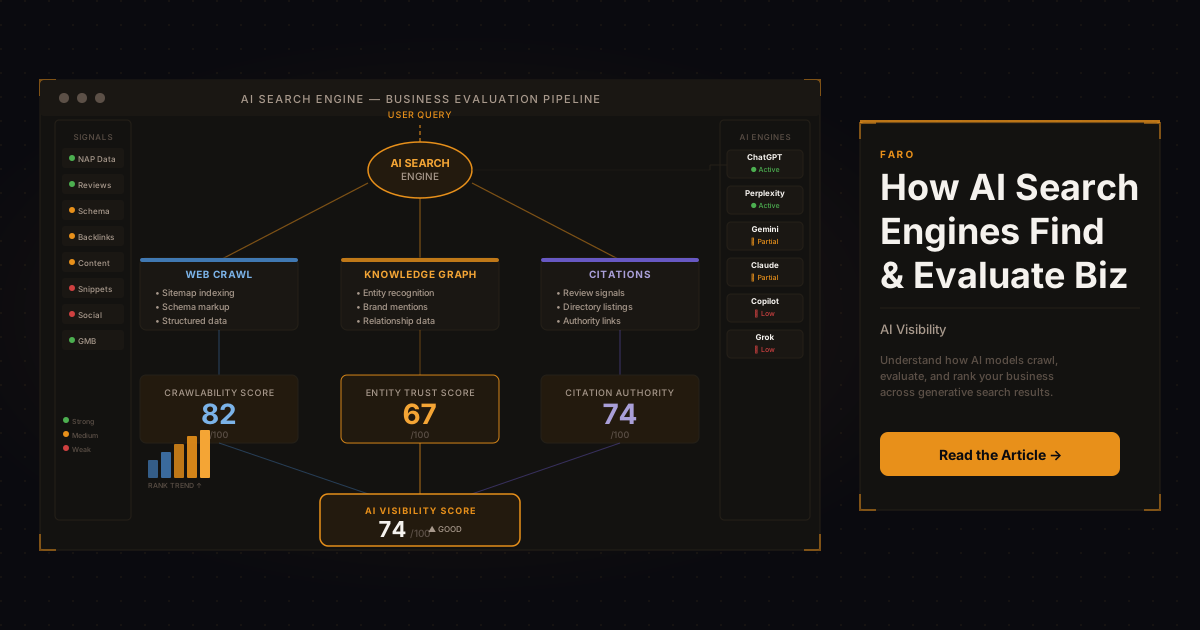
What actually happens when an AI search engine gets a query?
AI search engines don't retrieve a ranked list of URLs. They retrieve chunks of text from a training corpus or a live retrieval index, synthesize those chunks into a coherent answer, and then decide whether to attribute sources. The decision to include or exclude your brand happens at the retrieval stage, before any synthesis occurs. If your content isn't in the retrieval pool, you won't appear in the answer regardless of how well-written it is.
Systems like Perplexity operate with live retrieval, sending real-time requests to indexed pages and pulling structured snippets. ChatGPT's web-browsing mode works similarly. Gemini blends retrieval with Google's existing index. In each case, the system looks for content it can verify, attribute, and present without introducing ambiguity. Vague, unstructured, or technically inaccessible content gets skipped.
Which signals do AI systems use to evaluate a business?
AI systems evaluate businesses across three broad signal categories: technical accessibility, content authority, and entity clarity. Technical accessibility means whether the AI crawler can actually reach and parse your pages. Content authority means whether your claims are corroborated by other sources the system already trusts. Entity clarity means whether the system can confidently identify what your business is, what it does, and who it serves.
Entity clarity is the most underestimated of the three. Schema.org's Organization markup gives AI systems a machine-readable declaration of your business identity, including your name, URL, founding date, industry, and service area. Without it, the system must infer those facts from unstructured text—and inference introduces uncertainty, which reduces citation confidence. Marketers who spent years optimizing title tags and meta descriptions now need to think at the structured-data layer.
How do AI crawlers differ from Googlebot?
Googlebot prioritizes crawl efficiency and link graph traversal. AI crawlers prioritize content extractability and semantic density. A page that scores well with Googlebot because it loads fast and carries strong anchor text inbound links may still be invisible to an AI retrieval system if the page content is wrapped in JavaScript that the AI crawler can't execute, or if the prose is too thin to extract useful information from.
The W3C's web messaging standards inform how browsers and crawlers interact with dynamic content, but most AI crawlers apply far more conservative JavaScript execution than a full browser. This means pages relying on client-side rendering to display key information—pricing, service descriptions, team credentials—may be effectively blank to AI retrieval systems. A static or server-rendered version of that content is what gets indexed and cited.
Your robots.txt file plays a different role than most marketers realize. Some AI crawlers respect specific disallow directives for their user agents, but others fall back on generic crawler rules. Misconfigured robots.txt files can block AI systems from entire sections of a site without the site owner knowing. Faro's robots.txt Analyzer shows exactly which AI user agents your current configuration blocks or admits.
Not sure whether AI crawlers can actually reach your site? Run a free AI Readiness Scan and get a scored breakdown of your technical accessibility, entity clarity, and content authority in under two minutes.
How do different AI search platforms compare in their evaluation approach?
Each major AI search platform retrieves and evaluates differently. Knowing those differences helps you prioritize which signals to address first.
| Platform | Retrieval Method | Primary Trust Signal | Schema Sensitivity | robots.txt Respect |
|---|---|---|---|---|
| ChatGPT (browsing mode) | Live retrieval via Bing index | Source corroboration + page authority | Medium | Yes (GPTBot directive) |
| Perplexity | Live retrieval, proprietary index | Content freshness + structured snippets | High | Yes (PerplexityBot directive) |
| Google Gemini | Google Search index + live retrieval | E-E-A-T signals + structured data | Very High | Yes (inherits Googlebot rules) |
| Claude (web search) | Live retrieval via external search API | Content clarity + entity disambiguation | Medium | Partial (ClaudeBot directive) |
| Bing Copilot | Bing index native | Bing ranking signals + page structure | High | Yes (BingBot directive) |
The pattern across all five platforms is consistent: structured data and entity clarity accelerate citation likelihood, while ambiguous or crawler-blocked content reduces it. Perplexity's high schema sensitivity makes it particularly responsive to AI Schema markup improvements, which is why many agencies prioritize Perplexity visibility as an early indicator of broader AI citation health.
Why does being recommended by AI matter commercially?
Research from Scrunch shows that brands recommended first by AI are 389% more likely to be Googled afterward. When an AI recommends a brand, that brand sees 182% more branded search and 117% more direct site visits. These aren't vanity metrics. They represent intent-rich traffic arriving at the bottom of the funnel, generated by a channel most brands aren't optimizing for yet.
The window for competitive differentiation is real and probably short. Early movers who structure their content for AI retrieval now will accumulate citation history before competitors catch up. Citation history matters because AI systems, especially those with retrieval-augmented generation architectures, weight corroboration: a brand cited across multiple trusted sources gets retrieved more reliably than a brand cited only on its own site.
The entity poisoning risk you can't ignore
A threat runs in the opposite direction. Research published on arXiv in 2025 demonstrated that a 13-word comment on Reddit can corrupt what ChatGPT's deep-research agents retrieve and report about a brand. Prompt injection attacks embedded in user-generated content can redirect AI summaries away from your official messaging entirely. This means AI readiness isn't only about getting included. It's about making your authoritative content so structurally clear and widely corroborated that injected misinformation can't displace it.
What can marketers actually do to improve AI search visibility?
Improving AI visibility follows a logical sequence. Start with technical access, confirm entity clarity, then build content authority. Skipping to content production before fixing access issues wastes effort. An AI crawler that can't reach your pricing page won't cite your pricing, no matter how well-written it is.
The practical checklist: First, audit your robots.txt to confirm AI user agents aren't blocked. Second, implement Organization, Product, and FAQ schema across your core pages. Third, create an llms.txt file that gives AI systems a direct declaration of your business context, products, and preferred citation format. This file functions similarly to robots.txt but is designed specifically for large language model crawlers. Fourth, ensure your pricing and service descriptions render in static HTML, not only in JavaScript-dependent components. Fifth, build third-party corroboration through press coverage, partner pages, and directory listings that carry structured data of their own.
Each step addresses a specific failure mode in the AI evaluation pipeline. None require heavy developer work. They require a marketer who understands what AI systems are looking for and systematically closes the gaps.
Summary
AI search engines evaluate businesses through three lenses: technical accessibility, entity clarity, and content authority. Getting any one wrong removes you from contention at the retrieval stage, before the AI even begins composing its answer. The commercial upside of being cited early is disproportionate; brands recommended first by AI see nearly four times more branded search. The risk of ignoring this is equally concrete, because competitors who fix their AI readiness now are accumulating citation history you'll struggle to displace later. Structured data, a well-configured robots.txt, an llms.txt file, and server-rendered content are the four fastest interventions most marketing teams can make today.
Faro's platform runs 30+ checks across every dimension AI search engines use to evaluate businesses. Get your AI Readiness Score and see exactly which gaps are keeping you out of AI-generated recommendations.
Frequently Asked Questions
Do AI search engines use the same index as Google?
Not exactly. ChatGPT's browsing mode retrieves through the Bing index. Gemini uses Google's index. Perplexity maintains its own proprietary retrieval index supplemented by live crawling. Being well-indexed by Google helps across the board, but it doesn't guarantee AI citation because each system applies its own retrieval and trust filters on top of index access.
Is schema markup really necessary if my content is well-written?
Yes. Well-written prose helps AI systems extract information, but schema markup removes ambiguity entirely by declaring facts in machine-readable format. AI systems operating under retrieval time pressure default to structured signals over prose interpretation. Without schema, even accurate content can be misattributed or skipped in favor of a competitor whose data is cleanly declared.
What is an llms.txt file and do I need one?
An llms.txt file is a plain-text document placed at your domain root that tells large language model crawlers who you are, what you do, and how you want to be cited. It's not yet a universal standard, but adoption among AI platforms is growing rapidly. Creating one now costs almost nothing and positions your site ahead of the standard becoming enforced. Faro's llms.txt Generator builds one from your existing site data in minutes.
How do I know if an AI crawler is being blocked on my site?
Check your robots.txt file for disallow rules that apply to user agents like GPTBot, PerplexityBot, ClaudeBot, and Bingbot. Many sites added broad crawler blocks during traffic optimization initiatives without realizing those rules also catch AI crawlers. A dedicated audit tool is faster than reading the file manually, especially if your robots.txt has grown over several years.
Can a competitor harm my AI search visibility deliberately?
Prompt injection research published in 2025 confirmed that malicious content in user-generated spaces, like forum comments or review platforms, can influence what AI deep-research agents report about a brand. The best defense is making your authoritative content highly corroborated and structurally unambiguous so that injected misinformation lacks the weight to displace it. Monitoring your AI citations regularly through tools like Faro's citation monitor gives you early warning if something shifts.