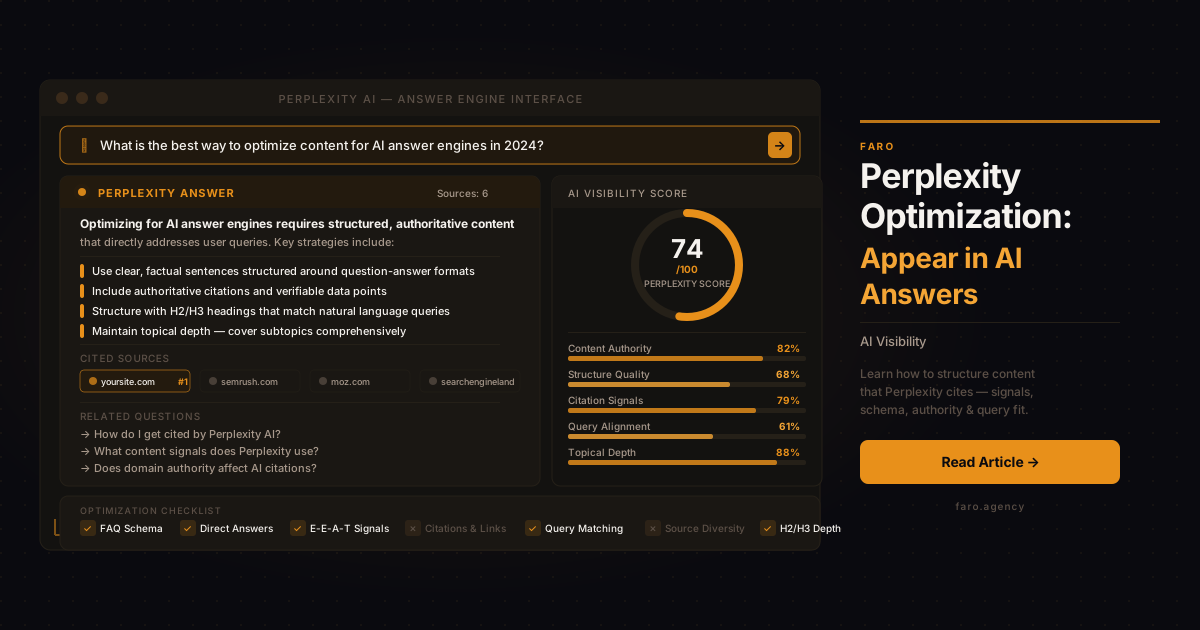
Your competitor just appeared as the first cited source in a Perplexity answer about the exact problem your product solves. A B2B buyer read that answer, Googled your competitor's name, and booked a demo — all without your brand ever appearing. That scenario is not hypothetical. AI-driven referral traffic grew roughly 10x in the past 12 months, and Perplexity is one of the fastest-growing channels inside that wave. Perplexity optimization is the practice of structuring your content, technical setup, and authority signals so that Perplexity selects your brand as a cited source in its AI-generated answers. If you have not started yet, you are already behind.
Why does Perplexity matter more than Google for certain buyer journeys?
Perplexity functions as a research synthesizer, not a list of blue links. When a CFO types "best contract intelligence software for mid-market companies," Perplexity reads dozens of pages, synthesizes a direct answer, and cites two or three sources inline. The buyer often goes no further. AI Overviews already reduce organic click-through rates by 58% on average, and Perplexity's interface is even more answer-complete than Google's. For high-intent, research-heavy B2B queries, Perplexity is where the shortlist gets built. Being the cited source, not just a ranked page, is now the commercial objective.
How does Perplexity decide which sources to cite?
Perplexity uses a retrieval-augmented generation (RAG) pipeline: it queries its own web index, selects candidate pages, and passes them to a large language model that writes a synthesized answer with inline citations. The selection criteria differ meaningfully from classic Google ranking factors. The platform weighs several signals simultaneously.
The core citation signals Perplexity evaluates
First, topical authority and specificity: pages that answer a narrow question more completely than any competitor get prioritized. Broad, introductory content rarely gets cited because it adds little synthesis value. Second, freshness: Perplexity's crawl favors recently updated pages, especially for fast-moving topics. Third, structured, parseable content: clear headings, short paragraphs, and explicit answer sentences help the model extract quotable passages quickly. Fourth, crawl accessibility: if your robots.txt blocks AI crawlers like PerplexityBot, you are invisible by definition. Fifth, domain authority and link signals: these remain relevant as a proxy for trustworthiness, even in a RAG context. Schema.org structured data further helps Perplexity identify what a page is about without ambiguity.
Not sure whether Perplexity can even crawl your site right now? Run a free AI Visibility Checker to see exactly which crawlers your current setup blocks, plus 29 other checks that affect your AI visibility score.
What does a Perplexity-ready page actually look like?
Perplexity-ready pages share a recognizable anatomy. The page opens with a direct, declarative answer to the question implied by its title. It uses H2 and H3 headings that mirror real user questions. Key facts appear in the first two paragraphs, not buried in a conclusion. Data points are attributed with specific sources, which signals credibility to the RAG model. Tables and lists appear where comparisons or steps are needed, because structured formats are easier for AI to extract and quote. Pages that treat SEO and AI visibility as the same problem tend to perform well in both channels.
| Page element | Traditional SEO value | Perplexity citation value | Priority for AI visibility |
|---|---|---|---|
| Direct answer in first paragraph | Medium | Very high | Critical |
| Question-format H2 headings | High | Very high | Critical |
| Schema.org structured data | High | High | Critical |
| Comparison tables | Medium | Very high | High |
| Inline data citations | Low | Very high | High |
| llms.txt file | None | High | High |
| Keyword density | Medium | Low | Low |
| Meta description optimization | High | Low | Low |
Does your robots.txt silently block Perplexity?
This is the most common and most damaging mistake. Many sites updated their robots.txt files in 2023 and 2024 to block AI crawlers broadly, then forgot about it. PerplexityBot, Amazonbot, and other AI agents may be blocked even if the site owner has no memory of making that change. Google's robots.txt documentation explains the directive syntax, but the semantics for AI-specific user-agents require separate attention. You need to explicitly allow PerplexityBot or confirm it is not blocked by a wildcard rule. Faro's robots.txt Analyzer surfaces these conflicts automatically, showing which crawlers your current file permits and which it denies, without requiring you to parse the syntax yourself.
What role does llms.txt play in Perplexity optimization?
The llms.txt standard, proposed in late 2024, gives AI systems a curated map of your site's most important content. Where robots.txt tells crawlers what to avoid, llms.txt tells language models what to prioritize. For Perplexity optimization specifically, a well-formed llms.txt file can steer the retrieval step toward your highest-value pages rather than letting the crawler land on thin or outdated content. This matters most for sites with large archives where only a fraction of pages represent current, authoritative thinking. Faro's llms.txt Generator builds a correctly structured file based on your sitemap and page metadata, so you are not handwriting XML-adjacent syntax at midnight.
How does schema markup improve your Perplexity citation rate?
Structured data does something subtle but powerful in a RAG context: it removes ambiguity. When Perplexity's retrieval system reads a page, schema markup tells it definitively that this entity is a product, this entity is an organization, this number is a price, and this paragraph is an FAQ answer. Without schema, the model has to infer all of that from prose, which introduces noise. Research published in 2025 showed that a 13-word Reddit comment can corrupt ChatGPT deep-research agents by introducing ambiguous or contradictory information. Schema reduces your vulnerability to that kind of contamination by making your page's authoritative facts machine-readable and unambiguous. Faro's AI Schema Creator generates the right schema types for your page category and validates the output before you publish.
What is the commercial payoff of being cited by Perplexity?
The downstream effect of AI citation is measurable and significant. Brands recommended first by an AI system are 389% more likely to be Googled afterward, 182% more likely to be searched by name, and 117% more likely to receive a direct site visit. Those are not vanity metrics. In a B2B context where a single converted deal can be worth tens of thousands of dollars, appearing in three Perplexity answers per week in your category could directly influence pipeline. The buyer who reads a Perplexity answer, sees your brand cited twice, and then Googles you is a warm lead, not a cold one. This is the commercial case for treating Perplexity optimization as a revenue-adjacent activity, not a technical side project.
In short
Perplexity optimization is a direct line to buyer attention at the moment of research. The signals that drive citation—parseable content structure, crawl accessibility, schema markup, and an llms.txt file—are all fixable in days, not quarters. Brands that appear as cited sources in AI answers generate measurable downstream search and visit intent. The gap between optimized and unoptimized sites is widening every month as AI traffic compounds. Starting with a clear picture of where your site currently stands is the fastest way to close that gap.
Get your full AI visibility picture in under two minutes. Run a free AI visibility check and see exactly which of the 30+ checks your site passes and fails, with prioritized fixes for Perplexity, ChatGPT, and Google AI Overviews.
Frequently Asked Questions
Does Perplexity use the same ranking signals as Google?
No. Perplexity uses a retrieval-augmented generation pipeline that selects pages based on topical specificity, content parsability, freshness, and crawl accessibility—not traditional ranking factors like title tag optimization or click-through rate. Domain authority still plays a role as a trust proxy, but keyword density and meta descriptions have minimal influence on citation selection.
How do I check whether PerplexityBot can crawl my site?
Open your robots.txt file and look for directives targeting PerplexityBot or wildcard user-agent rules that might block it. Faro's robots.txt Analyzer automates this check and flags conflicts clearly. You can also verify by checking your server logs for PerplexityBot requests over the past 30 days.
Is Perplexity optimization different from answer engine optimization (AEO)?
Perplexity optimization is a specific application of AEO. The broader AEO discipline covers all AI answer surfaces including Google AI Overviews, ChatGPT search, and Copilot. Perplexity has its own crawler, its own index, and its own retrieval logic, so while the principles overlap, some tactics like the llms.txt file and PerplexityBot allowlisting are specific to this platform.
How long does it take to see results after optimizing for Perplexity?
Most sites see Perplexity recrawl updated pages within one to four weeks if the crawler is not blocked. Structural changes like adding schema markup and improving content parsability can influence citation selection within a single crawl cycle. Tracking your brand's citation frequency in Perplexity requires a monitoring setup; Faro's Agency tier includes an AEO Citation Monitor for this purpose. To start before that, how ChatGPT, Claude, and Perplexity build their citations sets out a manual weekly tracking method you can run in a spreadsheet.
Can Perplexity cite my site if it is not ranking on Google page one?
Yes. Perplexity maintains its own web index and does not simply mirror Google's ranking order. A page with strong topical specificity, clear structure, and good crawl accessibility can be cited by Perplexity even if it sits on page three of Google results. This makes Perplexity optimization particularly valuable for newer domains or pages targeting niche B2B queries where competition is high in traditional search.