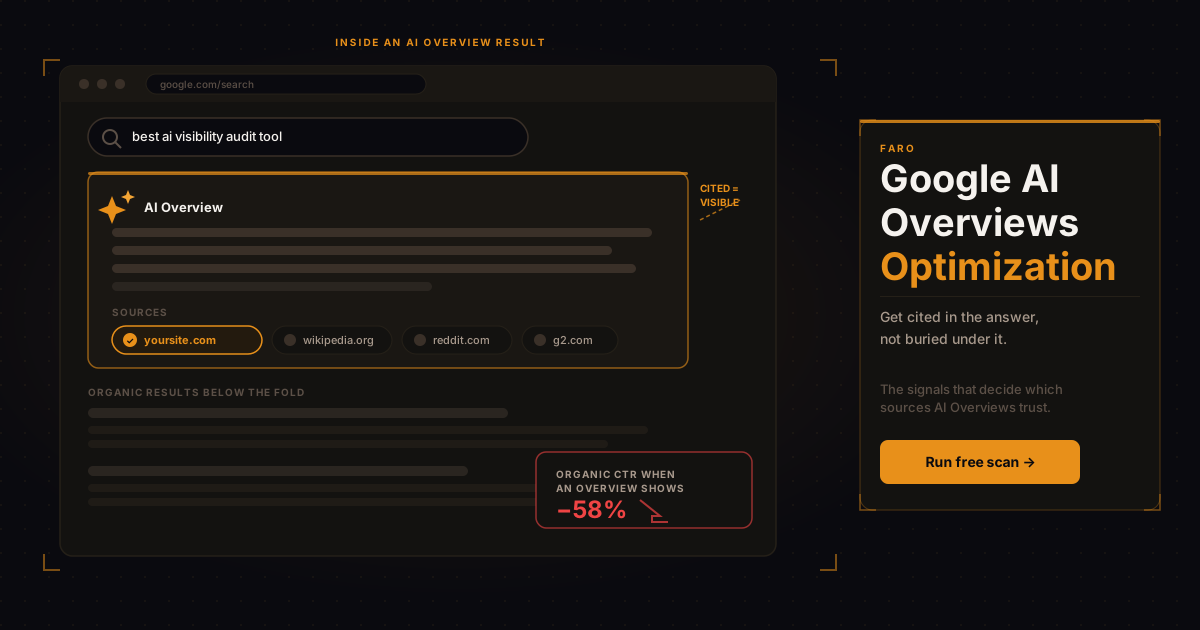
Google AI Overviews optimization comes down to one thing: being the clearest, most citable source on a specific question. Not the highest-ranking page in the classic sense. The most quotable one. Google's generative layer reads the web, picks a handful of sources it trusts to answer the query, and stitches them into a summary at the top of the results. Your job is to be one of those sources.
That's a different game than the blue-link ranking most teams spent a decade learning. The old signals still matter. But the winning page in an AI Overview is often not the page that would have ranked #1 a few years ago. It's the page that answered the question most directly, in a structure a language model could lift without guessing.
Here's how the mechanism actually works, and what you can do about it this week.
What are Google AI Overviews, really?
AI Overviews are the AI-generated answer box Google shows above the traditional results for many queries. Google's own documentation describes them as a way to surface information from across the web with links to dig deeper. The summary is synthesized by a Gemini-based model; the citations underneath are the sources it drew from.
The part most people miss: an AI Overview is a retrieval-and-synthesis system, not a ranking list. Google isn't just ordering ten pages. It's pulling passages from several pages, deciding which claims to trust, and generating a new paragraph. Two things follow from that. First, you can be cited in an Overview without ranking in the top three organic results. Second, you can rank #1 organically and still get left out of the Overview entirely, which stings a lot more.
Google has published guidance confirming there's no separate markup or program to get into AI Overviews; the same content and quality systems that power Search feed the feature. You can read that directly in Google's documentation on AI features in Search. So the levers are the ones you already have, applied with a sharper eye for what a model can actually use.
Why do some pages get cited and others don't?
Because the model needs a clean passage it can trust and reuse. When a generative system builds an answer, it looks for text that states a fact plainly, near context that confirms the page is authoritative on the topic. If your answer is buried three scrolls down, wrapped in marketing language, or contradicted by another line on the same page, the model has to work harder. It usually just picks an easier source instead.
Think about what makes a passage easy to cite:
- The answer comes first. A short, direct statement in the opening lines of a section, before the throat-clearing.
- Claims are specific and verifiable. Numbers, dates, named entities. “Processing takes 2 to 3 business days” beats “fast turnaround.”
- The page is internally consistent. No pricing that says $29 in one spot and $39 in another. Models penalize contradiction, and honestly, so do humans.
- Structure signals topic authority. Clear headings, logical hierarchy, and schema that tells Google what kind of content this is.
It's not only your own pages competing for that citation slot, either. Overviews increasingly draw on third-party community discussion alongside brand sites, which is exactly why your Reddit presence now affects AI search visibility even when you never post there yourself.
A mid-size accounting SaaS in Denver ran into this last year. They ranked in the top five for “how does automated invoice reconciliation work,” but the AI Overview kept citing a competitor. When they looked at their own page, the actual explanation didn't appear until after 400 words of positioning copy. They moved a two-sentence answer to the top of the section, added a definition list, and started showing up in the Overview within a few weeks. Same authority. Better structure. That's usually the whole story.
How do you optimize for AI Overviews step by step?
Treat it as a structured pass over your highest-intent pages, not a site-wide rewrite. Here's the order I'd work in.
- Find the queries where an Overview already shows. Search your target questions and note which ones trigger an AI Overview and who gets cited. If a competitor owns it, that's your target.
- Answer the question in the first two sentences. Under each relevant heading, lead with the direct answer. Save the nuance and the sales pitch for after.
- Add structured data. Mark up your content with the appropriate schema type (FAQ, HowTo, Product, Article) using schema.org vocabulary. It won't force a citation, but it removes ambiguity about what your page is.
- Make sure Google's crawlers can reach the answer. If the key content loads only after a JavaScript interaction, or sits behind a consent wall, it may never get indexed as answerable text.
- Fix contradictions. Grep your own page for numbers, dates, and claims. One inconsistent figure can quietly disqualify you.
- Build a machine-readable layer. An llms.txt file and clean JSON-LD schema give AI systems a low-friction map of what you offer.
None of these are exotic. That's the point. The teams winning AI Overview citations aren't doing secret things; they're doing ordinary things with unusual discipline.
See what an AI reads on your page. Faro's AI Visibility Checker checks whether your answers are structured, your schema is valid, and your content is reachable by AI crawlers, then scores it. Run your top page and find out why you're getting skipped.
AI Overviews vs classic SEO: what actually changes
Most of your SEO fundamentals carry over. A few priorities shift. Here's the honest comparison.
| Factor | Classic SEO | AI Overviews |
|---|---|---|
| Unit of success | Page rank position | Passage cited in the answer |
| Winning content | Comprehensive, keyword-aligned | Direct, quotable, unambiguous |
| Answer placement | Anywhere on the page | Top of the relevant section |
| Consistency | Helpful | Close to mandatory |
| Traffic pattern | Click-through from a link | Brand exposure, fewer but higher-intent clicks |
That last row deserves a word of caution. AI Overviews reduce clicks for informational queries; people get the answer without leaving the page. That's real, and it's not going away. My take: chasing raw traffic on top-of-funnel questions is a losing position now, and the smarter move is to own the queries where being cited builds trust that pays off later in the buying process. Being the source Google quotes is worth more than a click that would have bounced anyway.
How do you measure AI Overview visibility?
Start manual, then systematize. There's no clean “Overview rank” in Search Console yet, so you triangulate.
Keep a list of your 20 to 30 priority questions. Once a week, search each one and record whether an Overview appears, whether you're cited, and who else is. Watch for the queries where a competitor shows up and you don't; that gap is your roadmap. Pair that with Search Console impressions data, which now folds AI feature appearances into the standard reports per Google's Search Console documentation. And if you're doing this across a portfolio, track it against rivals with competitor intelligence instead of checking by hand.
Frequently asked questions
Can I pay or submit my site to appear in AI Overviews?
No. There's no submission form and no paid placement. Google generates Overviews from its normal Search index, so the path in is strong, well-structured, reachable content. Anyone selling you “guaranteed AI Overview placement” is selling smoke.
Does schema markup guarantee a citation?
No, but it helps. Schema removes ambiguity about what your content is, which makes it easier for Google to trust and reuse. Think of it as reducing friction, not buying a ticket. Valid JSON-LD is table stakes now, not a differentiator.
Will AI Overviews kill my organic traffic?
For purely informational queries, expect fewer clicks. For commercial and comparison queries, the picture is more mixed, and being cited can actually lift qualified traffic. The businesses that get hurt worst are the ones whose entire model depended on ranking for questions with a one-line answer.
How is this different from optimizing for ChatGPT or Perplexity?
The core discipline is the same: be clear, structured, and citable. The retrieval systems differ in the sources they favor and how they crawl, so the tactics diverge at the edges. A page built to be quotable tends to do well across all of them, which is why we treat AI visibility as one problem, not five.
In short
Google AI Overviews optimization is about being the clearest, most trustworthy answer to a specific question, not gaming a rank position. Lead with the direct answer, keep your claims specific and consistent, mark up your content with valid schema, and make sure crawlers can actually reach the text. Measure it by tracking a fixed set of priority queries over time and watching where competitors get cited and you don't. The fundamentals of good SEO still apply; they just reward discipline and structure more than they used to.
If you want to see how an AI system reads your site right now, run a free AI Visibility Checker. It flags the structure and schema issues that keep good pages out of AI answers, and points at the fixes. For teams doing this across many client sites, the Faro for Agencies workflow tracks AI visibility and citations at scale, and the pricing page lays out what fits.
Faro's AI SEO tools cover every layer of AI visibility — schema, robots.txt, llms.txt, pricing clarity, and competitor benchmarking — in one toolkit.