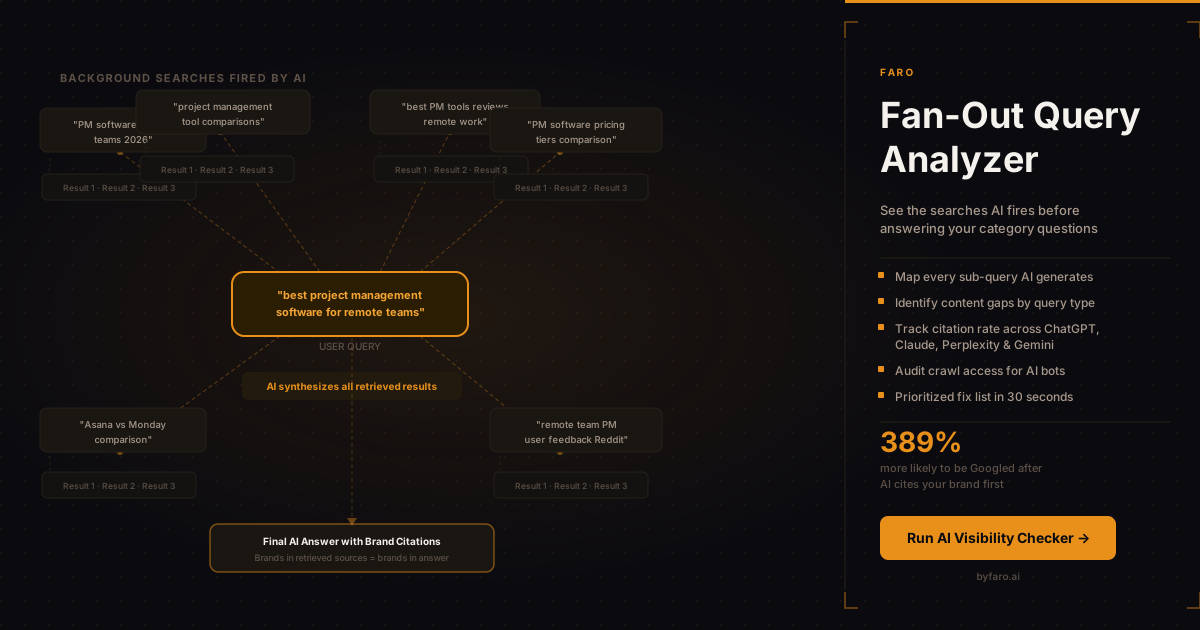
When someone types a question into ChatGPT or Perplexity and gets a confident, detailed answer with brand recommendations, that answer did not come purely from the model's training data. Before writing a single word, the model fired a series of targeted background searches: specific sub-queries designed to gather current, reliable information on the topic. The content retrieved by those sub-queries is what shapes the final answer. Those searches are called fan-out queries.
Most brands have never heard the term. That gap is costing them citations. Understanding how fan-out works, and what it retrieves, is now a core requirement for any serious AI visibility strategy.
What Are Fan-Out Queries?
A fan-out query is a sub-search generated internally by an AI model to research an answer before presenting it to the user. The term comes from how a single user query “fans out” into multiple parallel or sequential background searches. The model doesn't just guess; it researches.
Here is a concrete example. A user asks: “What is the best project management software for remote teams?” The model does not answer from memory alone. It fires something like the following background searches:
- “best project management software remote teams 2026”
- “project management tool comparisons reviews”
- “top rated PM tools for distributed teams”
- “project management software pricing tiers”
- “Asana vs Monday vs ClickUp comparison”
- “remote team project management user feedback Reddit”
The results from those searches are retrieved, parsed, and synthesized into the answer the user sees. The brands that appear consistently across those retrieved sources are the brands that end up in the recommendation. The brands that don't appear in the retrieved sources don't appear in the answer, regardless of how good their product is.
This behavior is documented across AI systems that use retrieval-augmented generation (RAG) and real-time web search, including ChatGPT with web browsing, Perplexity, Gemini with deep research, and Claude with web access. The specific sub-queries vary by model and by user question, but the pattern is consistent: the model fans out before it answers.
How Fan-Out Differs from a Single Search Query
Traditional SEO targets what a human types into Google. Fan-out optimization targets the specific sub-questions an AI generates to research its answer. These two disciplines overlap significantly, but they are not the same thing, and the differences matter for content strategy.
| Dimension | Traditional SEO | Fan-Out Optimization |
|---|---|---|
| What you're targeting | Queries humans type into search bars | Sub-queries AI models generate internally to research answers |
| Query type | Single query with clear intent signals | Multiple parallel or sequential sub-queries, often more specific |
| Content format that wins | Keyword-optimized pages, pillar content, backlink-rich domains | Specific comparison pages, structured data, review content, category-specific deep pages |
| Measurement | Rank position, impressions, organic CTR | AI citation rate, brand mention position, prompt share-of-voice |
| Timeline to results | Weeks to months for rank movement | Days to weeks for live-retrieval systems (Perplexity, ChatGPT search), months for training-data-dependent models |
| Why it matters | AI Overviews reduce organic CTR by 58%, shrinking the value of traditional rank positions | Brands cited first by AI are 389% more likely to be searched afterward |
The strategic implication is not that SEO becomes irrelevant. It is that SEO is necessary but no longer sufficient. The overlap between what ranks in Google and what gets retrieved by AI fan-out queries is real, but the gap is growing. AI-driven traffic grew roughly 10x in the past 12 months, while traditional organic click-through rates declined. Teams that treat AI citation as a separate optimization layer, not a byproduct of SEO, are the ones closing that gap.
Why Your Content Strategy Needs to Account for Fan-Out
The key insight from understanding fan-out is this: AI models are not looking for the best homepage. They are looking for the most relevant, specific content for each sub-query they generate. A brand with a polished homepage and weak content depth loses to a brand with detailed comparison pages, structured product pages, and third-party review coverage across multiple angles.
Consider what fan-out retrieval actually favors. When the model generates a sub-query like “project management software pricing tiers 2026,” it retrieves pages that specifically address pricing structure. If your pricing page is JavaScript-rendered and opaque to crawlers, you get skipped. If a competitor has a clear, server-rendered pricing page with plan names, feature lists, and comparison tables, they get retrieved. The technical accessibility of your content to AI crawlers is directly tied to whether you appear in fan-out retrieval.
When the sub-query is a comparison: “Asana vs alternatives for remote teams,” it retrieves content that directly addresses that comparison. If you have published honest, substantive comparison content, you appear. If you haven't, you don't. The model doesn't infer from your homepage that you are competitive in comparisons.
Third-party sources matter significantly in fan-out retrieval. Research has shown that Reddit accounts for 54 to 71 percent of all user-generated content URLs retrieved by AI deep-research agents. When a fan-out query is looking for authentic user feedback, it is pulling from community discussions, not from your marketing copy. Your presence in those discussions matters.
Find out which AI sub-queries your content is winning and losing
Faro's AEO Citation Monitor runs your brand through AI platforms and shows you your citation rate, position, and mention context across ChatGPT, Claude, Perplexity, and Gemini.
How to Identify the Fan-Out Queries for Your Category
You cannot optimize for fan-out queries you haven't mapped. The process for identifying them is more systematic than keyword research because you are trying to model what an AI would search, not what a human would type. For a deeper walkthrough of exactly how a single user query multiplies into dozens of these sub-searches before an AI system settles on an answer, see our explainer on query fan-out.
Start by running your actual target queries through ChatGPT with web browsing enabled and Perplexity. Both systems show you the sources they retrieved and sometimes show the specific sub-queries they generated. Read those sub-queries carefully. They are the fan-out map for your category. Write them down, group them by intent, and use them as a content gap audit.
Think about the dimensions an AI model would research when answering a question about your category:
- Best-in-class lists: “top [category] tools” or “best [category] software for [persona]”
- Comparisons: your brand vs specific competitors, or a general category comparison table
- Pricing: “[category] software pricing” or “how much does [category] cost”
- Reviews: recent user feedback, review aggregators, community discussions
- Feature-specific: queries targeting specific capabilities you have or claim to have
- Use-case specific: “[category] for [specific vertical or team type]”
For each of these dimensions, audit whether your existing content would appear in the top results for that sub-query. If it would not, that is a content gap your fan-out strategy needs to close.
Third-party keyword research tools map out the “People Also Asked” question trees from Google, which serve as a reasonable proxy for the sub-questions AI models are likely to generate. They don't show you exactly what an AI fires, but they reveal the semantic space around a topic that AI models tend to explore.
The Content Characteristics AI Retrieves from Fan-Out Results
Not all content is equally retrievable by AI fan-out. The characteristics that make content more likely to be retrieved and cited are different from the characteristics that make content rank well in a traditional search.
Specificity wins. AI models need specific, factual content they can synthesize into a coherent answer. A page that says “we are a great project management tool” is not retrievable in a useful way. A page that says “Faro supports up to 25 team members, integrates with Slack and Jira, and offers unlimited scan history on Agency plans starting at $99/month” is retrievable because it contains facts the model can extract and use.
Structured data accelerates retrieval accuracy. When your content includes schema.org structured markup for your product, pricing, and organization, AI crawlers can extract that information with higher confidence than from unstructured prose. This is especially true for pricing, feature lists, and comparisons. Use Faro's AI Schema Creator to generate and validate the right schema markup for your site without having to hand-code JSON-LD.
Freshness matters for live-retrieval systems. Perplexity, ChatGPT with web search, and Gemini with deep research all use live web retrieval. Content published or updated recently carries a recency signal that older content does not. If your pricing or feature pages haven't been updated in 18 months, they may be retrieved but treated as potentially stale by the model, which affects how confidently it cites you.
Crawl accessibility is a hard gate. If your content is blocked in robots.txt for AI crawlers like GPTBot or PerplexityBot, it doesn't matter how good it is: it will never be retrieved. Many sites blocked AI crawlers in 2023 and 2024 as a reflexive response to scraping concerns and have not revisited that decision. Check your robots.txt configuration to confirm you are not accidentally excluding yourself from AI retrieval.
Authority and consistency across sources amplify your signal. When multiple independent sources (review sites, community discussions, news coverage, third-party comparisons) consistently describe your product in a certain way, that consistency signals to the AI model that the information is reliable. A brand that appears in 12 independent sources with consistent descriptions will be cited more confidently than one that appears in 3 sources with conflicting information. Building that distributed presence across independent sources is one of the highest-value activities in a fan-out strategy. That dynamic reinforces why: when AI recommends your brand to a new customer, that customer is 182% more likely to visit your website, which means citation quality directly drives traffic quality.
Putting It Into Practice
A practical fan-out strategy has three phases. First, map the sub-queries: run your category questions through AI systems that show sources, extract the sub-queries, and group them by intent. Second, audit your content coverage: for each sub-query cluster, determine whether you have content that would rank for that query and whether that content is technically accessible to AI crawlers. Third, close the gaps systematically: start with the highest-volume sub-query types (best-in-class lists and comparisons), ensure your pricing page is server-rendered and structured, and build your presence in third-party sources that AI systems retrieve.
The technical layer is the fastest to fix. Use Faro's AI Visibility Checker to get a scored assessment of how accessible your site is to AI crawlers, whether your structured data is complete, and which specific technical issues are likely blocking your retrieval. The scan runs in about 30 seconds and produces a prioritized fix list. Start there before investing in new content, because technical blocks can prevent even excellent content from being retrieved.
In Short
Fan-out queries are the background searches AI models run before producing an answer. Your presence in those retrieved results determines whether you appear in the final citation. Fan-out optimization differs from traditional SEO: it requires content depth across comparison, pricing, and use-case angles; structured data that AI can extract with confidence; technical crawl accessibility for AI systems; and distributed third-party presence that signals reliability. Traditional SEO is a prerequisite but not sufficient on its own. The brands winning AI citations are the ones that have mapped their fan-out query landscape and built content and technical infrastructure to appear in each dimension of it.
Frequently Asked Questions
Are fan-out queries the same across all AI platforms?
No. Each AI system generates different sub-queries based on its own architecture and retrieval strategy. ChatGPT, Perplexity, Gemini, and Claude each approach retrieval differently. Perplexity tends to generate more and more specific sub-queries than other platforms. The practical implication is that your brand needs breadth of coverage across content types and angles, not optimization for a single assumed query set. Brands that rank well across a wide range of category sub-queries perform well across multiple AI platforms.
Does optimizing for fan-out queries hurt traditional SEO?
It does not, and in most cases it helps. The content characteristics that perform well in fan-out retrieval, such as specificity, structured data, freshness, and technical accessibility, are also characteristics that SEO benefits from. Writing detailed comparison pages, structuring pricing clearly, and ensuring your site is fully crawlable all support both SEO and AI citation. The main addition fan-out strategy requires beyond standard SEO is attention to AI crawler permissions and schema markup completeness.
How do I know which fan-out queries my brand is missing?
The most direct method is to run category questions through AI systems that show their sources (Perplexity and ChatGPT with web browsing), then look at which sources they retrieved and which brands appear in those sources. If your brand does not appear in the retrieved sources for a sub-query type, you have a coverage gap. Faro's AEO Citation Monitor automates part of this: it runs structured prompts across multiple AI platforms and reports whether and how your brand is cited, giving you a citation rate and position that you can track over time.
If AI traffic is growing, why would a brand not already be focused on this?
Most marketing teams are still structured around traditional search metrics: rankings, impressions, and organic CTR. AI citation rate is not yet a standard metric in most analytics setups, which means it is not being optimized for. The teams that move first on fan-out strategy will build a citation advantage that compounds over time, because AI systems that have retrieved and cited a brand consistently in the past are more likely to continue doing so as those citations accumulate across indexed sources.
The fastest starting point is checking your technical foundation. Run the Faro AI Visibility Checker on your domain to see which technical issues are likely blocking your retrieval across AI systems. It takes 30 seconds and produces a scored, prioritized fix list. Once the technical layer is clear, your content investments in fan-out coverage will actually reach the retrieval systems they are meant to serve. Pro users can go further with the Fan-Out Query Analyzer — enter any topic and see the exact background queries ChatGPT, Claude, and Perplexity fire, ranked by cross-model consensus.