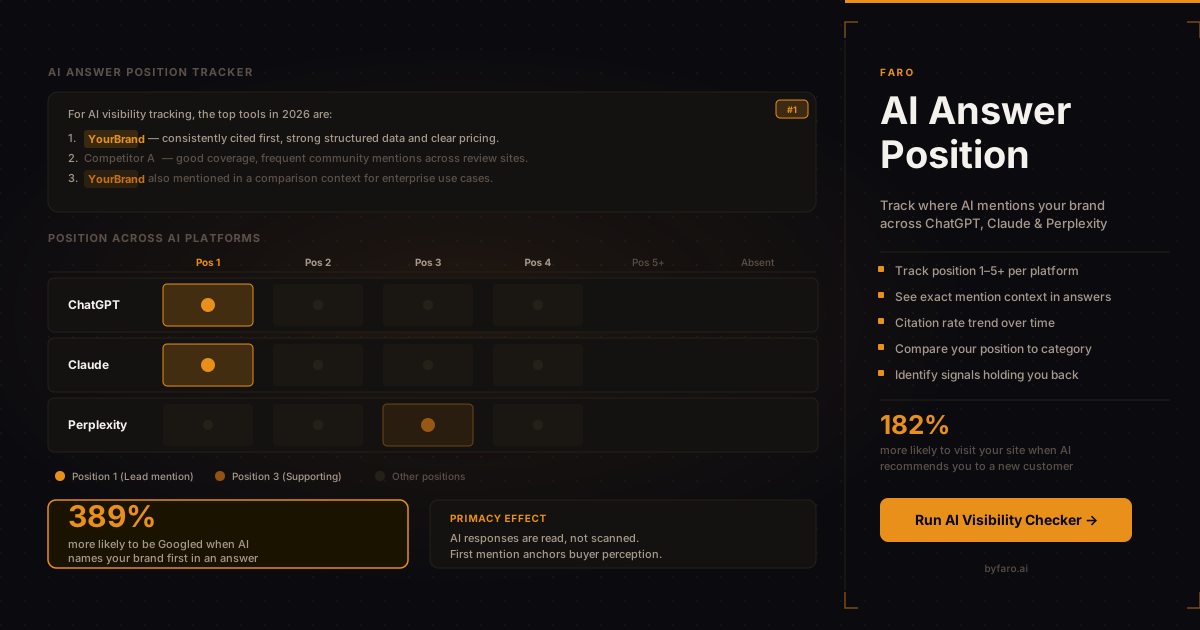
Most visibility conversations stop at a binary question: does AI mention us or not? That question misses the point. Whether your brand appears in an AI answer is table stakes. Where it appears is what actually determines whether a buyer remembers you, clicks through, or searches your name.
AI answer position is the specific location of your brand within a generated response: first mention, supporting mention, closing mention, or absent. Those positions are not equivalent. On a traditional search results page, users scan a list and self-select what to click. In an AI response, users read a flowing paragraph. The brand named first in that paragraph captures significantly more attention and recall than the brand named fifth, even when both appear in the same answer. Tracking and improving that position is now a core marketing function.
What Is AI Answer Position?
AI answer position refers to the ordinal placement of a brand mention within an AI-generated response. A working taxonomy looks like this:
- Position 1 (Lead): Your brand is named first, often as the primary recommendation. The model opens its recommendation with your name. This is the highest-value position.
- Position 2-3 (Supporting): Your brand appears as a credible alternative or secondary recommendation. Still visible, but behind the lead brand in the reader's mental hierarchy.
- Position 4+ (Tail): Your brand is included for completeness, often with a qualifier like “also worth considering.” Recall and click-through at this position are significantly lower.
- Absent: Your brand does not appear at all. This is the position most teams are currently focused on escaping, but moving from absent to tail is not the same as moving to lead.
Position is not static. It varies by AI platform, by the specific phrasing of the user query, by the time of day (for live-retrieval systems that pull fresh web content), and by what your competitors are doing to their own content. This variability is exactly why measurement matters: you cannot manage what you cannot track consistently.
Why Position Inside an AI Answer Matters More Than a Search Ranking
Search rankings operate on a scan model. A user sees ten blue links, scans the titles and descriptions, and clicks what catches their eye. Position 1 is valuable, but position 3 or 4 still gets meaningful clicks if the title is well-written. Users have choice and agency.
AI answers operate on a read model. The user receives a single flowing response. They do not choose between five answers; they read one. The first brand named in that response benefits from a primacy effect: it anchors the reader's understanding of the category. Subsequent brands are evaluated relative to that anchor.
The commercial impact of this primacy effect is not theoretical. A 2026 study of AI-influenced purchase behavior found that brands recommended first by AI are 389% more likely to be searched on Google afterward. The same research shows that when AI recommends a brand to a new customer, that customer is 182% more likely to visit the brand's website. These effects are driven by the recommendation itself, but position amplifies them: the brand named first captures more of that search and visit behavior than the brands named second or third.
Meanwhile, traditional ranking value is declining. Industry data shows AI Overviews reduce organic click-through rates by 58%, and AI-driven traffic has grown roughly 10x in the past 12 months. Because Google AI Overviews is one of the biggest drivers of that shift, it's worth treating as its own project; see our guide on how to show up in Google AI Overviews for the specifics of that surface. The channel where position matters most is shifting from the search results page to the AI answer box. Marketing teams that track Google rankings but not AI answer position are measuring the channel that is shrinking and ignoring the one that is growing.
Track your AI answer position across ChatGPT, Claude, and Perplexity
Faro's AEO Citation Monitor runs structured prompts across AI platforms and reports your citation rate, position, and mention context. See exactly where you rank inside AI answers, not just whether you appear.
The Signals That Influence AI Answer Position
AI models do not assign positions randomly. Position reflects how well a brand's information is structured, sourced, and accessible to the retrieval systems that feed the model. Several factors consistently influence where a brand appears.
Structured data and schema markup. When your site uses schema.org markup for your organization, product, pricing, and FAQ content, AI crawlers can extract that information with higher confidence than from unstructured prose. Confidence in the extracted information correlates with priority in the generated answer. A brand whose pricing, features, and category positioning are machine-readable is easier to cite accurately, and AI models favor accuracy. Use Faro's AI Schema Creator to generate and validate the right structured markup for your site without hand-coding JSON-LD from scratch.
Grounding quality and citation density. AI systems that use live retrieval, including ChatGPT with web search, Perplexity, and Gemini with deep research, pull from web sources before generating an answer. The brand that appears most consistently across the highest-authority retrieved sources gets cited first. This means your citation footprint across independent review sites, category directories, and community discussions matters directly to your position.
Recency of your content. For live-retrieval AI systems, content freshness carries weight. A pricing page that has not been updated in 18 months signals potential staleness. A page that was updated last week signals accuracy. Regular, substantive updates to your core pages (pricing, features, comparison content) improve your grounding signal in live-retrieval systems.
Pricing and feature clarity. AI models frequently answer buyer questions that include pricing intent: “What does X cost?” or “Which tool has X feature?” Brands whose pricing is server-rendered, specific, and structured are retrieved more accurately for these queries. Brands with vague or JavaScript-gated pricing pages are skipped. A pricing page audit tells you exactly what AI can and cannot extract from your current pricing structure.
UGC presence. Research has shown that Reddit accounts for 54 to 71 percent of all user-generated content URLs retrieved by AI deep-research agents. Community discussions are a primary grounding source for AI systems. Brands with active, positive community presence across forums and review platforms have a structural advantage in both citation rate and position.
What Moves Your Position Up vs. Down
| Moves Position Up | Moves Position Down (or Out) |
|---|---|
| Complete schema markup (Organization, Product, FAQ) | No structured data; AI must infer from unstructured prose |
| Server-rendered pricing with clear plan names and features | JavaScript-gated or vague pricing; “Contact for pricing” pages |
| Consistent brand mentions across multiple independent sources | Brand only appears on own website; no third-party coverage |
| AI crawler access allowed in robots.txt (GPTBot, PerplexityBot) | AI crawlers blocked in robots.txt from 2023-2024 era decisions |
| Fresh, recently updated content on core pages | Stale pricing or feature pages not updated in 12+ months |
| Active community presence; UGC mentions on Reddit and forums | Absent from community discussions AI retrieves as grounding |
| Specific comparison and use-case content covering category angles | Only homepage-level content; no comparison or deep-use-case pages |
How to Measure Your Current AI Answer Position
Measuring AI answer position requires systematic prompt testing across platforms, not a one-time check. AI answers vary by query phrasing, platform, and time. A single manual test gives you a snapshot. Systematic tracking gives you a trend.
The manual approach starts with identifying the five to ten buyer questions most relevant to your category. Run each question through ChatGPT, Claude, and Perplexity. Record whether your brand appears, at what position, and the exact surrounding language. Do this across multiple phrasings of the same query: “best X tool” versus “top X software” versus “X tool recommendations.” Aggregate the results across sessions to get a rough position distribution.
The manual approach has limits. It is slow, inconsistent across testers, and gives no historical trend data. Systematic measurement runs the same structured prompts at regular intervals, records the raw output, and extracts position data automatically. Faro's AEO Citation Monitor does this across ChatGPT, Claude, Perplexity, and Gemini: it runs your brand through structured prompts, reports your citation rate and position, and shows the mention context so you can see exactly how the AI is describing you, not just that it mentioned you.
Position data is most useful when tracked alongside the signals that influence it. When you improve your structured markup or update a stale pricing page, you want to see whether position changes in the following weeks. Without before-and-after measurement, you are optimizing blind.
Common Position Traps: Why Big Brands Are Not Always First
A counterintuitive finding from systematic AI answer monitoring: brand size does not reliably predict AI answer position. Large, well-known brands frequently appear at position 3 or lower in AI answers about their own category. Smaller, newer brands sometimes lead. Understanding why reveals exactly what to fix.
The technical-block trap. Many large brands blocked AI crawlers in 2023 and 2024 and never revisited that decision. If GPTBot and PerplexityBot are blocked in your robots.txt, your content is not retrieved, regardless of how strong your brand is. AI systems fall back to whatever third-party coverage they can find, which may describe you less accurately or less favorably than your own content would. This is a fixable technical problem, not a content strategy problem. Check your robots.txt configuration to confirm AI crawlers have access to your site.
The content-depth trap. Brands that invested heavily in brand awareness content (broad, narrative-driven pages) over specific, factual content (pricing tables, feature comparisons, use-case pages) often underperform in AI answers. AI models need facts to extract, not brand stories to retell. A smaller brand with a detailed pricing page, clear feature specifications, and honest comparison content will often out-position a larger brand with a beautifully written but content-thin website.
The inconsistency trap. AI models synthesize information from multiple sources. When different sources describe your product differently (different pricing, contradictory feature claims, varying category labels), the model faces conflicting signals. It responds by being cautious: it may describe you vaguely, hedge its recommendation, or place you lower where inconsistency is less likely to mislead the user. Consistent, accurate information across your own site and across third-party sources is a prerequisite for lead-position performance.
The recency trap. A brand that was cited consistently last year but has not updated its content or generated new coverage recently will see its position erode in live-retrieval AI systems over time. Competitors who publish regularly, update pricing pages quarterly, and maintain active community presence will gradually displace stale entries. Position is not set-and-forget; it requires ongoing maintenance.
Agencies managing multiple clients face these traps across dozens of domains simultaneously. Faro's agency tools are built for exactly this workflow: track AI answer position and citation signals across client accounts in a single dashboard, not one manual check at a time.
In Short
AI answer position is the metric that bridges AI citation and commercial outcome: not just whether your brand appears in an AI response, but where. Brands cited first in AI answers are 389% more likely to be Googled afterward, and the signals that drive first position are specific and fixable: structured data, pricing clarity, crawl access for AI bots, fresh content, and consistent third-party presence. The brands currently leading in AI answer position are not necessarily the largest; they are the ones whose content is most reliably structured and accessible. With AI traffic growing and traditional organic CTR falling, position inside the answer box is now one of the highest-value metrics a marketing team can track.
Frequently Asked Questions
Is AI answer position the same across all platforms?
No. ChatGPT, Claude, Perplexity, and Gemini each have different retrieval architectures and weight different signals. Your brand might hold position 1 on Perplexity and position 3 on ChatGPT for the same query. This is why measurement needs to cover multiple platforms, not just one. The signals that move position, such as structured data, crawl access, and citation density, tend to improve position across all platforms, but the magnitude of the effect varies.
How often does AI answer position change?
For live-retrieval systems like Perplexity and ChatGPT with web search, position can shift weekly or even daily as new content is indexed and retrieved. For training-data-dependent responses, position is more stable but updates with model training cycles. The practical implication is that improvements to your site and third-party coverage can show position changes relatively quickly in live-retrieval systems (sometimes within days), while changes to training-data-based models take longer to reflect.
Can a small brand realistically achieve position 1 in AI answers?
Yes, and it happens regularly. AI position is not determined by brand size or ad spend; it is determined by content quality, structural accessibility, and citation density. A smaller brand with a well-structured pricing page, complete schema markup, accessible robots.txt, and consistent community presence will routinely out-position larger brands that have neglected these signals. The AI Visibility Checker at Faro identifies exactly which of these signals your site is missing, so you know where to focus first.
What is the fastest way to improve AI answer position?
Fix the technical blocks first. If AI crawlers are blocked in your robots.txt, no amount of content improvement will help because the content is invisible to the retrieval system. After crawler access is confirmed, add or complete schema markup for your key pages (pricing, product, organization, FAQ). These two changes tend to produce the fastest position improvement because they remove hard gates, not just weak signals. Content and citation-density improvements take longer but compound over time. The best starting point is a full AI Visibility Checker that surfaces both technical issues and content signal gaps in a single prioritized report.
The fastest starting point is a technical audit. Run the Faro AI Visibility Checker on your domain to see exactly which signals are holding your AI answer position back: crawler access, structured data gaps, pricing page issues, and more. It takes 30 seconds and returns a scored, prioritized fix list. Once the technical layer is solid, your content and citation-building work will actually reach the retrieval systems that determine your position. To see where you currently rank across ChatGPT, Claude, and Perplexity for your category, use the Vertical AI Leaderboard — it surfaces real citation positions for any vertical in under a minute.