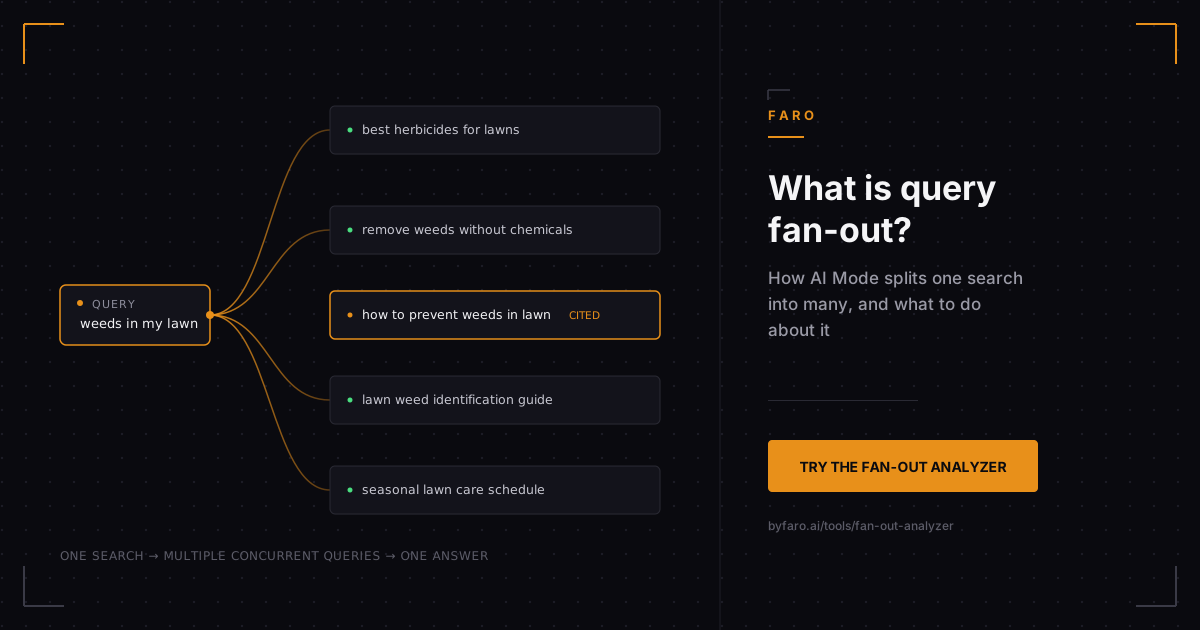
Google's AI Mode and AI Overviews do not treat a search the way classic Google Search does. Instead of matching one query to a ranked list of pages, the system breaks that single query into several related searches, runs them at once, and stitches the results into one answer. Google calls this a "query fan-out" technique, and it changes what it actually takes for your content to get pulled into an AI-generated response, not just a blue link.
Key takeaways
- Query fan-out is Google's own term for how AI Mode and AI Overviews split one search into several concurrent related searches before generating an answer.
- Google explicitly warns against building a separate page for every fan-out variation; doing so to manipulate AI responses violates its scaled content abuse policy.
- One thorough page that answers a topic's real sub-questions in the same place outperforms a cluster of thin, near-duplicate pages built to catch each variation.
- Structured data does not directly cause fan-out inclusion, but Google's own data shows it materially lifts click-through once a page is shown, which is what actually pays off once you appear.
- You can only manage what you can see; tracking which of your pages show up across a query's fan-out, and which competitors take the slots you miss, is the actual optimization loop.
What is query fan-out?
Query fan-out is Google's own name for the process its AI Mode and AI Overviews use to answer a search: rather than matching your query to one ranked list, the system generates a set of related sub-queries, runs them concurrently, and pulls from multiple sources to build a single response. Google's AI optimization guide defines it as "a set of concurrent, related queries generated by the model to request more information and fetch additional relevant search results to address the user's query." The example Google gives: search "how to fix a lawn that's full of weeds" and the system might branch into searches for the best herbicides, weed removal without chemicals, and weed prevention, then weave the useful pieces of each into one answer.
This is a genuinely different retrieval model from classic search, where one query maps to one set of ranked results. Under fan-out, a single search you never see running actually spawns several searches behind the scenes, and your page has to be relevant to the sub-query that gets fired, not just the headline term the person typed.
How does query fan-out actually work inside AI Mode and AI Overviews?
Google's own documentation describes AI Mode and AI Overviews as sharing "a 'query fan-out' technique, issuing multiple related searches across subtopics and data sources, to develop a response," according to Google's page on AI features and your website. AI Overviews are meant to help someone "get to the gist of a complicated topic or question more quickly," while AI Mode is built for queries "where further exploration, reasoning, or complex comparisons are needed." Both run the fan-out process; AI Mode just tends to spin off more sub-queries because the questions it handles are broader.
The practical effect is that the system is doing something closer to research than lookup. It decides what the person probably needs to know beyond the literal words they typed, issues those as separate searches, and then, per Google, its "advanced models identify more supporting web pages," which is why AI-generated answers often cite a wider and more varied set of sources than a traditional top-ten result page. Your page does not need to rank first for the exact phrase someone typed. It needs to be the best available answer to one of the sub-questions the system decides to ask on that person's behalf, and it needs to be structured clearly enough that the system can lift the relevant part with confidence. Faro's AI visibility scan flags whether your pages are already structured that way before you invest in more content.
Why does Google warn against building a page for every fan-out query?
Because Google has already flagged that exact tactic as spam. Its AI optimization guide states plainly: "While it might be tempting to create separate content for every possible variation of how people might search (for example, by focusing on other queries that people have asked, or fan-out queries), doing so primarily to manipulate rankings or generative AI responses in Google Search violates Google's scaled content abuse spam policy." That is a direct answer to the instinct a lot of content teams will have the moment they learn what fan-out is: spin up a page for every sub-query a topic could generate. Google is telling you, in writing, not to do that.
The reasoning behind the warning matters more than the rule itself. Google's systems are built to understand topical relevance without exact keyword matches, so a thin page built solely to catch one fan-out phrase adds duplication risk without adding real coverage. A content team that reads "fan-out" as "more pages" is optimizing for the old model of search, one query, one page, layered onto a system that no longer works that way. The sub-queries a topic generates are a map of what a thorough answer needs to cover, not a list of URLs to create.
What actually helps a page surface across a fan-out cluster?
One page that genuinely answers a topic's real sub-questions, in the same place, written for a human reader first, is what gets pulled into more of a fan-out cluster, not a set of thin pages each targeting a single variation. If a search like "how to fix a lawn full of weeds" can fan out into herbicide comparisons, chemical-free removal, and prevention, the page most likely to get cited across multiple sub-queries is the one that already covers all three clearly, with headers the system can map straight to a sub-question, rather than three separate pages each covering one slice thinly.
| Old habit (single-query era) | What works under query fan-out |
|---|---|
| A new page for every keyword variation | One page that answers every real sub-question a topic raises |
| Headings written to match search phrases | Headings written as the actual questions a reader would ask, answered directly beneath |
| Depth spread thin across many URLs | Depth concentrated in one URL the system can cite for multiple sub-queries |
| Optimizing for the literal query typed | Anticipating the sub-queries the system will generate on the reader's behalf |
In practice, that means mapping out the sub-questions a topic actually raises before you write anything, the way you would plan an FAQ, and answering each one in a self-contained section a system can lift on its own without needing the rest of the page for context. It also means resisting the urge to publish a companion page for every angle. Fewer, deeper pages beat more, thinner ones under this model.
Not sure which of your own pages are already showing up across a topic's fan-out, and which ones are getting skipped in favor of a competitor's? Faro's fan-out analyzer maps the sub-queries a topic generates and shows you which of those slots your content actually fills. The walkthrough of the fan-out analyzer explains what each sub-query row is telling you before you act on it.
Does structured data change how you show up in a fan-out response?
Structured data does not make Google include your page in a fan-out response by itself, but it does make the page easier for the system to parse correctly once it is a candidate, and Google's own data shows it has a real, measurable effect once a page is shown. Google's structured data introduction states that markup gives Google "explicit clues about the meaning of a page," used both to understand the page and, per Google, "to gather information about the web and the world in general," which is the same underlying comprehension layer AI features draw from. We go deeper on which properties matter most for that comprehension layer in our guide to structured data for AI agents.
The business impact Google cites is worth taking seriously: Rotten Tomatoes saw a 25 percent higher click-through rate on pages enhanced with structured data, Food Network measured a 35 percent increase in visits, and Nestlé found pages appearing as rich results carried an 82 percent higher click-through rate, all figures from Google's own structured data documentation. None of that is AI Mode specific, but it points at the same mechanism: markup reduces ambiguity about what a page is and what it answers, and a system deciding which page best fills a fan-out slot is doing exactly that kind of disambiguation. If your pages are marked up clearly enough for classic rich results, they are also easier for a fan-out process to lift correctly.
How do you check whether your content is showing up across a query's fan-out?
You check by actually mapping the sub-queries a target topic generates and testing which of your pages, if any, get pulled into responses for each one, rather than assuming your top-ranking page for the head term is covering the whole cluster. A page that ranks first for "email deliverability tips" can still be invisible on the three or four sub-queries a fan-out search on that topic spins off, because ranking for the exact phrase someone typed was never the mechanism doing the work.
The reliable way to know is to track it directly: run the topic's likely fan-out queries, note which of your pages get cited and which sub-questions go unanswered on your site entirely, and check who is filling the gaps. That last part matters as much as the first two. If a competitor's page is answering the sub-query your page is silent on, that is a specific, fixable content gap, not a vague ranking problem. Faro's competitor intelligence tool shows which competitor pages are winning those slots on the topics you care about, and the AI schema tool checks whether your existing pages carry the structured data needed to be read cleanly once they are in the running.
FAQ
Is query fan-out the same thing as related searches at the bottom of a results page?
No. Related searches are suggestions shown to the user after the fact. Query fan-out happens before an AI Mode or AI Overviews answer is generated, as the system's own internal step to gather enough information to build that answer, and the sub-queries it runs are never shown to the user directly.
Should I write a separate page for every fan-out variation of my target keyword?
Google has stated directly that doing this to manipulate rankings or AI responses violates its scaled content abuse policy. One thorough page that answers a topic's real sub-questions performs better than several thin pages built to catch each variation separately.
Does query fan-out apply to ChatGPT and Perplexity too, or only Google?
Google is the source that has publicly named and defined "query fan-out" as a technique. Other AI answer engines use comparable multi-query retrieval methods conceptually, but each platform's exact process is proprietary and undocumented in the way Google has documented its own.
How many sub-queries does a typical fan-out generate?
Google has not published a fixed number, and its documentation only illustrates the concept with a single lawn-care example rather than a count. Treat the number as variable by topic complexity rather than citing a specific figure as a rule.
Does query fan-out replace traditional keyword research?
It changes what keyword research is for. Instead of targeting one phrase per page, the useful output of research becomes a map of the real sub-questions a topic raises, which is what a fan-out process is approximating when it generates its own related searches.
In short
Query fan-out is Google's documented technique for splitting one search into several concurrent related searches inside AI Mode and AI Overviews, then synthesizing the results into one answer. Google has also documented, explicitly, that building a separate page for every fan-out variation is a spam violation, not a strategy. What holds up instead is one well-structured page that answers a topic's real sub-questions directly, marked up clearly enough for a system to lift with confidence, paired with actually checking which of your pages show up across a topic's fan-out and which competitor is filling the gaps you leave open. Our piece on how AI search engines find and evaluate businesses covers the broader evaluation process this fits into.
Want to see which sub-queries your best pages are actually winning, and which ones a competitor owns instead? Run your site through Faro's fan-out analyzer and see the gaps directly.