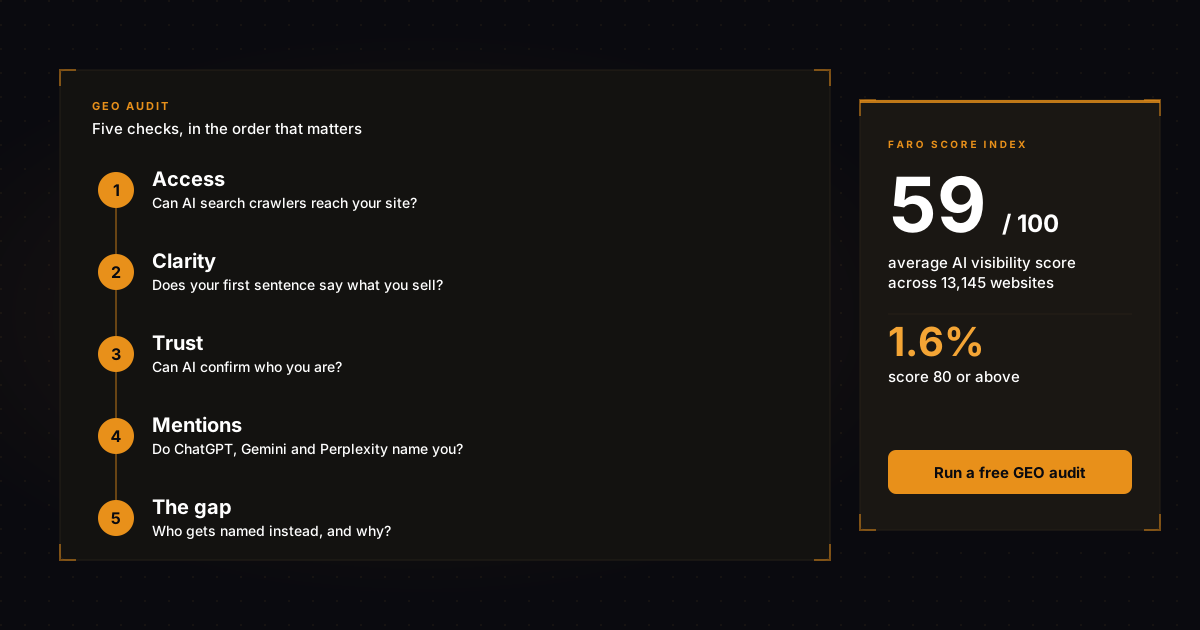
A GEO audit is a check of whether AI assistants like ChatGPT, Gemini, Perplexity and Google's AI Overviews can find your business, understand what you sell, and name you when a customer asks for a recommendation. It covers three things: whether AI tools can reach your site, whether your pages answer buyer questions clearly, and whether you actually show up in AI answers today.
You can run a basic one yourself in about 30 minutes. Start with the technical half: our free AI visibility checker scans your site in about 30 seconds, needs no sign-up, and gives you a fix list in order of impact. Then do the prompt test below, which no tool can fully do for you.
Key takeaways
- A GEO audit asks one question: when a buyer asks AI for a recommendation in your category, are you named, and if not, why not?
- It has five parts: access, clarity, trust, mentions, and who gets named instead of you.
- Across 13,145 sites in the Faro Score Index, the average AI visibility score is 59 out of 100. Only 1.6% score 80 or more.
- The most common gaps are not technical: 21% of sites bury what they do below a tagline, and 26% have no About page an AI can read.
- Google says there is no special file or markup needed for AI Overviews. Fix the basics before you buy anything.
What is a GEO audit?
A GEO audit is a review of how AI search tools see your business, using the same buyer questions your customers type. GEO stands for generative engine optimization: making your business easy for AI tools that write answers (rather than list links) to find, quote and recommend.
The term comes from a 2023 research paper on generative engine optimization, which tested how content changes affect what AI answers cite. The authors found that the right changes could boost a source's visibility in AI answers by up to 40%, and that what works varies by industry. That second finding is the reason an audit has to start from your own customers' questions, not a generic checklist.
If you are still sorting out the acronyms, our guide to SEO vs AEO vs GEO explains how the three overlap. In practice, a GEO audit and an AEO audit check almost the same things. Agencies that sell this as a service usually call it an AEO audit for clients.
How is a GEO audit different from an SEO audit?
An SEO audit asks whether Google ranks your pages. A GEO audit asks whether AI tools mention your business by name when someone asks for help. The two share a foundation, because AI tools still need to crawl and read your pages, but they measure different outcomes.
| SEO audit | GEO audit | |
|---|---|---|
| Main question | Do my pages rank on Google? | Does AI name my business when buyers ask? |
| Measured by | Rankings, clicks, impressions | Mentions and citations in AI answers |
| Who reads your site | Googlebot | Googlebot plus AI search crawlers from OpenAI, Anthropic and Perplexity |
| What matters most | Keywords, links, page speed | Clear answers, who you are, proof, being talked about elsewhere |
| Result you get | A position in a list of links | A sentence that names you, or names a competitor |
One thing they share: Google's own guidance on AI features says the normal SEO best practices still apply to AI Overviews and AI Mode. So a GEO audit does not replace your SEO work. It checks the extra layer on top.
What does a GEO audit check?
A useful GEO audit checks five things, in this order. Each one depends on the one before it: there is no point improving how you are described if AI tools cannot reach your pages in the first place.
1. Access: can AI tools reach your site?
AI search tools send their own crawlers. OpenAI's crawler documentation is direct about it: sites that block OAI-SearchBot will not be shown in ChatGPT search answers. Perplexity says the same about PerplexityBot. These are separate from the crawlers that collect training data, so you can block training and still appear in AI search.
Most sites get this right. In the Faro Score Index, 4.2% of sites block PerplexityBot. But when a site does get it wrong, it is usually by accident: a security plugin, a firewall rule, or a robots.txt copied from somewhere else. Our guide to which AI crawlers to allow lists each one and what blocking it does.
2. Clarity: does your site say plainly what you do?
AI tools read the first lines of your pages to decide what you are. If your homepage opens with a slogan, the AI has to guess. In the Faro Score Index, 21% of sites bury what they actually do below a tagline or navigation, and 26% have no About page an AI can find.
The fix is not technical. Your homepage's first sentence should say what you sell and who it is for. Your About page should say who runs the business, where, and since when. Your pricing page should show a number. In our data, 56% of sites show no price that an AI can read, which means an assistant comparing options has nothing to compare.
3. Trust: can AI confirm who you are?
AI tools are more willing to recommend a business when they can match it to the same business elsewhere: a LinkedIn page, a Google Business Profile, a directory listing. On your own site, structured data is the label that makes those matches easy. In the Faro Score Index, 34% of sites have no structured data at all, 40% do not say what type of organization they are, and 54% do not link their site to their profiles elsewhere.
Keep this in proportion. Google states that there is no special schema you need to add to appear in AI Overviews. Structured data helps AI tools identify you correctly; it does not make them recommend you. A schema markup validator will tell you whether yours is readable in a minute.
4. Mentions: do AI tools name you today?
This is the part most audits skip, and the one that matters most. Ask the AI tools the questions your buyers ask, and write down who gets named. The step-by-step method is below.
5. The gap: who gets named instead of you, and why?
When a competitor is named and you are not, look at the sources the AI cites for that answer. Often it is a review site, a comparison article, or a directory you are not listed on. That list of sources is your to-do list, and it is usually more useful than any technical fix.
How do you run a GEO audit yourself?
You need a spreadsheet, 30 minutes, and access to ChatGPT, Gemini, Perplexity and Google. Here is the method.
- Write 10 buyer questions. Use the words a customer would use, not your industry's jargon. Mix three types: "best [your service] in [your city]", "[your product type] for [a specific need]", and "[competitor] alternatives". Ask your sales team which questions they hear most.
- Ask each AI tool every question. Use a logged-out or private window so past chats do not shape the answer. Run ChatGPT, Gemini, Perplexity and a Google search with AI Overviews or AI Mode.
- Record three things per answer. Were you named? Were you linked? Who else was named? A simple yes or no grid of 10 questions by 4 tools gives you a score out of 40.
- Note the sources cited. Perplexity and Google's AI features show their sources. Copy them into a column. Repeated domains are the places you need to appear.
- Run the technical scan. Our free GEO audit covers access, clarity, trust and structured data in about 30 seconds and ranks the fixes.
- Read your homepage like a stranger. Copy the first 50 words of visible text. If someone who has never heard of you cannot say what you sell from those words alone, neither can an AI.
- Write the fix list. Sort it by the order in the next section, not by what is easiest.
AI answers change from day to day and from person to person, so treat one run as a snapshot. The useful number is the trend: run the same 10 questions every month and compare. A tool like our AI rank tracker does this automatically, and our guide on how to track AI mentions over time covers the manual version.
What do most sites get wrong?
We looked at the latest scan of every site in the Faro Score Index: 13,145 websites, as of November 12, 2026. These are sites people have scanned with Faro or that we added to the index, not a random sample of the web, so read them as patterns rather than a census.
| Check | Share of sites that fail | Fix difficulty |
|---|---|---|
| No price an AI can read | 55.8% | Easy |
| No links to the business's profiles elsewhere | 54.4% | Easy |
| No organization type in structured data | 40.3% | Easy |
| No structured data at all | 34.0% | Medium |
| No About page | 25.7% | Easy |
| Homepage does not say what the business does up front | 21.1% | Easy |
| No contact page or email | 15.2% | Easy |
| Blocks PerplexityBot | 4.2% | Easy |
The average score is 59 out of 100 and the median is 61. 17% of sites score under 50, and only 1.6% score 80 or above. Most of the gap between an average site and a strong one is made of fixes that take an afternoon, not a rebuild.
What should you fix first after a GEO audit?
Fix in this order. Each step makes the next one worth doing.
- Access. Unblock any AI search crawler you blocked by accident. OpenAI says robots.txt changes take about 24 hours to reach ChatGPT search; Perplexity says up to 24 hours.
- Your first sentence. Rewrite the opening of your homepage, About page and main service pages so each one says what you do and for whom, in plain words.
- Proof. Put prices, numbers, named customers and reviews where AI tools can read them as text, not inside images.
- Identity. Add organization structured data that links to your real profiles elsewhere.
- Answers to buyer questions. For every question from your audit where you were not named, make sure one page on your site answers it directly in its first paragraph. Our guide on how to rank in ChatGPT covers this step in depth.
- Being named elsewhere. Work through the sources the AI cited for your competitors: directories, review sites, comparison articles.
- Optional extras. An llms.txt file is cheap to publish with an llms.txt generator, but no major AI platform has confirmed it reads one. Do it last, not first.
For Google specifically, see our guide on how to rank in AI Overviews. For the full strategy beyond the audit, read our AI search optimization guide.
GEO audit checklist
Copy this into your notes and tick it off.
- 10 buyer questions written in customer language
- Each question asked in ChatGPT, Gemini, Perplexity and Google AI Overviews or AI Mode
- Named, linked and competitors recorded for every answer
- Sources cited by the AI tools listed and counted
- AI search crawlers (OAI-SearchBot, PerplexityBot, Claude-SearchBot) allowed in robots.txt
- No firewall or security plugin refusing those crawlers
- Homepage first sentence says what you do and for whom
- About page with who, where and since when
- Prices or price ranges visible as text
- Contact details on a page AI tools can read
- Organization structured data with links to your profiles elsewhere
- One page that directly answers each buyer question you were not named for
- A date in your calendar to rerun the same 10 questions next month
For a longer version aimed at fixing a site in a week, see our AI visibility audit checklist.
How much does a GEO audit cost?
You can do everything above for free: the AI tools have free tiers and the AI visibility checker is free. What you pay for is repetition. Running the same questions every month across several AI tools by hand takes time, so paid tools automate the tracking and alert you when something changes. Faro's paid plans add saved scan history and weekly re-scans; see pricing for the current plans.
If you hire an agency, ask for three things in writing: the exact list of questions they will test, which AI tools they will test them in, and whether they will rerun the same list after the fixes. An audit without a repeatable question list cannot show you whether anything improved. If you are comparing software instead, our roundup of the best AI visibility tools lists the options with prices.
Frequently asked questions
Is a GEO audit the same as an AEO audit?
Almost. Both check whether AI tools can find, understand and recommend your business. GEO is the term from academic research on AI search; AEO (answer engine optimization) is more common among marketers. The checks are the same.
Can I do a GEO audit for free?
Yes. Ask ChatGPT, Gemini, Perplexity and Google your customers' questions and record who gets named, then run a free scan like Faro's AI visibility checker for the technical side. Paid tools mainly save time on repeat checks.
How long does a GEO audit take?
About 30 minutes for a small business doing it by hand: 20 minutes for the prompt test across four AI tools, a few minutes for a technical scan, and the rest to write the fix list.
Do I need schema markup to show up in AI answers?
No. Google says there is no special schema you need for AI Overviews or AI Mode. Structured data helps AI tools identify your business correctly, so it is worth having, but it does not on its own make AI tools recommend you.
Do I need an llms.txt file?
Not to pass a GEO audit. No major AI platform has confirmed that it reads llms.txt. It is cheap to publish, so add it after the fixes that matter, not instead of them.
How often should I run a GEO audit?
Run the prompt test monthly with the same questions so you can see the trend, and rerun the technical scan after any website change, new plugin or new firewall rule.
In short
A GEO audit tells you whether AI tools can reach you, understand you, trust you, and name you, and who they name instead. Start with ten real buyer questions, run them through four AI tools, scan your site, and fix in order: access, first sentence, proof, identity, answers, mentions elsewhere. Run your free GEO audit now and you will have the technical half done before your coffee cools.