When a potential customer asks ChatGPT to recommend a project management tool, an AI agent doesn't look at your homepage design. It doesn't read your brand story or admire your typography. It looks for structured signals: pricing data, clearly labeled features, accessible API documentation, a legible robots.txt, and a site that doesn't block AI crawlers in the first place. If those signals are missing or ambiguous, your business doesn't appear in the answer. That's what AI readiness is about.
AI readiness is the degree to which your website is optimized for discovery, evaluation, and action by AI agents. Not by humans. Not by search engines. By the autonomous software systems that are increasingly making purchasing decisions, shortlisting vendors, and surfacing recommendations on behalf of their users.
Why AI readiness is different from traditional SEO
Search engine optimization is built around one core question: will Google's crawler understand this page and rank it for the right queries? AI readiness asks a different set of questions entirely.
An AI agent evaluating your website isn't running a PageRank algorithm. It's asking: Can I find your pricing without navigating five levels deep? Is your API publicly documented? Are your features described in machine-readable structured data? Does your robots.txt allow AI crawlers access? Is there a clear contact method or purchasing path an agent can follow without human intervention?
These questions require a different kind of site audit. SEO tools measure keyword density, backlink profiles, and Core Web Vitals. AI readiness tools measure agent accessibility, data structure quality, pricing transparency, API discoverability, and the signals that AI models use to form confident recommendations.
The six dimensions Faro measures
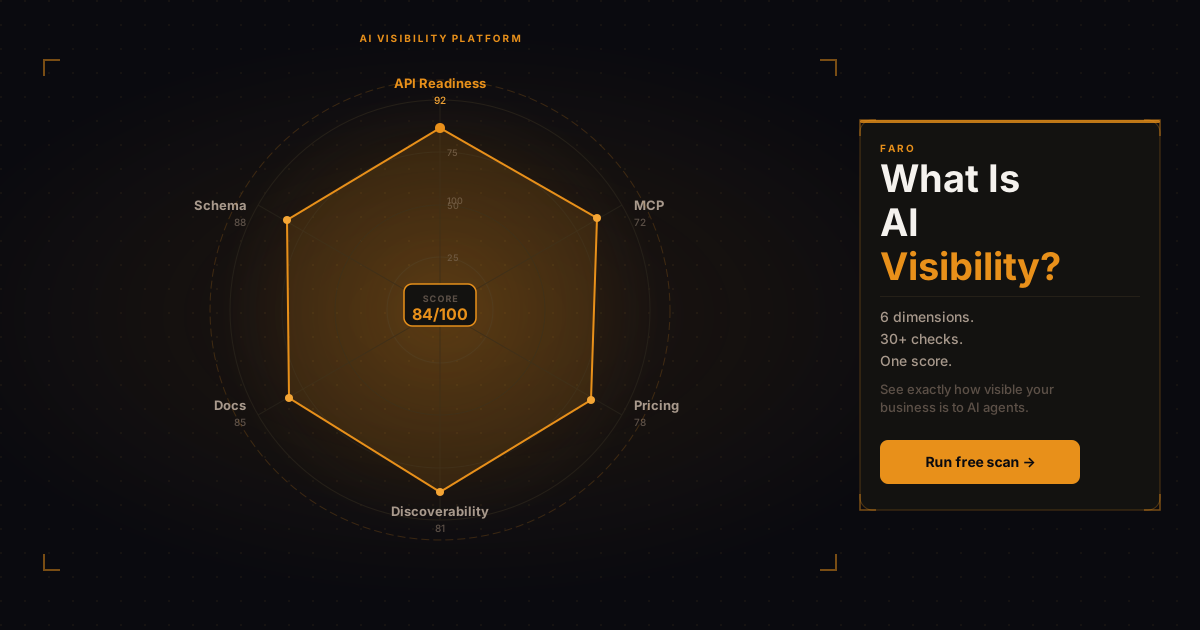
AI readiness isn't a single metric. It's a composite score built from six distinct dimensions, each representing a different way that AI agents evaluate and interact with your site.
API readiness measures whether your product exposes public API endpoints, whether those endpoints are documented, and whether authentication methods are clearly explained. AI agents increasingly need programmatic access to services; if your API is undocumented or hidden behind a sales call, you're invisible to the agents that might otherwise use it.
MCP readiness evaluates whether your service offers a Model Context Protocol server, which allows language models to connect directly to your product as a tool. This is an emerging standard, but it's moving fast. Businesses that ship MCP servers early get a significant advantage in AI agent ecosystems.
AI discoverability checks whether your site uses llms.txt, whether your sitemap is current and accessible, and whether your content is structured for agent comprehension rather than purely for human reading. A well-structured llms.txt file gives AI agents a prioritized map to your most important content so they spend their evaluation capacity on what matters.
Structured data assesses your JSON-LD schema markup. AI agents use structured data to extract clean, reliable facts about your organization, products, pricing, and features without parsing unstructured prose. Missing or incorrect schema leaves agents guessing.
Pricing transparency determines whether your pricing is accessible without JavaScript rendering, whether plan names and limits are clearly labeled, and whether there's a programmatic path to purchase or sign up. An agent evaluating software for a buyer needs to compare prices without human intervention; buried or rendered pricing fails this test.
Documentation quality measures whether your product documentation is crawlable, structured with clear headings, and comprehensive enough for an agent to form a confident recommendation. Thin or paywalled documentation is a significant drag on AI readiness scores.
See your AI readiness score in 30 seconds
Free scan. No account required.
How does an AI readiness score translate to business impact?
The AI agent economy is not hypothetical. Operators, shopping agents, procurement bots, and research assistants are actively crawling, evaluating, and recommending software businesses right now. Perplexity's shopping features, ChatGPT's web browsing, and Claude's tool-use capabilities all depend on a site's ability to surface clean, structured, accessible information quickly.
Businesses with high AI readiness scores tend to share a few characteristics: they have clearly documented APIs, accessible pricing pages that render without JavaScript, structured data that lets agents extract product and organization details accurately, and they don't accidentally block AI crawlers in their robots.txt. Businesses with low scores often have no idea they're blocking crawlers, because those blocks were put in place years ago for a different reason, or they have pricing that's buried behind a "contact sales" form that an agent simply cannot complete.
The commercial risk isn't that AI agents will dislike you. It's that they won't find you at all, or they'll form an incomplete picture of what you offer, which means they recommend a competitor with better structured signals. Just as a site with no metadata struggles to rank on Google, a site with no AI readiness signals struggles to appear in AI-generated recommendations.
What's the difference between a high score and a low score?
Faro scores sites from 0 to 100 and assigns a letter grade from A to F, a system we break down in detail in how the AI readiness score is calculated. A high-scoring site (typically A or B grade, score above 75) has the following in place: a public API with OpenAPI documentation, pricing accessible on a static HTML page, JSON-LD schema for Organization and Product entities, an llms.txt file pointing agents to key content, a robots.txt that doesn't block major AI crawlers, and documentation that an agent can read and cite without rendering JavaScript.
A low-scoring site (C grade or below, score under 50) typically has one or more of the following problems: pricing is JavaScript-rendered or gated behind a demo request; no structured data is present; the robots.txt disallows GPTBot, ClaudeBot, or PerplexityBot; API documentation doesn't exist or is locked to logged-in users; and there's no llms.txt to help agents understand the site's priorities.
Most sites fall in the C-to-D range on first scan. That's not a catastrophe; it's an opportunity. The average site has 6 to 9 fixable issues, most of which take less than a day of developer time to address. The high-impact items, structured data and llms.txt, can be done without a developer at all using Faro's generator tools.
How to start improving your AI readiness score
The fastest wins for most sites fall into two categories: access fixes and structure fixes.
Access fixes are about making sure AI agents can reach your content. This means auditing your robots.txt file to confirm you're not blocking crawlers like GPTBot (OpenAI), ClaudeBot (Anthropic), PerplexityBot, or Googlebot-Extended. It also means checking that your pricing and key product pages render meaningful HTML server-side rather than relying on client-side JavaScript that agents can't execute. These fixes typically require a developer but take under two hours to implement.
Structure fixes are about making sure agents can extract accurate information from what they find. Adding JSON-LD schema markup for your Organization entity (name, URL, description, contact information) and your core product or service takes roughly an hour and dramatically improves the quality of information AI systems can extract from your site. Faro's AI schema tool checks whether that markup is already in place and flags what's missing. Creating an llms.txt file at your domain root takes under 10 minutes using the Faro llms.txt Generator and immediately improves how AI agents prioritize your content.
Beyond those quick wins, API documentation, MCP server setup, and deeper pricing transparency require more investment, but they move the needle on the dimensions that matter most for AI agent commerce: can an agent not just find you, but actually do something once it does?
In short
AI readiness is about how well your website performs when AI agents, not human users, evaluate and interact with it. It covers six dimensions: API readiness, MCP readiness, AI discoverability, structured data, pricing transparency, and documentation quality. Most sites score in the C-to-D range on first audit and have multiple fast-fix opportunities. The penalty for ignoring it is growing: AI agents that can't find, understand, or act on your site will recommend your competitors instead. Running a scan takes 30 seconds and costs nothing.
Frequently asked questions
Is AI readiness the same as answer engine optimization (AEO)?
No. AEO typically refers to optimizing for brand mentions in AI-generated answers, such as appearing in a ChatGPT summary or a Perplexity answer. AI readiness is about optimizing for agent interaction: can an AI agent crawl, understand, and take action on your site? AEO is about content visibility; AI readiness is about technical accessibility and data structure.
Does AI readiness affect my Google SEO?
Many AI readiness improvements, particularly structured data and crawl access, also benefit traditional search performance. JSON-LD schema is used by Google for rich results. A clean robots.txt helps both Google and AI crawlers. That said, AI readiness focuses on signals beyond what Google needs: llms.txt, API documentation, and MCP server availability are irrelevant to Google but critical for AI agents.
How long does it take to improve an AI readiness score?
Quick wins (robots.txt fix, adding llms.txt, adding basic JSON-LD schema) can be done in an afternoon with minimal developer involvement. API documentation is typically a multi-day project if it doesn't already exist. Full MCP server implementation for a complex product can take a week or more, but the incremental wins start showing immediately.
Do I need a developer to improve my AI readiness?
Not for everything. Creating an llms.txt file, adding basic Organization schema to your site's head, and auditing your robots.txt can all be done by a marketer with basic HTML access. Fixing JavaScript-rendered pricing pages and building API documentation does require developer support.
The first step is knowing where you stand. Run the Faro AI Readiness Scan on your site now. It takes 30 seconds, it's free, and you'll get a score across all six dimensions plus a prioritized list of what to fix first.
Want a deeper explanation of what AI readiness means and how scoring works? Read our Help Center guide on AI readiness.
Faro's AI SEO tools suite covers all six dimensions: run a scan, generate llms.txt, audit your schema, check robots.txt, and benchmark against competitors.