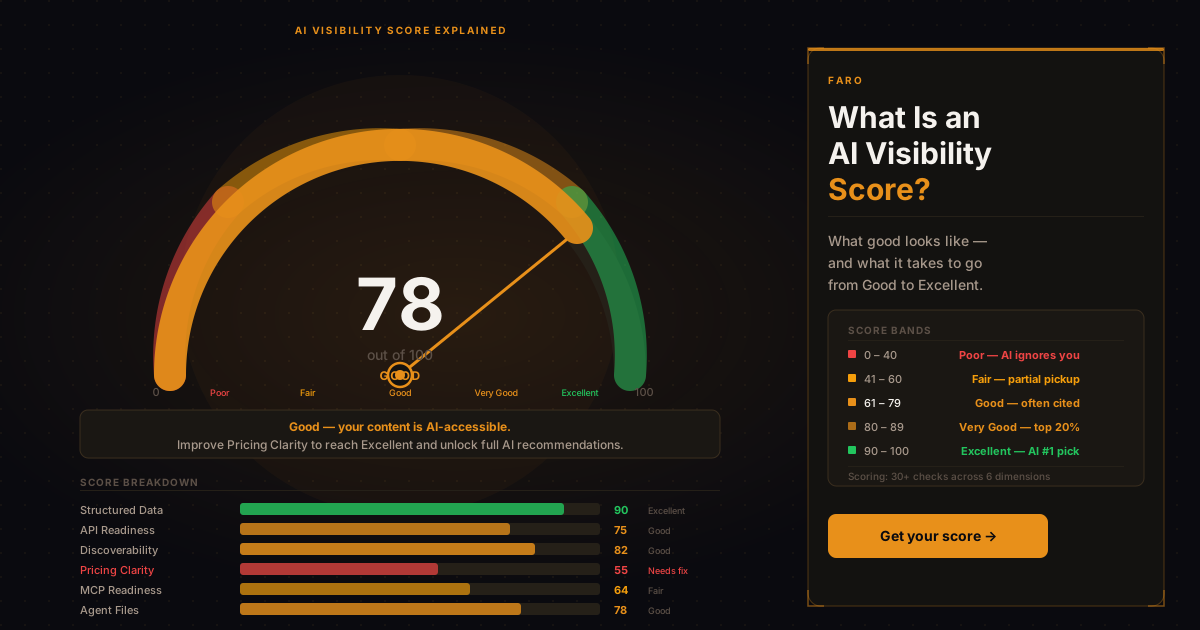
If you've run an AI visibility scan on your website, you've seen a score. Maybe it's 62 out of 100. Maybe it's 31. The number is clear, but what it represents, what a good score looks like, and what the score actually predicts about your business performance in an AI-driven world are questions that most scan tools don't answer well.
This article explains the AI visibility score from the ground up: what each check category contributes, how to read your score in context, and what you should prioritize to improve it. If you haven't run your first scan yet, our guide on how to use the AI Readiness Scan walks through what to expect before your results come back.
What an AI Visibility Score Measures
An AI visibility score is a composite measure of how well your website is structured for AI systems. It covers six dimensions that together determine whether AI models can find, understand, and interact with your business:
API and agent accessibility
Can AI agents take actions on your site? This dimension checks whether you have published agents.json, whether your site has an API with documented endpoints, and whether agent-specific files like an A2A Agent Card (/.well-known/agent-card.json) are present. A site with no API and no agents.json scores zero here. A site with a documented API, published agents.json, and a properly formatted A2A card scores near maximum.
AI crawler access
Are AI crawlers allowed to access your content? This checks robots.txt for explicit permissions to GPTBot, ClaudeBot, PerplexityBot, and Google-Extended. It's binary at the individual crawler level: either you allow it or you don't. A site that allows all four scores full marks here. A site with a wildcard Disallow: / rule or explicit AI crawler blocks scores zero, regardless of how strong other dimensions are.
This is the most consequential single check in the audit. Blocking AI crawlers eliminates the possibility of real-time AI retrieval regardless of how good your other signals are.
AI discoverability
Can AI models find and understand your site without human assistance? This dimension checks llms.txt existence and quality, sitemap publication, Content-Type response headers, and link header signals. A site with a detailed llms.txt, a valid XML sitemap, and correctly configured headers scores well here. A site with none of these scores poorly even if it has excellent structured data.
Structured data
Is your business identity machine-readable? This checks for Organization or SoftwareApplication JSON-LD schema, sameAs entity links, FAQPage schema, and schema completeness. Schema that exists but is missing key fields (description, url, logo, or sameAs) scores partially. Schema that populates all fields and links to external profiles scores fully.
Pricing transparency
Can AI models retrieve your pricing without authentication? This checks for a publicly accessible pricing page, structured Offer markup on product pages, and clear plan differentiation. “Contact us for pricing” patterns fail this check. Publicly accessible pricing with structured markup passes it.
Documentation quality
Is your technical documentation structured and accessible? This dimension checks for API documentation existence, documentation accessibility without login, and content organization that supports AI parsing. Gated documentation that requires an account to access fails here. Publicly accessible, well-structured documentation scores well.
How Scores Are Weighted
Not all checks carry equal weight. In Faro's scoring model, the weights reflect the relative impact each dimension has on AI recommendation visibility:
- AI crawler access: 25% (foundational, nothing else matters if crawlers are blocked)
- Structured data: 25% (machine-readable identity is the most direct AI legibility signal)
- AI discoverability: 20% (llms.txt and sitemap have measurable impact on retrieval models)
- Pricing transparency: 15% (high importance for agent-mediated evaluation and purchase)
- API and agent accessibility: 10% (important for the agent economy but fewer sites have APIs)
- Documentation quality: 5% (relevant for technical products)
These weights explain why a site can have well-written llms.txt and strong structured data but still score below 60 if it has blocked AI crawlers. The crawler access check is non-negotiable.
What Do Score Ranges Mean?
0 to 30: Invisible to AI
A site in this range is almost certainly blocking AI crawlers or has no structured data at all. AI models relying on live retrieval can't access the site, and models using training data have little structured information to draw on. Sites here are effectively invisible in agent-mediated discovery. The fixes are urgent and technical: unblock crawlers, add schema, publish llms.txt.
31 to 55: Partially structured
This range typically means crawlers are allowed and basic schema exists, but coverage is incomplete: missing llms.txt, incomplete sameAs links, no agents.json, or pricing that isn't marked up. The site can be found and partially understood by AI, but not reliably. This is where most websites currently land.
56 to 75: Agent-aware
Sites in this range have done the fundamentals correctly. Crawlers are allowed, schema is in place, llms.txt is published, and pricing is transparent. Gaps at this level are usually in the details: incomplete sameAs links, no agents.json, uneven schema coverage across pages. This is a competitive baseline in most categories.
76 to 90: Strong AI foundation
Sites here have complete structured data, strong discoverability signals, published agents.json, and publicly accessible documentation. They are well-positioned for both training data inclusion and live retrieval. The remaining gaps are typically in advanced checks: OKF bundle, A2A card, complete variant-level product schema.
91 to 100: Agent-first infrastructure
This range requires not just correct technical signals but the full agent accessibility stack: agents.json with documented actions, A2A card, publicly accessible API documentation, complete schema coverage across the full site, and a detailed llms.txt. Few sites currently score here. Sites in this range are explicitly built for AI agent interaction, not just optimized for it.
What range is your site in?
Run Faro's free AI Visibility Checker to see your score by category and identify which checks are costing you the most points.
The Relationship Between Score and Mention Rate
The AI visibility score measures structural readiness. The mention rate (how often AI models mention your business in relevant queries) measures actual visibility. These are related but distinct, and understanding the relationship matters for setting expectations.
A high AI visibility score is a necessary but not sufficient condition for a high mention rate. You can have perfect structural signals and still have a low mention rate if your business lacks training data presence in the models' knowledge base. Conversely, a well-known business with decades of media coverage can have a moderate mention rate despite a poor structural score, because training data presence partially compensates for missing signals.
The practical implication: fixing structural score gaps produces fast, measurable improvements in mention rate on retrieval-based models (days to weeks). Building training data presence is slower (6 to 18 months) but more durable. Both matter.
How to Prioritize Score Improvements
The highest-leverage improvements follow a consistent pattern regardless of current score:
- If AI crawlers are blocked: fix this first, before anything else. Nothing else in the audit matters while crawlers are blocked. This is a 30-minute fix with immediate impact.
- If no Organization schema: add JSON-LD with name, url, description, and sameAs. This is the highest-impact structural signal after crawler access.
- If no llms.txt: publish a detailed file with your business description, customer profile, key pages, and what makes you different. This is a 2-hour project with measurable impact on retrieval models.
- If no pricing page or markup: ensure pricing is publicly accessible and marked up with Offer schema or clear page structure.
- If no sameAs links: create or verify your LinkedIn, Crunchbase, and Wikidata profiles and link them from your schema.
- If no agents.json: publish a basic capability manifest, even a minimal version with your API contact information.
For a broader, ranked punch list beyond these six priorities, Faro's AI visibility checklist walks through ten fixes in the order most sites should tackle them.
Score Benchmarks by Industry
Based on Faro scan data, average AI visibility scores vary significantly by industry. SaaS and developer tools companies tend to score highest (average around 52), largely because their developer audiences have driven earlier adoption of structured APIs and documentation. E-commerce has moderate averages (around 38), with strong schema coverage on the top platforms but poor discoverability signals. Professional services, healthcare, and local businesses score lowest (average around 22), with frequent AI crawler blocks and almost no llms.txt adoption.
These averages mean that in many industries, even a score of 55 to 60 represents a significant competitive advantage. The absolute number matters less than where you sit relative to your category. Faro's Score Index shows exactly where your score lands next to real businesses in your category, so you're comparing against actual competitors instead of an industry average.
Score Decay: Why You Need to Re-Scan Regularly
AI visibility scores can decrease over time for reasons outside your immediate control:
- Security updates or CMS changes that inadvertently block AI crawlers
- Schema plugins that break after updates
- New check categories added to the scoring standard
- llms.txt files that become outdated as your product evolves
Re-scanning quarterly is a minimum for most businesses. Monthly re-scanning is appropriate for businesses where AI visibility is a growth priority. Faro's scan history in the dashboard lets you track score changes over time and catch regressions before they affect visibility.
In Short
An AI visibility score measures six dimensions of how well your website is structured for AI systems, weighted by the impact of each dimension on AI recommendation visibility. Scores below 30 indicate invisible-to-AI infrastructure. Scores of 56 to 75 are the competitive baseline most businesses should target. Scores above 75 require the full agent accessibility stack. The score is a structural diagnostic, not a direct measure of AI visibility. Improving the score is the fastest path to improving mention rate on retrieval-based AI models.
Frequently Asked Questions
How is an AI visibility score different from a PageSpeed score?
PageSpeed measures how quickly your website loads for human users. An AI visibility score measures how well your website communicates structured information to AI systems. They test completely different things. A site can have a perfect PageSpeed score and a terrible AI visibility score, and vice versa.
Does a high AI visibility score guarantee I'll appear in AI answers?
No. The score measures structural readiness, which is one of two components of AI visibility. The other is training data presence, which depends on your brand's historical coverage in media, publications, and online discussions. A high score maximizes your structural contribution to visibility, but businesses with very low training data presence may still have low mention rates despite perfect scores.
My score dropped since last time I scanned. What happened?
Score drops usually have one of three causes: a CMS or security update that changed your robots.txt or schema output, a new check category added to the scoring standard, or a file (like llms.txt or agents.json) that has become inaccessible due to a server configuration change. Run the scan and look at which specific checks changed from pass to fail to identify the cause.
Is the Faro AI visibility score the same as scores from other tools?
Different tools weight checks differently and may include different check categories. Faro's scoring includes OKF bundle readiness, A2A card detection, and AEO-specific checks that many other tools don't cover. A score from Faro is not directly comparable to scores from other tools, but the underlying pass/fail checks for individual signals are consistent with industry standards.
helloplain text x27 here no hashplain text #x27 here with hash