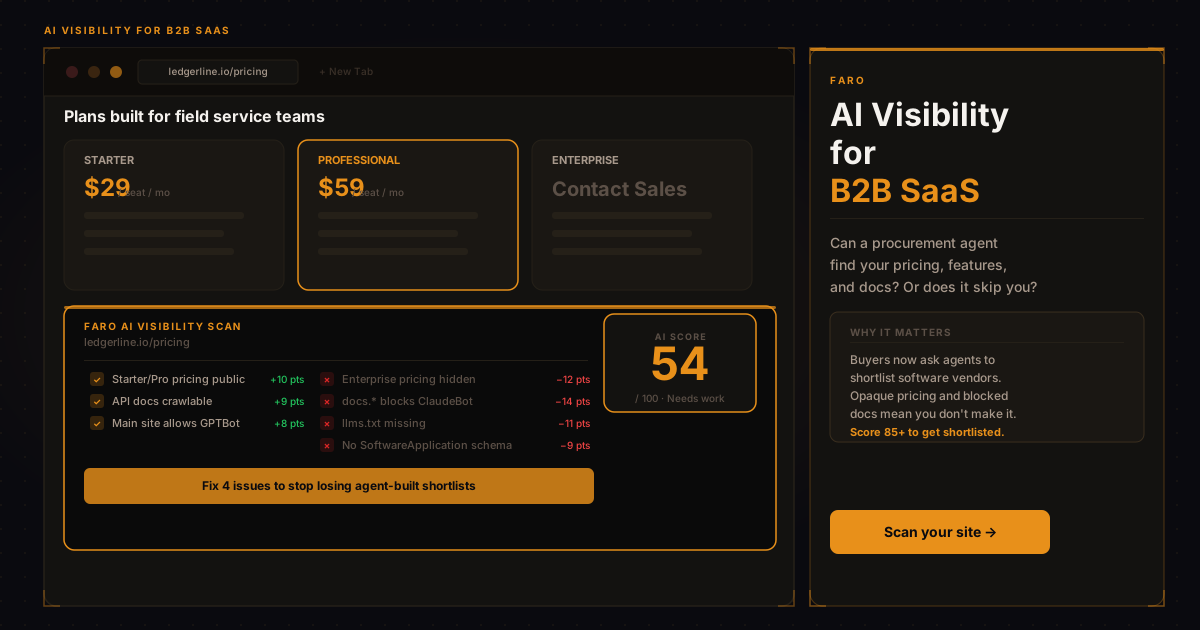
B2B SaaS buyers used to start with a Google search, a G2 comparison, and a call with sales. Increasingly, they start by asking an AI agent to shortlist vendors for them: “find me three project management tools that support SSO and have a free trial.” If your software isn't structured for that agent to read, you don't make the shortlist. It's that simple, and it's already happening.
This is a different problem than AI readiness for e-commerce, even though the underlying mechanics overlap. E-commerce agents compare price and stock. Procurement agents evaluating SaaS are checking something messier: pricing tiers, feature availability by plan, integration support, security posture, and whether there's an API at all. Get this wrong and you don't lose a sale. You lose the chance to even be considered. For the broader picture beyond pricing and schema, our complete guide to AI visibility for SaaS companies covers the full set of signals AI systems weigh before a SaaS product gets shortlisted.
Why B2B SaaS Is a Harder Problem Than E-Commerce
A product page for a standing desk has maybe six attributes an agent cares about: price, dimensions, color, stock, rating, shipping. A SaaS pricing page has to communicate plan tiers, per-seat versus flat pricing, feature gating across tiers, usage limits, annual versus monthly discounts, and whether enterprise pricing is even public. Most SaaS companies bury half of that behind a “contact sales” button, which is exactly the kind of dead end that makes an agent give up and move to the next vendor.
And unlike a physical product, software has behavior. An agent doing real diligence for a buyer might want to know if you support SAML SSO, whether you have a SOC 2 report, what your uptime SLA is, and whether your API supports the integration the buyer needs. None of that shows up in a meta description. It has to be structured, or explicitly written somewhere an agent can parse without guessing.
What Procurement Agents Actually Check
Based on how current agentic browsing and research tools operate (Perplexity's research mode, ChatGPT with browsing, Claude with web search), a procurement-style query against your SaaS site typically triggers a few passes:
- Pricing page fetch, to extract tiers, per-seat cost, and feature gates
- Product or feature page fetch, to confirm specific capabilities (SSO, API access, integrations)
- A check for a documentation or API reference, especially if the query mentions integration or automation
- A trust check, often against your security or compliance page, if the buyer's prompt mentions enterprise, compliance, or procurement
If any of those pages return thin content, require login, or hide behind JavaScript rendering that doesn't resolve for a crawler, the agent either fills the gap with a guess (bad for you, because it's often wrong) or drops you from consideration (worse).
The Six Fixes That Matter Most
1. Publish pricing as structured, crawlable content
“Contact us for pricing” is a conversion-rate decision that made sense in a sales-led world. It's a liability in an agent-mediated one. At minimum, publish starting prices per tier, what's included, and per-seat versus flat-fee structure. If enterprise pricing genuinely can't be public, say so explicitly and describe what enterprise unlocks, rather than leaving a blank the agent has to interpret.
Faro's Pricing Audit tool checks whether your pricing page actually exposes this in a machine-readable way, not just whether a human can read it.
2. Use SoftwareApplication or Product schema on your product pages
Schema.org has a dedicated type for this. A minimal SoftwareApplication block on your homepage or product page gives agents a structured anchor for category, pricing, and operating requirements instead of forcing them to infer it from marketing copy:
{
  "@context": "https://schema.org/",
  "@type": "SoftwareApplication",
  "name": "Ledgerline",
  "applicationCategory": "BusinessApplication",
  "operatingSystem": "Web",
  "offers": {
    "@type": "Offer",
    "price": "89.00",
    "priceCurrency": "USD",
    "priceValidUntil": "2026-12-31"
  }
}
This won't single-handedly get you recommended. But it removes ambiguity, and ambiguity is what gets SaaS vendors filtered out of agent-generated shortlists. Faro's AI Schema Creator generates this automatically from your existing pricing and product pages.
3. Don't block AI crawlers on your docs subdomain
This one trips up more SaaS companies than you'd think. Docs often live on a separate subdomain (docs.yourcompany.com) with its own robots.txt, sometimes generated by a different tool (Mintlify, ReadMe, GitBook) than the marketing site. It's common for that subdomain to have a stricter or just outdated robots.txt that blocks GPTBot, ClaudeBot, or PerplexityBot, even when the main site allows them. Check both. Google's own robots.txt documentation covers how directives are scoped per host, which is exactly where this gap hides. Faro's robots.txt Analyzer will flag a mismatch between your root domain and subdomains.
4. Write an llms.txt that actually describes what your software does
A surprising number of SaaS llms.txt files (where they exist at all) are just a repackaged tagline. That's a wasted opportunity. Your llms.txt is one of the few places you get to speak directly to a model in plain language about what problem you solve, who you're built for, what integrations you support, and what makes you different from the three competitors an agent is probably also evaluating. The llms.txt spec is intentionally loose on format, which means most companies underuse it. Faro's llms.txt Generator builds a first draft from your existing site content in under a minute.
5. Expose your API docs, even if the API itself is gated
If a buyer's query involves “does it integrate with Salesforce” or “can we automate this,” the agent is going to look for API documentation. If your API reference is locked behind a signup wall, the agent can't confirm anything and will often just report that integration support is unclear. Public, crawlable API docs (even a static reference page listing endpoints and auth methods) solve this. It costs you nothing in security to describe what the API does; the credentials are still gated.
Increasingly, some SaaS platforms are going a step further and exposing an MCP (Model Context Protocol) server so agents can query and act on data directly rather than just reading about it. That's not table stakes yet for most B2B SaaS. But it will be the difference between “agent-readable” and “agent-usable” within the next couple of years, and the companies experimenting with it now are going to have a real head start.
6. Make your trust signals findable, not just present
SOC 2, GDPR compliance, uptime history, data residency: most B2B SaaS companies have this information somewhere, usually a PDF behind a form. An agent doing procurement diligence for an enterprise buyer isn't filling out that form. Put a plain-text summary of your compliance posture on a public trust or security page, with the detailed report available on request. That one change alone resolves a huge share of the “can't confirm compliance” gaps agents run into.
See where your SaaS site actually stands
Faro's AI Readiness Scan checks pricing transparency, schema, crawler access, llms.txt, and documentation structure for any URL in under 30 seconds. Most B2B SaaS sites we've scanned fail on pricing transparency first.
A Realistic Example
Take a fictional but representative case: a scheduling and dispatch SaaS out of Denver, built for field service companies, priced per technician seat. Their pricing page said “starting at $29” with everything else behind a demo request. Their docs subdomain blocked GPTBot by default (a leftover from a template their dev agency used). Their llms.txt didn't exist. When we ran a query simulating a buyer asking an agent to compare field service scheduling tools, the tool wasn't mentioned at all, not misrepresented, just absent. Two of its direct competitors, both with public per-seat pricing and open docs, were named specifically. That's not a ranking problem. It's an existence problem, and it's the one I'd bet a meaningful share of B2B SaaS companies have right now without knowing it.
What This Doesn't Mean
This isn't an argument for giving away enterprise pricing you have real strategic reasons to keep negotiated, or for exposing internal API credentials. It's an argument for removing unnecessary ambiguity. There's a difference between “we don't publish enterprise pricing because deals are custom” (fine, say that) and simply having nothing there at all (an agent fills that silence with an assumption, and the assumption is rarely in your favor).
In Short
B2B SaaS procurement is starting to run through AI agents before it reaches a human buyer, and the bar for being considered is structural, not persuasive. Publish real pricing. Add SoftwareApplication schema. Check that your docs subdomain isn't blocking AI crawlers your main site allows. Write an llms.txt that says something. Expose your API reference even if the API is gated. Put trust and compliance signals somewhere public. None of this is expensive to fix. Most of it takes an afternoon per item, not a redesign.
Run the scan, fix what it flags, and check again next quarter. Agent behavior is changing fast enough that what passes today may not in six months.
Frequently Asked Questions
Does my SaaS need Product schema like an e-commerce store?
Use SoftwareApplication schema instead of generic Product schema; it's the type built for this and includes fields like applicationCategory and operatingSystem that a generic Product type doesn't. See the full field list at schema.org/SoftwareApplication.
What if we're freemium and pricing is genuinely complex?
Publish the free tier limits and the starting paid price clearly, even if the top tier is custom. An agent that can confirm “free tier exists, paid starts at $X” has enough to include you in a shortlist. An agent that finds nothing concrete usually doesn't.
How is this different from just doing good SEO?
Traditional SEO optimizes for ranking in a list of links a human will scan. Agent readiness optimizes for being correctly understood and confidently included in a synthesized answer or shortlist, often without a click at all. The two overlap on Faro's AI Readiness Scan but they're not the same discipline.
Should we worry about competitors scraping our now-public pricing?
Your pricing is very likely already visible to any competitor willing to sign up for a trial or ask a sales rep. Keeping it opaque mainly costs you agent visibility, not competitive secrecy.
Is this relevant if we sell exclusively through an enterprise sales team?
Yes, arguably more so. Enterprise buyers increasingly use AI tools to build initial vendor lists before ever talking to a rep. If your agency or in-house team wants a structured way to audit this across a portfolio of client sites, Faro's agency plan is built for exactly that.