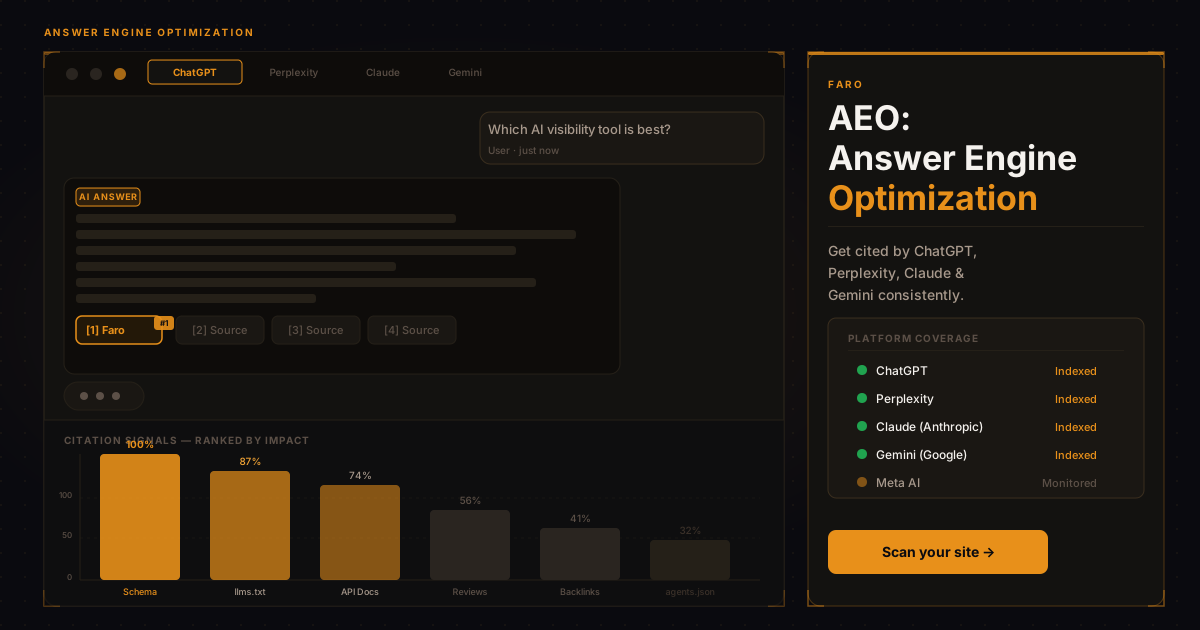
Answer engine optimization (AEO) is the practice of structuring your website so AI answer engines like ChatGPT, Perplexity, and Claude can find, read, and cite your business accurately. It is not SEO with a new name. The signals that move your ranking in Google do not reliably predict whether an AI system includes you in a recommendation, and several of the most important AEO signals do not affect SEO at all. This guide covers the specific tactics that determine your AI discoverability, how to measure them, and what most businesses are currently getting wrong.
What is an answer engine, and why does optimization differ from SEO?
A search engine returns a ranked list of links. An answer engine returns a synthesized response, often without links, drawn from sources it has already evaluated for credibility and relevance. The user never sees the result set; they see a conclusion. That structural difference changes what optimization means.
When Google evaluates a page, it considers hundreds of signals including backlinks, page speed, keyword density, and structured markup. When ChatGPT or Perplexity evaluates a page, the primary question is simpler: can I understand this page clearly enough to cite it with confidence? Factors like backlinks matter less. Factors like content structure, pricing transparency, and machine-readable metadata matter more.
There is also an intent difference. AI answer engines are increasingly used for high-intent queries: “what is the best CRM for a 10-person sales team,” “which project management tools integrate with Slack,” “what does Salesforce Professional cost per user.” These are commercial queries where the answer engine is functioning as a research assistant or procurement aid. Businesses that appear in these responses get considered; businesses that don't exist in the AI's understanding of the category get skipped.
The seven AEO signals that matter most
These are the factors that most reliably determine whether an AI answer engine can cite your business confidently, ordered from highest to lowest implementation impact.
1. llms.txt: the AI sitemap
llms.txt is a plain-text file at the root of your domain that tells AI systems which pages contain authoritative information about your business. Unlike robots.txt, which focuses on crawler access, llms.txt is a positive signal: it says “here is where to find accurate information about what we do, what we cost, and how to work with us.” Sites with a well-structured llms.txt file are more likely to be cited accurately because the AI has been given a reliable map. You can generate one in under two minutes using Faro's llms.txt generator.
2. Structured data markup
JSON-LD schema markup gives AI systems machine-readable context about your business: what category you're in, what products you offer, what your pricing looks like, how to contact you. AI answer engines process structured data before body copy because it's unambiguous. A site with complete JSON-LD schema for its primary entity types (Organization, Product, Service, FAQPage) gives AI systems the confidence to include it in category recommendations.
3. Pricing page machine-readability
When a user asks an AI system “how much does [your product] cost,” the system goes looking for a pricing page and attempts to parse it. If your pricing is rendered by JavaScript after the page loads, many AI crawlers cannot see it. If your plan names, prices, and feature limits are buried in complex CSS layouts or tab components, the system may not extract them correctly. Pricing pages that are server-rendered, clearly labeled, and structurally simple outperform visually sophisticated ones in AI discoverability.
4. AI crawler permissions in robots.txt
Several major AI systems use dedicated crawlers: GPTBot for OpenAI, PerplexityBot for Perplexity, ClaudeBot for Anthropic. By default, many website templates block all unknown bots, which can silently exclude these crawlers. An AI-friendly robots.txt explicitly permits the crawlers you want to allow and limits or denies those you do not. Blocking AI crawlers is sometimes deliberate and sometimes accidental; either way, the effect is the same.
5. Content that answers questions directly
AI answer engines are optimized to extract direct answers. Pages that bury the answer in paragraphs of context are harder to cite than pages where the first sentence of a section answers the likely question. This is structurally close to what makes a good FAQ section for SEO featured snippets, but applies more broadly to all body content. Headings phrased as questions with direct first-sentence answers are a high-leverage AEO content pattern.
6. API and integration documentation
When AI agents evaluate software on behalf of a buyer, one of the first signals they look for is API availability and documentation quality. An API section that clearly states authentication methods, available endpoints, rate limits, and integration complexity signals to an AI agent that your product can be programmatically accessed. Products with clear API docs are more likely to appear in agent-assisted procurement decisions.
7. Entity consistency across pages
AI systems build a knowledge graph about your business from multiple page visits. If your product name, company name, pricing, and category description are inconsistent across pages, the AI's internal model of your business becomes uncertain, and it may cite you with less confidence or cite inaccurate information. Entity consistency means your key facts are stated the same way on every page where they appear.
See how your site scores on AEO signals
Faro scans all seven signals in 30 seconds and shows you exactly what to fix.
How to measure AEO performance
The measurement challenge in AEO is that AI answer engines do not publish ranking reports. There is no “Perplexity Search Console.” You cannot directly query whether ChatGPT is citing you in its responses unless you run the queries manually. This makes measurement more operational than in traditional SEO, but it is not unmeasurable. Turning those signals into a number leadership will actually act on is a separate step — Faro's guide to proving AI visibility drives revenue covers how to connect AEO measurement to dollars.
Signal audits
The most reliable proxy for AEO readiness is a structured audit of the signals described above. Scoring each signal systematically and tracking that score over time tells you whether your site is becoming more or less machine-readable. An AI visibility scan does this automatically and produces a score breakdown across each dimension.
Manual citation sampling
Run the top five queries your customers use to evaluate your category through ChatGPT, Perplexity, and Claude on a monthly basis. Record whether your business appears, whether the information is accurate, and whether competitors appear instead. This is a small sample but it is a direct measure of the outcome you care about. Keep a log; changes in citation frequency often track closely with technical AEO changes on your site.
Referral traffic from AI platforms
When AI systems do include links in their responses, those visits appear in your analytics as referrals from chatgpt.com, perplexity.ai, claude.ai, and similar domains. AI referral traffic is currently small relative to organic search for most businesses, but it is growing. Track it as a separate segment in your analytics tool so you can see the trend.
Competitive comparison
AEO performance is relative. If your primary competitors have better structured data, clearer pricing pages, and llms.txt files while you do not, they will appear in AI recommendations more often regardless of absolute quality differences. Scanning competitor sites with Faro's competitor intelligence tool shows you where the gap is widest and which fixes would most quickly close it.
| Method | What it measures | Frequency | Reliability |
|---|---|---|---|
| Signal audit | Technical readiness across 6+ factors | Monthly or after site changes | High (direct signal measurement) |
| Manual citation sampling | Actual appearance in AI responses | Monthly | Medium (small sample, query-dependent) |
| AI referral traffic | Visits from AI platform links | Ongoing via analytics | Medium (excludes unlinked citations) |
| Competitor comparison | Relative readiness vs. category | Quarterly | High (relative ranking signal) |
Common AEO mistakes and how to fix them
Most businesses that underperform in AI recommendations are not making strategic errors. They are making technical omissions that are fixable in a few hours. These are the most common:
JavaScript-only pricing pages. Single-page application pricing pages that render after the client receives JavaScript are invisible to many AI crawlers. The fix is server-side rendering for pricing content, or at minimum a static HTML fallback that contains the key pricing information. Use Faro's pricing audit tool to check whether your pricing page is readable as served.
Missing or blocked AI crawlers in robots.txt. A robots.txt that uses a wildcard Disallow or references an overly broad user-agent block may be accidentally excluding GPTBot, PerplexityBot, or ClaudeBot. The Faro robots.txt analyzer shows you exactly which AI crawlers are allowed and which are blocked, and generates a corrected file you can deploy immediately.
No structured data on key pages. Organization schema on the homepage and Product or Service schema on key landing pages are the minimum viable structured data configuration for AEO. Many sites have either no schema or only the Article schema that gets auto-generated by a blog plugin, which does nothing for product-level AI discoverability. Use the Faro AI schema generator to create correctly structured JSON-LD for your primary entity types.
Inconsistent product descriptions across pages. If your homepage calls your product a “business intelligence platform” and your about page calls it a “data analytics tool,” AI systems have two conflicting entity definitions. Pick your primary descriptor, use it consistently, and put it in your structured data.
No llms.txt file. This is the highest-impact, lowest-effort AEO signal to add. A well-structured llms.txt file can be created and deployed in under 10 minutes. Most sites don't have one because the standard is relatively new; that gap is an opportunity for early adopters.
AEO vs. GEO vs. traditional SEO: which to prioritize?
AEO (answer engine optimization) and GEO (generative engine optimization) are often used interchangeably. For practical purposes, they refer to the same set of practices: making your site readable and citable by generative AI systems. The terminology varies by community; the technical signals are nearly identical. For a closer look at exactly where AEO overlaps with classic SEO and where the two diverge, see AI discoverability vs. SEO.
The prioritization question depends on where your customers are in their buying behavior. If your category has high AI search intent, meaning buyers commonly ask AI systems for category recommendations, AEO should be treated as a peer investment to traditional SEO, not a secondary one. B2B SaaS, professional services, marketing tools, legal services, and financial products all fall into this category. If your buyers are primarily searching Google and browsing category marketplaces, traditional SEO remains the primary channel and AEO is a supporting investment.
The practical reality is that most of the high-impact AEO work takes one to three days of engineering and content effort, while SEO is ongoing. There is almost no category where an AEO implementation project is not worth doing.
In short
Answer engine optimization is a distinct discipline from SEO, with a different signal set and a different definition of success. The highest-impact AEO moves are technical and implementable in under a week: llms.txt, structured data markup, server-rendered pricing pages, and AI-friendly robots.txt. Measurement relies on signal audits, manual citation sampling, and AI referral traffic because there is no direct ranking report. The businesses building this foundation now will have a structural advantage as AI-assisted purchasing continues to grow as a share of commercial discovery.
Frequently asked questions
Is AEO the same as SEO?
No. They share some signals, particularly structured data and content clarity, but AEO addresses a different set of optimization targets: llms.txt, AI crawler permissions, server-rendered pricing, and API documentation. A site can rank well in Google while being nearly invisible to AI answer engines, and vice versa.
How long does it take to implement AEO improvements?
Most high-impact AEO changes take one to three days of engineering effort. Creating an llms.txt file and correcting robots.txt can each be done in under an hour. Adding JSON-LD schema markup to key pages typically takes a day. Server-side rendering for pricing pages is the most variable item, ranging from a few hours to a week depending on your tech stack. None of these are long projects.
Which AI systems matter most for AEO right now?
ChatGPT and Perplexity drive the most commercial query volume as of mid-2026, with Claude growing rapidly in research and procurement contexts. Google AI Overviews matters for queries that start in Google search. Optimizing for ChatGPT (GPTBot) and Perplexity (PerplexityBot) first captures the majority of current AI search traffic.
What is the difference between AEO and making your site readable for AI agents?
They are closely related but not identical. AEO focuses on discoverability and citation in AI answer engines, primarily for information retrieval queries. Making a site readable for AI agents includes AEO signals plus additional factors like API access, authentication documentation, and action-taking capabilities, which matter when the AI is acting as a purchasing or procurement agent rather than simply retrieving information.
How do I know if AI systems are currently citing my business?
The most direct method is manual sampling: run five to ten queries your customers typically use to find your category through ChatGPT, Perplexity, and Claude, and record whether you appear and whether the information is accurate. Track this monthly. You can supplement this by monitoring AI referral traffic in your analytics platform as a secondary signal.
The fastest way to identify your specific AEO gaps is a structured audit. Run the Faro AI Visibility Checker on your site to see a scored breakdown of each signal, a prioritized fix list, and an estimated implementation time for each item. For businesses comparing AI visibility against category competitors, the competitor intelligence tool shows you where the gap is and what to close first.
See everything in Faro's AI SEO tools suite — from schema validation to llms.txt generation to pricing page audits.