Every few years, a new optimization discipline emerges and the first question is always the same: how much of what I already do still works? When social media emerged, the question was whether SEO content could carry over. When voice search became significant, it was whether written content would work for audio queries. Now with AI agents, the question is whether your existing SEO investment gives you a head start on AI discoverability.
The honest answer is: some of it does, and a surprising amount of it doesn't. Understanding the difference saves you from both over-investing in the wrong things and under-investing in what actually moves the needle.
What is AI discoverability?
AI discoverability is the degree to which AI agents, language models, and AI-powered search and recommendation systems can find, accurately understand, and act on information about your business. It's distinct from SEO in a critical way: SEO is primarily about ranking in search results that a human then clicks. AI discoverability is about the quality and accuracy of the information AI systems extract and use when generating answers, recommendations, and autonomous actions on behalf of users.
A site can rank on page one of Google and still be nearly invisible to AI agents if its pricing is JavaScript-rendered, its structured data is missing, and its robots.txt blocks AI crawlers. Conversely, a site with mediocre SEO but excellent structured data, a clean llms.txt, and a well-documented public API may be recommended confidently by AI agents even when it doesn't rank highly on traditional search. It also overlaps closely with, but isn't identical to, answer engine optimization (AEO), which focuses specifically on getting cited in AI-generated answers rather than the broader discoverability picture covered here.
What carries over from SEO
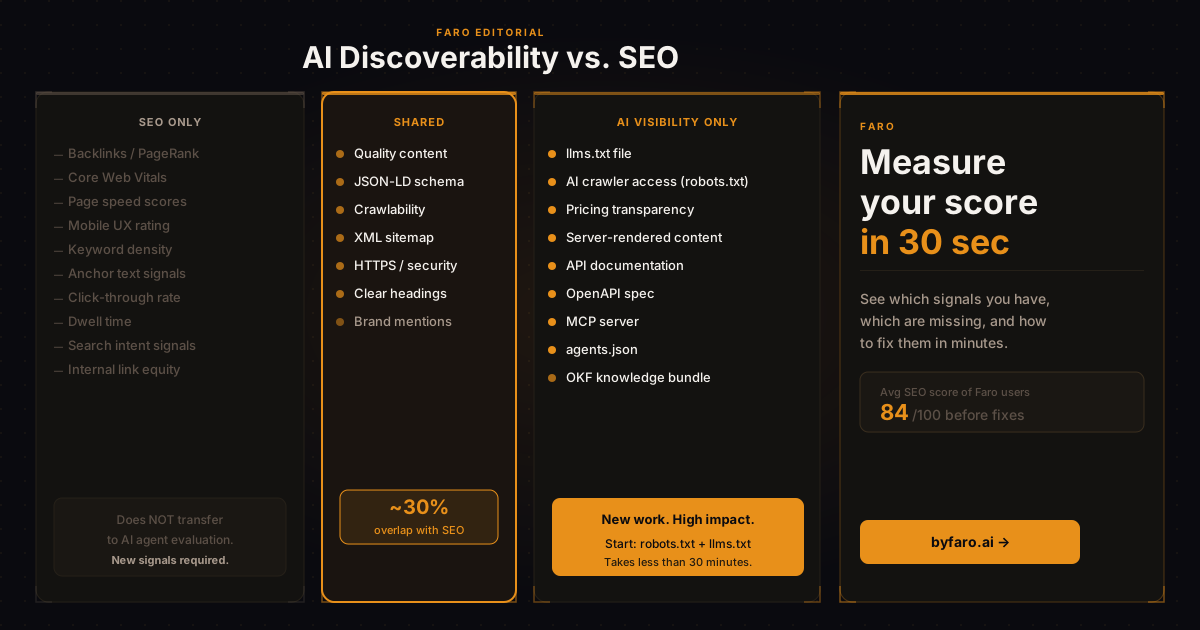
Content quality is the most significant overlap. AI agents, like search engines, prefer clear, accurate, well-organized content over thin pages with keyword stuffing. If you've been publishing substantive content that genuinely answers user questions, that investment pays off in AI visibility too. Agents use content quality as a signal when deciding how confidently to recommend a business.
Structured data also overlaps. The JSON-LD schema markup you may have added for Google rich results (Organization, FAQ, Article, Product) is exactly the same markup AI agents use to extract structured facts about your business. If you have good schema implementation, you're ahead on AI discoverability too.
Crawlability and site structure matter in both contexts. A clean sitemap, a well-structured information architecture, and fast server response times help both search engines and AI crawlers navigate your site efficiently. HTTPS is a baseline requirement for both.
What doesn't transfer from SEO
Backlinks are the most significant non-transfer. PageRank and link authority are core to Google's ranking algorithm but largely irrelevant to AI agent evaluation. An agent evaluating software for a purchasing decision doesn't consult your domain authority score. It checks whether your pricing is accessible, your API is documented, and your features are clearly described.
Core Web Vitals, mobile UX scores, and page speed — while important for Google and for human users — have limited relevance to AI agents. Agents don't experience visual layout, they don't care about Largest Contentful Paint, and they don't render the page in a browser. What they care about is whether the HTML that arrives in the initial server response contains the information they need.
Keyword density and on-page keyword optimization are also less relevant. AI agents are semantic systems; they understand context and intent rather than counting keyword occurrences. Stuffing your pricing page with keywords will help your SEO slightly and help your AI visibility not at all. Clear, accurate prose beats keyword optimization for agent evaluation.
The genuinely new work
The areas where AI discoverability requires entirely new investment are the most interesting and least discussed. API readiness is the biggest one: AI agents that perform actions on behalf of users, not just research tasks, need programmatic access to services. If your product doesn't have a documented public API, it simply can't be used by action-taking agents. OpenAI's Actions specification is one example of how agents declare the API calls they can make — but any agent framework requires the same foundation: a public, documented API. This is a software development investment that has no equivalent in SEO.
Pricing transparency for machines is another new requirement. SEO encourages having a pricing page for human conversion. AI discoverability requires that pricing page to be server-rendered, with plan names and limits clearly labeled, and with a purchase path an agent can follow. Many SaaS pricing pages are entirely JavaScript-rendered and unusable by agents.
The llms.txt file has no SEO equivalent — see our complete llms.txt guide for how to build one. It's a new layer of optimization that exists specifically for AI agents, giving them a prioritized map to your most important content rather than leaving them to navigate your full site architecture.
See your AI discoverability score vs. your SEO setup
Free scan. 30 seconds.
How should you prioritize if you have limited resources?
If you're already doing solid SEO and want to extend that investment into AI discoverability, the fastest path is to address the access and structure gaps rather than rebuilding everything.
The highest-priority first steps are: check your robots.txt for AI crawler blocks and fix them; add or complete your JSON-LD schema markup (particularly Organization and Product/SoftwareApplication); create an llms.txt file at your domain root; and ensure your pricing page renders meaningful HTML server-side. These four steps are achievable in a day for most teams and move the needle significantly on AI visibility.
The longer-horizon investment is API documentation and, eventually, MCP server support. These are genuinely new capabilities that don't have analogues in your existing SEO workflow, but they represent the future of how AI agents interact with software businesses — our guide to MCP servers covers what to build first.
In short
SEO and AI discoverability share about 30% of their signal set: quality content, JSON-LD schema, crawlability, and site structure. Backlinks, Core Web Vitals, and keyword density don't transfer. The new work specific to AI discoverability is robots.txt access for AI crawlers, llms.txt, server-rendered pricing, and (for software businesses) API documentation and MCP readiness. Start with the fast wins: most sites can improve their AI discoverability score significantly in under a day.
Frequently asked questions
If I rank well on Google, does that mean AI agents will find me?
Not necessarily. Google ranking signals and AI agent evaluation signals are different. A high-ranking site can be invisible to AI agents if it blocks AI crawlers in robots.txt, has JavaScript-only pricing, or lacks structured data. AI agents evaluate sites on their own terms.
Does AI discoverability work affect traditional SEO?
Many AI discoverability improvements, particularly structured data and crawlability, also benefit SEO. Server-rendering your pricing page, for example, helps both Google and AI crawlers. The two disciplines are complementary, not competing.
How do I measure my AI discoverability?
Run the Faro AI Visibility Checker on your site. It produces a scored assessment across six dimensions of AI discoverability in under 30 seconds. You'll get a grade, a score, and a prioritized list of what to fix first.
Will AI discoverability replace SEO?
Not in the short term. Search engines and AI agents serve different use cases and different user behaviors. As AI agent usage grows, AI discoverability will become an increasingly important channel alongside traditional search, not a replacement for it.
Start by running the Faro AI Visibility Checker on your site. It tells you exactly where you stand on each of the six AI discoverability dimensions and gives you a prioritized fix list to start with the highest-impact changes first.
For the full toolkit — schema audits, robots.txt analysis, llms.txt generation, and competitor benchmarking — see Faro's complete AI SEO tools suite.