A prospect asks ChatGPT which CRM platform is best for a mid-market B2B team. ChatGPT names three vendors. Yours is not one of them, even though your pricing page, your case studies, and your integration docs all exist online. The problem is not your content. The problem is that AI agents cannot read it in real time, so they fall back on whatever was baked into their training data months ago. MCP servers for business solve exactly that gap, and the companies already running them are pulling ahead in AI-generated recommendations at a pace that SEO alone cannot match.
What is an MCP server, and how does it differ from a regular API?
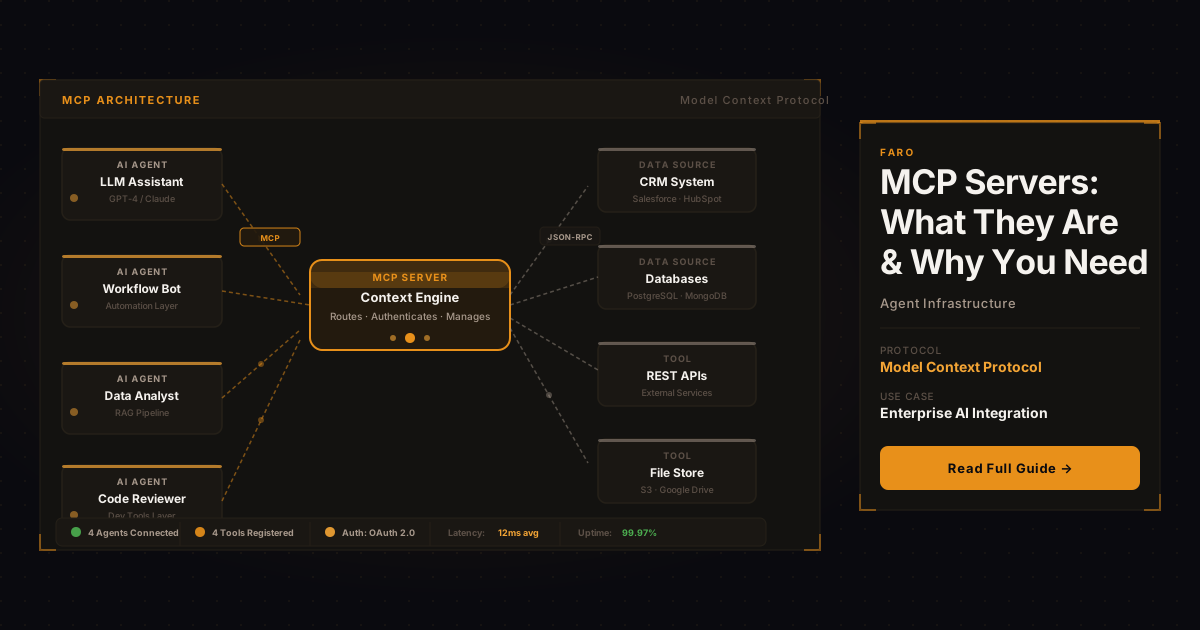
An MCP server is a structured intermediary that exposes your business data and tools to AI agents using the Model Context Protocol, an open standard introduced by Anthropic in late 2024. Where a traditional API returns raw data that a developer then has to interpret and format, an MCP server packages that data into context-ready responses that AI agents can consume directly without custom middleware for every use case. Think of it as the difference between handing a contractor a filing cabinet full of documents versus handing them a briefing note. The agent gets what it needs, formatted the way it needs it, on demand.
Why does this matter for marketing and revenue teams right now?
AI-driven traffic grew roughly 10x in the past 12 months, according to Ahrefs research on organic traffic benchmarks, and AI Overviews alone reduce organic click-through rates by 58% on average. If AI agents are the new first page of Google, being invisible to them is the equivalent of a ranking penalty you never get a notification about. Brands that AI systems recommend first are 389% more likely to be Googled afterward and 117% more likely to receive a direct site visit. An MCP server is how you stay in those recommendations as your product evolves, your pricing changes, and your case studies accumulate, because it feeds agents current information rather than a frozen snapshot from training.
What can an MCP server actually expose to an AI agent?
This is where the commercial value becomes concrete. An MCP server is not limited to static web content. It can expose any data source or tool your business operates, provided you configure the relevant connectors. Common use cases include:
- Product catalog and pricing data: agents retrieve current SKUs, tiers, and promotional rates rather than citing a pricing page that changed last quarter
- CRM records: sales agents answer prospect questions using live deal history and account data
- Support knowledge bases: customer-facing agents pull from your actual documentation, not a hallucinated paraphrase of it
- Internal tools: agents trigger actions in your stack, from creating a Jira ticket to sending a Slack notification, through standardized MCP tool calls
- Competitive and market intelligence: agents surface fresh analyst data or monitoring feeds rather than recalling stale training-time information
The MCP specification published by Anthropic formalizes three primitives: Resources (data the agent can read), Tools (actions the agent can take), and Prompts (templated interaction patterns). Your MCP server implementation maps your business capabilities onto those three primitives.
Local vs. remote MCP servers: which configuration applies to your use case?
Local MCP servers run on the same machine as the agent client, which makes them appropriate for internal tooling and developer workflows where data sensitivity is high and internet exposure is not acceptable. Remote MCP servers run on your infrastructure or a cloud host and communicate over HTTP with server-sent events, which is the architecture that matters for customer-facing AI features and for making your business data discoverable by third-party AI products. Most marketing and revenue applications require the remote configuration. If you are exposing your product data to AI assistants your prospects already use, a remote MCP server is the only viable path.
Not sure whether your current site structure is readable by AI agents at all? Run a free AI Readiness Scan on Faro to see your score across 30+ checks before you invest in MCP infrastructure.
How does MCP compare to other AI integration approaches?
Before committing to MCP architecture, marketing and agency teams often weigh it against alternatives. The table below maps the most common approaches against the dimensions that matter for business adoption.
| Approach | Real-time data | Agent-native | Dev effort | Works with 3rd-party AI products | Best for |
|---|---|---|---|---|---|
| MCP server (remote) | Yes | Yes | Medium | Yes, growing ecosystem | Business data exposure, agentic workflows |
| REST API (custom) | Yes | No | High | Only with custom connectors | Existing integrations with known clients |
| RAG pipeline (static) | Only at sync time | Partial | High | No | Internal knowledge retrieval |
| llms.txt file | On crawl | Yes | Low | Yes, widely supported | Discoverability, content context |
| Structured schema markup | On crawl | Partial | Low-medium | Yes, via search-integrated AI | Product, FAQ, pricing signals |
The table makes clear that MCP and lighter-weight approaches are not mutually exclusive. An llms.txt file handles discoverability and content context with low engineering overhead; an MCP server handles live data and action-taking. Businesses that invest in both create a layered AI presence that works at crawl time and at query time. You can generate a properly structured llms.txt file for your domain using Faro's llms.txt Generator.
What are the security and governance considerations before you go live?
MCP's power creates an attack surface that marketing teams are rarely briefed on. Because an MCP server can expose tools that take actions, not just read data, a poorly scoped server can be manipulated by prompt injection attacks. Research published in May 2025 demonstrated that a 13-word Reddit comment is sufficient to poison a ChatGPT deep-research agent, redirecting its behavior mid-session. For businesses running MCP servers with write-access tools, the implications are serious: scope your tool permissions tightly, implement authentication on every endpoint, and log all agent interactions so anomalies surface quickly. The MCP specification recommends OAuth 2.1 for remote server authentication; this is mandatory if your server touches customer data or transactional systems.
How do you know if your business is ready to run an MCP server?
Readiness comes down to four practical questions. First, do you have a data source that changes faster than a quarterly web crawl? Pricing, inventory, and support documentation all qualify. Second, do you have a development team or agency capable of maintaining a hosted service? MCP servers require uptime, versioning, and monitoring. Third, have you already addressed the foundational layer, meaning your site's AI readability, schema markup, and structured content signals? Building an MCP server on top of a site that AI agents cannot parse correctly is architecturally inefficient. Fourth, do you have a clear use case tied to a revenue outcome, such as ensuring your product appears in AI-generated shortlists or enabling your sales team to query live CRM data through an AI assistant?
If the answer to questions one and two is yes but question three is unclear, start with a structured audit. Faro's AI Schema Creator can help you identify and implement the structured data signals that make your existing content legible to AI systems before you invest in real-time data infrastructure.
What does implementation actually look like for a non-technical team?
Most marketing and agency teams will partner with a developer or technical agency to stand up the server itself, but the strategic decisions belong to the business side. The practical sequence runs like this: audit your current AI readiness baseline, identify the two or three data sources whose freshness most directly affects how AI agents describe your business, scope the MCP resource and tool definitions for those sources, build and host the server with appropriate auth, and then register it with the AI clients and directories your audience uses. The protocol is open and the tooling ecosystem is growing fast; frameworks like the official Model Context Protocol TypeScript SDK reduce the engineering lift considerably. Once live, the server needs monitoring in the same way any production service does, and your AI-generated mentions need tracking so you can see whether the investment is moving the needle on recommendations.
In short
MCP servers give AI agents real-time access to your business data, so the information those agents surface about your company reflects what you actually offer today, not what your website said six months ago at the last training cutoff. For businesses in competitive categories where AI-generated shortlists shape purchase decisions, running an MCP server is quickly becoming a baseline requirement rather than an advanced experiment. The infrastructure is not trivial, but the commercial case is straightforward: brands that appear consistently in AI recommendations are significantly more likely to receive direct searches and site visits. Start with your AI readiness foundation, then layer in live data exposure once the underlying signals are clean.
Ready to see where your AI infrastructure stands before building on top of it? Run your free AI Readiness Scan on Faro and get a scored report across 30+ checks covering discoverability, schema, structured content, and agent compatibility.
Frequently Asked Questions
Do I need a developer to set up an MCP server?
Yes. Remote MCP servers require engineering work to build, host, and maintain. Marketing teams own the strategic decisions, such as which data to expose and what use cases to prioritize, but implementation requires a developer or technical agency familiar with server-side development and the MCP specification.
Is MCP only for companies using Claude or Anthropic products?
No. Anthropic created the protocol, but it is open and has been adopted across the AI ecosystem. Claude, GPT-based agents, Gemini integrations, and a growing number of third-party AI products support MCP. The goal is interoperability, not lock-in to any single model provider.
How is an MCP server different from just having a good website?
A well-structured website is crawled periodically and its content is used in AI training and index-based retrieval. An MCP server responds to live queries in real time, which means it serves current data regardless of when an AI model was last trained. The two approaches are complementary; neither replaces the other.
What is the risk if I do nothing and my competitors build MCP servers?
If competitors expose live, accurate product data to AI agents and you do not, those agents will consistently surface more accurate and current information about competitor offerings. Given that AI-recommended brands are 389% more likely to be searched directly afterward, the compounding effect on brand awareness and pipeline is significant over a 12-to-18-month horizon.
Should I set up an llms.txt file before building an MCP server?
Yes. An llms.txt file is low-effort and addresses AI discoverability at the content layer, which is the foundation any real-time data layer builds on. Use Faro's llms.txt Generator to get that in place first, then prioritize MCP infrastructure for data sources that change faster than a crawl cycle can capture.