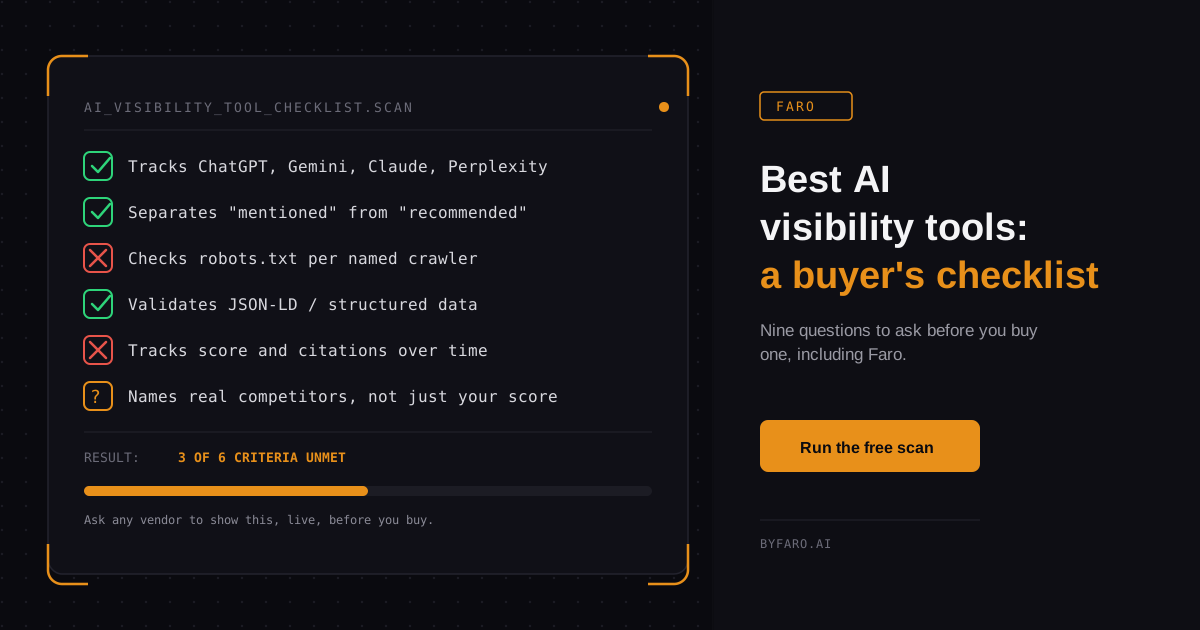
Search "best AI visibility tools" and you get the same problem every buyer's-guide query about a crowded software category runs into: half the results are written by a vendor scoring its own product first, and the other half are generic listicles that never explain what actually separates a serious platform from a one-time scan. Neither tells you what to check for yourself.
This is that checklist. Nine questions to ask about any AI visibility tool before you buy one, including Faro. None of them require taking a vendor's word for it; each one is something you can verify in a demo or a free trial in under ten minutes.
Key takeaways
- A real AI visibility tool checks more than ChatGPT. If a demo only screenshots one engine, ask what it does for Gemini, Claude, and Perplexity.
- Being mentioned and being recommended are different outcomes. A tool that cannot tell them apart is reporting noise.
- Visibility starts with access: a tool that skips robots.txt rules, JavaScript rendering, and soft 404s is scoring a site AI agents may never actually reach.
- Structured data and machine-readable formats (JSON-LD, Open Knowledge Format) are checkable facts, not vague "AI readiness" scoring.
- A one-time score is a snapshot. Ask whether the tool tracks score and citation changes over time, and what it does when a number drops.
- The buyer differs by team: an agency needs white-label and multi-client reporting; a single SaaS company needs depth on its own domain and a way to show the result to a CFO.
What does an AI visibility tool actually check?
A genuine AI visibility tool checks three layers, not one: whether AI crawlers and agents can technically access your pages, whether your content is structured so an AI system can parse it accurately, and whether AI engines are actually citing or recommending your brand in response to real queries. A tool that only does the third layer, the citation tracking, is measuring an outcome without telling you why it is happening or how to change it.
Most of the category markets itself around that third layer because it is the easiest demo: type a brand name, show a dashboard of mentions across ChatGPT and Gemini. It is also the least actionable on its own. If your brand is invisible in AI answers, the fix usually lives in the first two layers: a robots.txt rule accidentally blocking GPTBot, a React app that renders its pricing table client-side so nothing crawls it, or a homepage with no structured organization data for a model to ground an answer in. Ask any tool you are evaluating to show you the technical layer underneath its visibility score, not just the score.
Does it track more than one AI engine?
It should track at least ChatGPT, Google's AI features (AI Overviews and AI Mode), Claude, and Perplexity, since each draws on different sources and ranks brands differently. A tool that only reports on ChatGPT is reporting on one buying channel, not the category.
Google's own AI features documentation confirms that AI Overviews and AI Mode pull from the normal organic index rather than a separate content pipeline, which means a page's regular SEO health already partly determines whether Google's AI features can cite it at all. That is a different mechanism from how ChatGPT's search and Perplexity surface sources, so a tool measuring only one engine cannot tell you whether a visibility gap is a Google indexing problem or an OpenAI-specific crawling problem. Ask for a live look at coverage across engines before you buy, not a roadmap promise that more engines are "coming soon."
Does it separate being mentioned from being recommended?
A tool worth paying for distinguishes a brand that gets named in passing from one an AI system actually recommends as the answer to a buyer's question, because those are different commercial outcomes and conflating them produces a flattering number that means little. "Faro was mentioned in 40% of relevant prompts" and "Faro was the top recommendation in 40% of relevant prompts" are not the same claim, and a dashboard that only reports the first is easy to build and not particularly useful.
Ask for the actual prompt and the actual AI response behind any mention count the tool shows you in a demo. If the vendor cannot produce the underlying query and answer for a given data point, the number is a model output you cannot audit, and you should not be reporting it to your own stakeholders as fact.
Access comes before any citation score
Before any of the above matters, the tool needs to check the access layer: whether your robots.txt rules allow or block named AI crawlers, whether your content renders without JavaScript (most AI fetchers never execute scripts), and whether missing pages return a real 404 instead of a soft 404 that confuses an agent into thinking the page exists. A visibility score built on top of a site AI crawlers cannot actually read is a score built on a false premise.
| Access check | Why it matters | Red flag if missing from a tool |
|---|---|---|
| robots.txt rules per named crawler | One wildcard rule can block GPTBot, OAI-SearchBot, and ClaudeBot at once without the site owner noticing | Tool reports a generic "crawlability" score with no per-crawler breakdown |
| Content rendering without JavaScript | Most AI fetchers read server-sent HTML and do not execute scripts | Tool never mentions rendering or shows a "readiness" score with no rendering check behind it |
| Real 404s on missing pages | A soft 404 (200 status, sign-in wall, or homepage redirect) looks like a real page to an agent | Tool has no status-code check at all |
Faro's own AI visibility scan runs this access layer first, specifically because a citation score without it is not trustworthy.
Does it check structured data and machine-readable formats?
It should verify that your organization, products, and key facts are marked up in a format AI systems can parse directly, typically JSON-LD following the schema.org Organization vocabulary, rather than scoring "AI readiness" as a vague composite. JSON-LD is the encoding most AI systems and search engines expect this data in, and Google's own Organization structured data documentation is explicit that this markup reduces ambiguity about who your business actually is, in search results and, by extension, in anything downstream that draws on the same indexed data.
This is one of the few parts of AI visibility that is purely checkable, not interpretive: either the markup exists and validates, or it does not. A tool evaluation worth running should include generating or auditing this markup directly rather than describing it in a report with no fix attached. Faro's Open Knowledge Format generator builds this layer specifically, because a JSON-LD block on a homepage is necessary but is usually not sufficient on its own for how agents discover a site's full structure.
Does it track your score over time, or just hand you one snapshot?
A one-time scan tells you where you stand today and nothing about direction. A tool worth a recurring budget line needs to show score and citation trends over weeks and months, flag when a number moves, and ideally explain which specific change likely caused the shift. Buying a monitoring category product that only monitors once is a mismatch between the product and the budget line it sits in.
In a demo, ask to see a real account's history going back at least two months, not a mocked-up trend line. Faro's citation monitor exists for exactly this reason: a single audit tells a marketer what to fix once, but AI engines re-index and re-rank constantly, and a brand that passed a check in August can fail the same check in October without anyone touching the site.
Named competitor benchmarking should be standard, not a premium add-on
It should let you see, by name, which competitors AI engines recommend instead of you for the same buyer queries, not just your own isolated score. A visibility number with no competitive context does not tell you whether 40% citation share is winning or losing in your category; it is just a number.
Faro covers this specific buyer question in more depth in is there a platform that tracks who AI recommends instead of you, and the short answer is that this is table stakes for the category now, not a premium feature. If a tool you are evaluating cannot show you a named competitor comparison inside a live account, not a sales deck, treat that as a real gap, not an oversight. Faro's own competitor intelligence tool is built around exactly that comparison.
Connecting visibility to a number you can defend in a budget meeting
The honest answer from most of the category, including Faro, is that AI visibility is still closer to brand tracking than to a last-click revenue metric, and a tool that promises a clean, direct revenue attribution number should be treated with some skepticism rather than taken at face value. What a credible tool can do is connect visibility and citation trends to the leading indicators that do move revenue: branded search volume, demo requests from AI-referred sessions, and win rate in deals where a prospect mentions discovering you through an AI assistant.
Faro's guide on how to prove AI visibility actually drives revenue goes through the specific framework for building that case internally. Ask any vendor you are evaluating to show you exactly which of these leading indicators their tool actually tracks, rather than accepting a slide that implies a direct line from citation share to closed revenue.
Who should actually buy one, and does the pricing match your situation?
The right tool differs by who is buying it. An agency reselling AI visibility audits needs white-label reporting and a way to manage many client domains from one account; a single marketing team at one company needs depth on its own domain, its own competitors, and a way to explain the number to people who do not live in SEO dashboards every day. A SaaS company's buying committee in particular tends to include a CFO who wants a plain translation of "citation share" into something closer to pipeline, which is a different reporting need than an agency managing twenty client scores at once.
If you are evaluating this as a SaaS company specifically, Faro's AI visibility guide for SaaS covers what to prioritize first given how a typical SaaS buying committee evaluates a vendor, which looks different from an ecommerce or local-services buying process. Whatever team you are on, check the vendor's pricing page against your actual use case, not its cheapest advertised tier: a per-domain price that looks reasonable for one site can scale badly for an agency managing dozens. Faro lays out its own tiers plainly on its pricing page, and any tool that will not show pricing without a sales call is worth a second thought.
Frequently asked questions
Is there a free AI visibility tool?
Several vendors, Faro included, offer a free scan or checker as an entry point, usually limited to a single domain and a smaller set of checks than the paid product. Use a free scan to validate the access-layer and structured-data checks covered above before paying for ongoing monitoring.
What's the difference between an AI visibility tool and a regular SEO rank tracker?
A rank tracker measures where a page lands in traditional search results for a keyword. An AI visibility tool measures whether and how an AI system (ChatGPT, Gemini, Claude, Perplexity) cites, mentions, or recommends a brand in its generated answer, which is a different mechanism with different inputs, including crawler access and structured data that a rank tracker does not check at all.
Do I need a dedicated AI visibility tool if I already use an SEO platform?
Most general SEO platforms do not yet check AI-specific crawler access, structured data for machine readability, or citation tracking across AI engines in the depth a dedicated tool does. If AI-referred traffic or citations are material to your business, a dedicated tool fills a real gap rather than duplicating what your SEO platform already covers.
How often should I re-run an AI visibility check?
At minimum monthly, since AI engines re-crawl and re-rank on their own schedules independent of your publishing calendar. A one-time audit is useful for finding and fixing access-layer problems once; ongoing visibility needs ongoing monitoring to catch regressions.
Can an AI visibility tool actually fix problems, or does it only report them?
This varies significantly by vendor. Some tools are diagnostic only and hand you a list of issues to fix yourself or route to a developer; others, including Faro's structured-data and llms.txt tooling, generate the actual fix. Ask specifically what the tool outputs, a report or a deployable file, before assuming either.
Should I be suspicious of a tool that ranks itself first in its own "best AI visibility tools" content?
Treat any unranked, vendor-authored list with reasonable skepticism, including this one. The more useful approach is the one this article is built around: judge any tool, including Faro, against a fixed set of checkable criteria rather than trusting a vendor's own ranking of its competitors.
In short
A serious AI visibility tool checks three layers: crawler access, structured data and machine-readable formatting, and actual citation behavior across multiple AI engines, in that order, because the first two determine whether the third layer's numbers mean anything. It separates mentions from recommendations, tracks change over time instead of handing you one snapshot, names your real competitors, and connects its output to leading indicators you can actually defend in a budget conversation. Which specific tool fits depends on whether you are an agency managing many domains or a single team defending one, and the pricing page should reflect that difference honestly.
Run Faro's free AI visibility scan against your own site and judge it by the same nine questions above. If it does not hold up, that is useful information too.