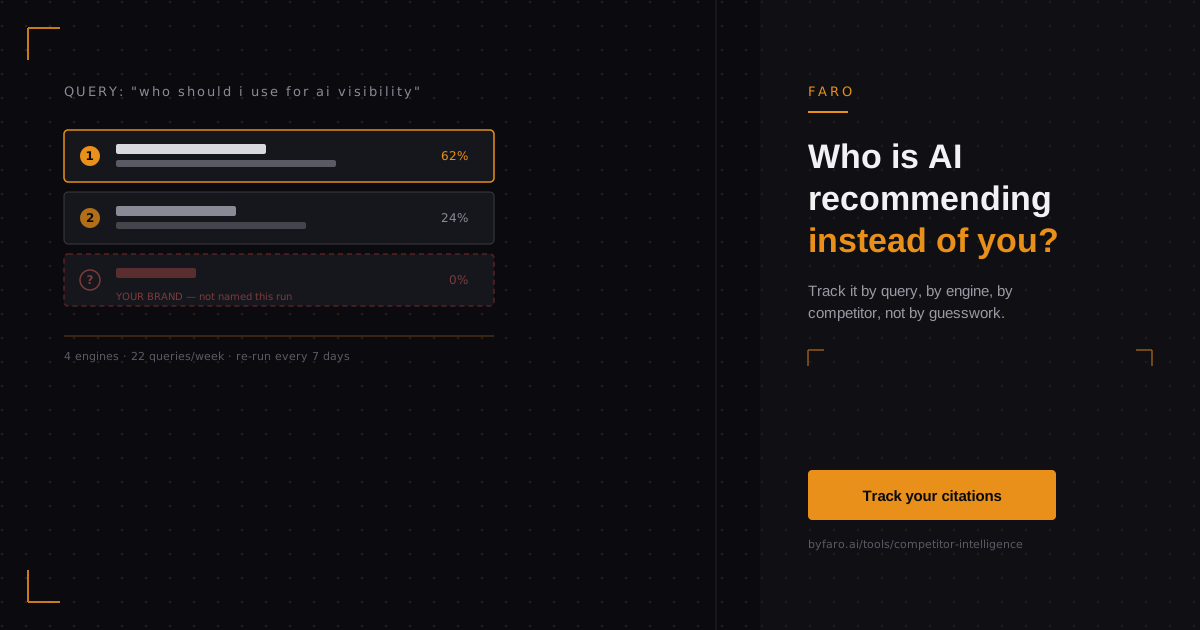
Yes, and the category has a name: AI citation monitoring, sometimes sold as AI competitive intelligence. It exists because a one-time AI readiness scan can only tell you about your own site. It cannot tell you that a prospect asked Gemini to compare vendors in your category this morning and got three competitor names back, with yours nowhere in the answer. ChatGPT, Gemini, Claude, and Perplexity field that exact kind of question dozens of times a day inside most B2B categories, and every answer names somebody. A tracking platform is built to catch who, for which question, and how often, so you are working from evidence instead of a hunch the next time someone on your team asks "are we losing deals to a competitor before the buyer even calls us."
Key takeaways
- AI citation monitoring and AI competitive intelligence are a distinct product category from a one-time AI readiness scan, and platforms in this category do exist.
- A small number of massive platforms, not individual business sites, take most of the citations inside Google's AI Overviews; getting named at all is harder than most marketers assume.
- Google, and separately Perplexity, have each published details on how their systems pull and filter sources; neither rewards AI-specific tricks over ordinary quality and machine-readable structure.
- The metric that matters is not "am I mentioned" but "how often is a specific named competitor mentioned instead of me, on which questions."
- A real tracking setup reports per-query results you can inspect; a vanity scanner reports one composite score and asks you to trust it.
Is there a platform that tracks who AI recommends instead of you?
Yes. AI citation monitoring platforms exist specifically to answer "who is AI naming instead of me," and they work by running a fixed set of real buyer questions against ChatGPT, Gemini, Claude, and Perplexity on a schedule, then logging every brand named in every answer. That is a different job from an AI readiness scan, which audits your own site's crawlability, schema, and content structure in isolation. A readiness scan tells you what to fix on your own property. A citation-tracking platform tells you whether the fix mattered, by showing whether a named competitor started losing ground on the exact questions you were previously absent from. Faro runs this as competitive intelligence tracking paired with an AI citation monitor, and the two categories, readiness and competitive tracking, are meant to be run together rather than treated as substitutes for each other.
Most teams discover the gap the hard way: they run one prompt manually, see a competitor's name, and treat it as proof of a trend. One prompt is an anecdote. A real answer requires the same question asked the same way, repeatedly, across engines that update their answers as models, indexes, and even the time of day change.
Why do so few sites get cited in AI Overviews at all?
Because citations in AI Overviews are heavily concentrated on a handful of massive platforms, not spread evenly across the open web. Ahrefs' running analysis of the most-cited domains in Google AI Overviews, updated as of September 2026, found that just five domains, YouTube, Reddit, Facebook, Google itself, and Instagram, account for roughly 65.9% of all citations tracked. YouTube alone carries a 22.9% mention share and Reddit 18.5%. That means an individual business site is not just competing against its direct rivals for the remaining citation share; it is competing against a handful of platforms that structurally dominate the pool before any brand-specific comparison even starts. This is also happening while raw click volume is shrinking: a separate Ahrefs study of 300,000 keywords found AI Overviews correlated with a 34.5% lower average clickthrough rate for the top-ranking page, compared to similar informational queries with no AI Overview present.
Put those two facts together and the stakes get clearer. There are fewer clicks available overall, and most of the citations that do exist are already claimed by platforms no single business can outrank. Whatever share is left gets split among direct competitors, which is exactly why knowing which competitor is claiming it matters more than it did when organic rankings alone decided who won the click.
How do ChatGPT, Gemini, and Perplexity actually decide who to name?
Each engine pulls and filters sources differently, and the mechanics matter because they explain why the same brand can appear in one person's answer and disappear from another's. Google's own Search Central documentation states plainly that "there are no additional requirements to appear in AI Overviews or AI Mode," and that the system instead uses a query fan-out approach, issuing multiple related searches to assemble "a wider and more diverse set of helpful links" than a single query would return. Perplexity works differently again: per its Agent API documentation, its web search tool accepts a search_domain_filter that can include or exclude up to 20 domains per request, and a max_results parameter of up to 50. That means the exact set of domains under consideration can be narrowed before the model ever ranks anything, which is one reason a prompt phrased "compare vendors in category X" can surface a completely different competitor set than a prompt phrased "who is the best tool for Y."
The practical read for anyone building a tracking process: a single prompt tells you almost nothing reliable, because both the fan-out behavior and domain filtering mean results shift with phrasing, not just with your own site's quality. Faro has covered the mechanics of query fan-out and how each major engine builds citations in more depth in this breakdown of query fan-out and in a platform-by-platform look at how ChatGPT, Claude, and Perplexity cite sources, and Faro's earlier piece on how Gemini decides which businesses to recommend goes further into the signals specific to Google's models. The short version here is narrower on purpose: if the engines vary their source set by phrasing and context, your tracking has to test enough real phrasings to see the pattern, not just the one prompt that happened to surface a competitor.
What should a competitor-tracking setup actually measure?
A useful setup measures four things per query, not one composite score for your whole brand: whether you were named at all, whether a specific competitor was named instead, how the answer described each of you, and whether that pattern holds or shifts over repeated runs. Share of voice, the percentage of tracked queries where your brand appears versus each named competitor, is the single most actionable number, because it is comparative by design; a standalone "visibility score" tells you nothing about whether the ground you're standing on is shrinking relative to a rival actively taking it. Sentiment and accuracy matter too: being named inaccurately, with a wrong price, an outdated feature list, or a claim you no longer support, is arguably worse than not being named, because it is actively steering a prospect on false information.
One factor worth watching as a leading indicator, not a lagging one: how machine-readable your own business information actually is. A page a model can parse cleanly into structured facts, name, category, pricing, service area, is easier for an engine to cite correctly than one where that information is buried in marketing prose. Faro's OKF generator produces that structured, agent-readable version of your business information in the open format several AI systems already look for, and it is worth checking before assuming a citation gap is a content problem rather than a structure problem.
What separates a real AI visibility platform from a vanity scanner?
A real platform reports at the query level and lets you see the actual answer text, the exact competitor named, and the exact date it happened; a vanity scanner reports a single number and asks you to take its methodology on faith. That distinction is the fastest way to evaluate any tool in this category, whatever it's called. Four criteria worth checking before you commit to one: it tracks live, current citations across more than one engine, since a ChatGPT-only or Gemini-only view will systematically miss where a category actually concentrates its research; it re-runs on a real schedule rather than a single snapshot, since a single run cannot distinguish a fluke from a trend; it names the actual competitors that showed up, not just an anonymized "competitor A," because you cannot act on a comparison you can't verify; and it shows its work, meaning the underlying query and answer are visible to you, not compressed into an opaque score with no way to audit how it was calculated.
For a broader side-by-side of how platforms in this category stack up against those four criteria, Faro maintains full platform comparisons rather than making that case in a single blog post.
How do you turn a citation gap into an actual fix?
Once tracking shows a specific competitor being named on a specific query where you are absent, the next step is diagnosing why before changing anything. Pull the actual answer text and check three things in order: whether your site is indexed and crawlable at all for that topic, whether the information an engine would need to answer that exact question exists on your site in a form a model can extract cleanly, and whether the competitor being named has a structural advantage, like clearer schema or a more recently updated page, that yours does not. Most gaps trace back to the second or third cause rather than the first; sites that are indexed and generally fine still lose citations to a competitor whose pricing page, service list, or comparison content simply answers the exact question more directly.
Fix the specific gap the tracking identified, not your whole site at once. A citation lost on "who offers X in Y region" calls for a service-area and pricing fix, not a general content overhaul. Re-run the same query set after the fix to confirm the gap actually closed, since that confirmation step is the entire point of tracking on a schedule instead of running a one-off prompt and moving on.
Frequently asked questions
Is there a free way to check which companies AI recommends in my category?
Yes, manually. Ask ChatGPT, Gemini, Claude, and Perplexity the same buyer-style question, phrased a few different ways, and log which brands each one names. It works as a spot check and costs nothing, but it does not scale past a handful of queries before the weekly logging becomes a job in itself, which is the gap a dedicated monitoring platform is built to close.
Does ChatGPT or Gemini show me who else it considered before naming a competitor?
No. None of the major engines expose a ranked shortlist of brands it weighed and rejected; you only see the names that made it into the final answer. That is exactly why query-level tracking across repeated runs matters more than a single answer: it is the only way to infer the pattern behind who consistently gets named and who consistently doesn't.
How often should I check who AI is recommending instead of me?
Weekly is a reasonable baseline for most brands. Answers shift with model updates and index refreshes, and a weekly cadence run against the same fixed query list is frequent enough to catch a real, sustained shift without mistaking normal answer variability for a trend.
Can I get an AI model to stop recommending a competitor?
No, and attempting to manipulate what a model says about a rival through hidden instructions or manufactured content crosses from legitimate optimization into the kind of poisoning that damages your own credibility if discovered. The durable fix is closing the actual gap, better structured data, more accurate and current content, that earned your competitor the citation in the first place.
Is AI citation tracking the same thing as tracking search rankings?
No. A search ranking is a position on a results page for one query at one moment. An AI citation is whether and how a model named your brand inside a generated answer, which can vary by phrasing, by engine, and by what other sources that engine chose to pull for that specific request. The two are related but require separate tracking methods.
In short
Platforms that track which companies AI recommends instead of you are a real, distinct category from a one-time readiness scan, built around running the same buyer questions repeatedly across ChatGPT, Gemini, Claude, and Perplexity and logging who gets named. Citations are scarcer and more concentrated than most marketers assume, with a handful of massive platforms claiming most of the share in Google's AI Overviews alone. The number worth tracking is share of voice against named competitors on real queries, not a single composite score. A real platform in this category shows you the query and the answer; a vanity scanner asks you to trust a number.
Not sure whether your gaps are structural or a content problem? Start with Faro's OKF generator to see how machine-readable your business information actually is before assuming the fix is a bigger rewrite than it needs to be.
Ready to see who is actually being named instead of you? Run Faro's competitive intelligence tracking and get query-level answers instead of a guess.