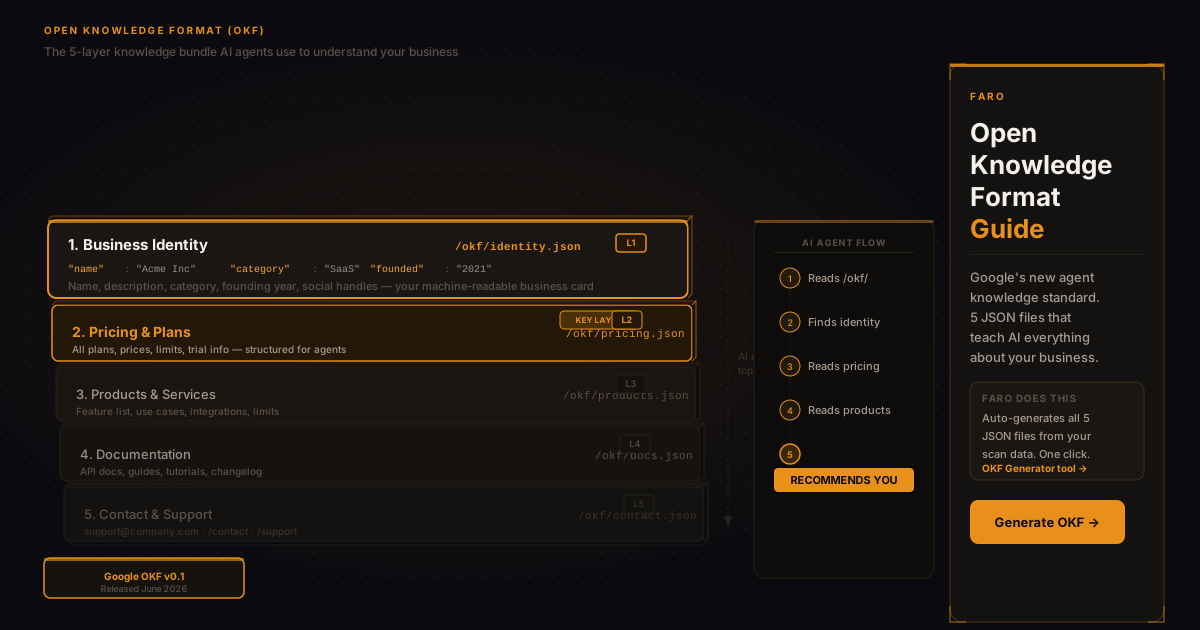
In June 2026, Google published version 0.1 of the Open Knowledge Format (OKF), a specification for how AI agents should represent, store, and exchange structured knowledge about businesses and entities. It's the most significant structural standard to emerge from the AI agent ecosystem since llms.txt, and it directly affects how AI agents understand and navigate your business.
This article explains what OKF is, how it relates to the other AI visibility signals you may already know, and what implementing it requires.
What Is the Open Knowledge Format?
OKF is a five-layer knowledge architecture designed to give AI agents a structured, consistent way to represent what they know about a business, service, or entity. Where JSON-LD schema (Schema.org) tells a search engine or AI what your website contains, OKF goes deeper: it specifies how an AI agent should organize, validate, and use that knowledge as part of a reasoning and action pipeline.
The five layers of OKF are:
- Identity layer: Stable identifiers, canonical name, domain, entity type, and legal entity information. This is the anchor layer that all other layers reference.
- Facts layer: Verified claims about the entity: what it does, when it was founded, where it operates, what it offers. Each fact can be tagged with a confidence level and source.
- Actions layer: What operations an AI agent can perform with or for this entity: API calls, booking flows, contact requests, document retrieval.
- Context layer: Situational information: industry category, target customer profile, competitive positioning, geographic markets.
- Provenance layer: Source tracking for all other layers. Where did each fact come from? How recently was it verified? Who attested it?
This five-layer architecture solves a problem that simpler standards like llms.txt and JSON-LD don't address: how should an AI agent weigh conflicting information from different sources, update its knowledge when information changes, and track the confidence level of what it knows about a business?
How OKF Differs from What You Already Know
vs. JSON-LD / Schema.org
Schema.org structured data is a vocabulary for annotating what your content contains. It tells a search engine or AI that a particular page is about a product with a specific price, or that an organization has a certain name and URL. It's a markup standard for web content.
OKF is an agent knowledge representation standard. It specifies how an AI agent should internally organize what it has learned about your business, not just how your website should be marked up. OKF can ingest Schema.org data as input, but it represents a higher level of abstraction.
vs. llms.txt
llms.txt is a natural language file that communicates your business identity and purpose to AI systems in prose. It's readable by both humans and language models. OKF is a structured data format designed for machine processing, not human reading. They serve complementary roles: llms.txt for accessible, natural language context; OKF for precise, machine-processable knowledge representation. For what the data says about whether AI systems read llms.txt at all, see what the Ahrefs llms.txt study found.
vs. agents.json
agents.json declares what actions an AI agent can take on your website (API endpoints, authentication, rate limits). OKF includes an actions layer that covers similar ground, but within a broader knowledge architecture that also captures identity, facts, context, and provenance. agents.json is an actionability manifest; OKF is a complete knowledge representation format.
What an OKF Bundle Contains
An OKF bundle for a business is typically a set of structured JSON files representing each layer of the knowledge stack. A minimal OKF bundle for a SaaS business looks like this:
// okf/identity.json
{
  "okf_version": "0.1",
  "entity_id": "acme-platform-v1",
  "canonical_name": "Acme Platform",
  "domain": "acme.io",
  "entity_type": "SoftwareProduct",
  "legal_name": "Acme, Inc.",
  "founded": "2021",
  "hq_country": "US",
  "identifiers": {
    "wikidata": "Q12345678",
    "crunchbase": "acme-platform",
    "linkedin": "company/acme-platform"
  }
}

// okf/facts.json
{
  "facts": [
    {
      "claim": "Acme Platform is a project management tool designed for marketing agencies",
      "confidence": 0.95,
      "source": "https://acme.io/about",
      "verified_at": "2026-06-29"
    },
    {
      "claim": "Pricing starts at $49 per month for up to 5 users",
      "confidence": 0.99,
      "source": "https://acme.io/pricing",
      "verified_at": "2026-06-29"
    }
  ]
}

// okf/actions.json
{
  "actions": [
    {
      "name": "get_pricing",
      "description": "Retrieve current plan pricing",
      "endpoint": "/api/v1/pricing",
      "auth_required": false
    },
    {
      "name": "start_trial",
      "description": "Initiate a 14-day free trial",
      "endpoint": "/api/v1/trials",
      "auth_required": false
    }
  ]
}
The bundle is typically served from a known path on your domain: /okf/ or /.well-known/okf/. An OKF index file at /okf/index.json lists the available files and their paths.
Why OKF Matters for Agent-Mediated Commerce
The agent economy creates a new category of buyer: AI systems acting on behalf of human users to evaluate, compare, and purchase products and services. These agents need to do something that human buyers don't: represent their knowledge about each option in a format that can be compared, updated, and acted on programmatically.
OKF is designed for exactly this use case. When an AI procurement agent is evaluating five competing project management tools, it builds an internal OKF-structured representation of each one. The quality of that representation depends on whether each vendor has published a clear OKF bundle, or whether the agent has to infer the structure from unstructured sources.
Vendors who publish OKF bundles give agents a higher-quality, higher-confidence representation of their business. This translates directly into more accurate comparisons, more reliable pricing retrieval, and better action completion rates. Vendors without OKF rely on AI inference, which produces lower-confidence representations and more errors.
Generate your OKF bundle
Faro's OKF Generator creates a complete five-layer OKF bundle for your business based on a scan of your site and the information you provide. It outputs all five JSON files ready to publish.
OKF and the AI Visibility Score
Faro's AI visibility checks include OKF bundle detection as a check in the agent accessibility dimension. The check looks for an OKF index file at the standard paths and validates the bundle structure. Publishing a valid OKF bundle adds points to your score, but more importantly, it positions you for the agent-mediated evaluation layer that is rapidly expanding.
OKF is currently in version 0.1, meaning the specification is early and will evolve. Implementing a basic OKF bundle now is a low-risk signal that gives you first-mover advantage, even if the specific fields evolve as the spec matures.
The Five-Layer Stack in Practice
For businesses implementing OKF for the first time, the practical approach is to build each layer from information you already have:
Identity layer: Pull from your existing JSON-LD Organization schema. Your canonical name, domain, entity type, and external identifiers (Wikidata, LinkedIn, Crunchbase) should already be documented somewhere.
Facts layer: Write three to eight claim-and-source pairs covering what your business does, who you serve, what you cost, and what makes you different. Link each claim to its source URL on your site.
Actions layer: If you have an API, list your top five to ten agent-relevant endpoints. If you don't, include the actions an agent can take on your website: request pricing, start a trial, contact sales, download documentation.
Context layer: Describe your industry category, target customer, and competitive positioning in structured fields. This is similar to what you'd put in llms.txt but structured as key-value pairs rather than prose.
Provenance layer: Add source URLs and verification dates to each fact and action. This is lightweight: a URL and a date for each claim.
Faro's OKF Generator automates this process. It scans your site, reads your existing schema and llms.txt, and generates all five files pre-populated with your information. You review and publish. For a walkthrough of what each generated file contains and how to publish it, see Faro's guide to using the OKF Generator.
How to Publish Your OKF Bundle
Publishing an OKF bundle requires four steps:
- Create the five JSON files (or generate them with Faro's OKF Generator)
- Host them at
/okf/identity.json,/okf/facts.json,/okf/actions.json,/okf/context.json, and/okf/provenance.json - Create an index file at
/okf/index.jsonthat lists all five files - Reference the OKF bundle from your robots.txt with the line:
OKF: https://yourdomain.com/okf/index.json
After publishing, run Faro's AI Visibility Checker to verify the files are correctly served and the bundle structure validates.
OKF in the Broader AI Standards Landscape
OKF is not the only emerging standard in this space. The MCP (Model Context Protocol) from Anthropic addresses how AI models invoke tools and services. Google's A2A (Agent-to-Agent) protocol addresses how AI agents communicate with each other. llms.txt addresses how AI models read natural language context.
OKF complements all of these. It provides the structured knowledge representation layer that MCP tools and A2A agents can query. A complete AI visibility stack for a mature business will likely include all of these standards, but OKF is the newest and least widely adopted, meaning the first-mover advantage is highest right now.
In Short
Open Knowledge Format (OKF) is Google's June 2026 specification for how AI agents should represent structured knowledge about businesses. It covers five layers: identity, facts, actions, context, and provenance. Publishing an OKF bundle gives AI agents a higher-quality, higher-confidence representation of your business, improving comparison accuracy, pricing retrieval, and action completion in agent-mediated commerce. The spec is at version 0.1, meaning early adoption carries significant first-mover advantage. Faro's OKF Generator creates a complete bundle from your site in minutes.
Start with an AI visibility scan to see your current agent accessibility score, then use the OKF Generator to build your bundle.
Frequently Asked Questions
Is OKF an official Google standard or a draft?
OKF v0.1 was published by Google in June 2026 as an open specification. It is an active proposal with broad industry engagement but has not yet been formally standardized by a standards body like the W3C. Version 0.1 status means the core architecture is stable but specific field names and structures may evolve. Implementing it now is low-risk because the five-layer structure is unlikely to change even if field names are adjusted in future versions.
Do I need to implement all five layers?
For AI visibility scoring purposes, having a valid OKF index file and at least the identity and facts layers qualifies. For maximum agent utility, implementing all five layers is recommended. Start with identity and facts (two files) and add layers incrementally.
How is OKF different from Google's Knowledge Graph?
Google's Knowledge Graph is a database of entities and relationships maintained by Google. OKF is a format specification that tells businesses how to publish structured knowledge that AI agents can use. They are complementary: having a Knowledge Graph entry for your business strengthens your OKF identity layer and vice versa, but they are separate systems. You publish OKF on your own domain; you don't publish to the Knowledge Graph.
Will publishing OKF affect my search rankings?
OKF is not a direct Google search ranking signal (as of June 2026). Its primary value is in AI agent discoverability and agent-mediated evaluation, not in traditional search. However, the structured data practices that OKF builds on (JSON-LD schema, clear entity signals) do have indirect SEO benefits through the same mechanisms they always have.
Where can I find the full OKF specification?
The OKF v0.1 specification is available through Google's developer documentation. Faro's OKF Generator implements the specification directly and generates compliant bundles. The AI Signals section in the Faro dashboard also publishes weekly updates on OKF adoption and specification changes.