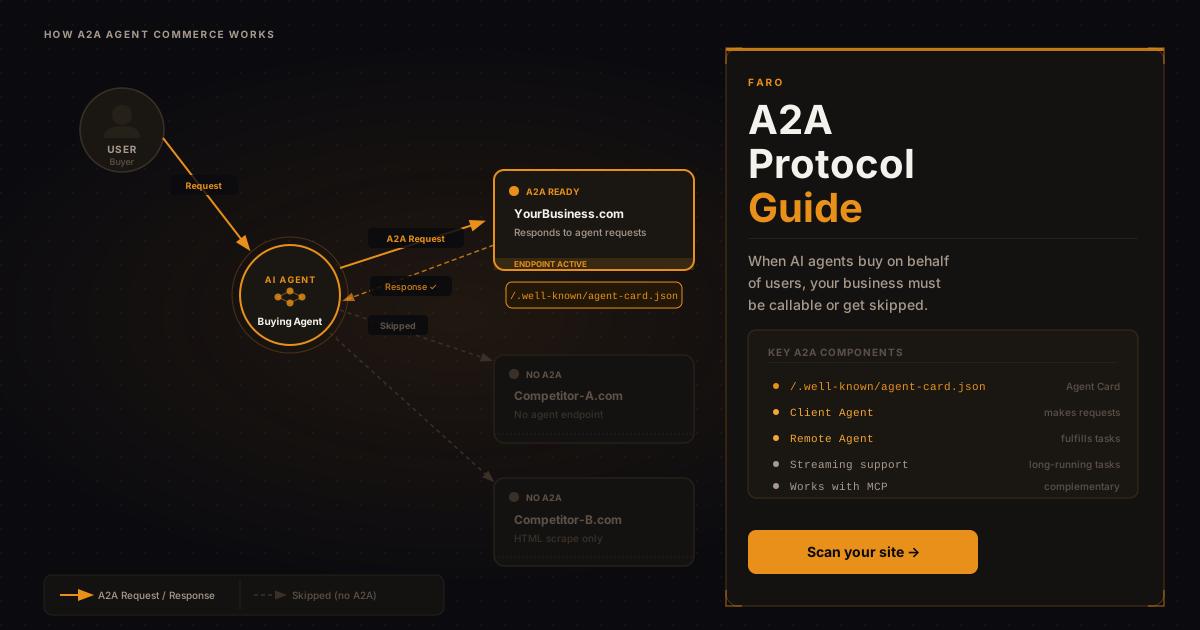
A new category of commercial transaction exists where no human ever clicks a link. An AI agent, acting on behalf of a buyer, researches options, contacts vendor endpoints, retrieves current pricing, checks availability, and selects a provider. The entire workflow completes before the user sees a result. If your business cannot respond to that kind of request, you are not in the selection set.
This is the practical consequence of Google's Agent-to-Agent (A2A) protocol, introduced in April 2025 as an open standard for AI agent communication. A2A defines how one AI agent communicates with, delegates tasks to, and receives structured results from another AI agent or a business endpoint. Understanding it is not optional for businesses that want to remain visible in an economy where AI agents are increasingly acting as the first point of contact between buyers and vendors.
Key takeaways
- Google's A2A protocol, introduced in April 2025, is an open standard for how AI agents communicate with, delegate tasks to and receive structured results from other agents or business endpoints.
- A business that exposes an A2A-compatible endpoint becomes a remote agent that client agents can call on behalf of buyers.
- The Agent Card is the JSON document that tells client agents what your service can do and how to reach it.
- A2A and MCP are complementary: MCP connects one model to tools and data, while A2A lets one agent delegate work to another.
- The first steps are publishing an Agent Card and making your pricing accessible without authentication.
What is the A2A protocol?
The A2A protocol is an open specification published by Google that defines a standard communication layer for AI agents. The official repository describes it as enabling agents to discover each other's capabilities, delegate tasks, stream long-running responses, and return structured results, all without requiring a human to mediate each step.
The protocol draws a clear distinction between two roles. A client agent is the one making requests: it has a goal, knows what it needs, and looks for capable services to fulfill subtasks. A remote agent is the one fulfilling those requests: it receives a task, processes it, and returns a result. Critically, a business that exposes an A2A-compatible endpoint becomes a remote agent in this model. Your pricing endpoint, booking flow, or quote API becomes callable by AI systems acting on behalf of real buyers.
The companies who contributed to the initial A2A specification alongside Google include Salesforce, SAP, and ServiceNow. That list signals where the protocol's early adoption will be concentrated: B2B software, enterprise procurement, and professional services platforms. If your buyers work in those sectors, A2A readiness is not a distant consideration.
How does A2A agent communication work?
A2A agent communication works as a request and response loop between a client agent and a remote agent. The client agent checks each vendor for an A2A-compatible endpoint, sends a structured task request, and receives a structured response with pricing, plan name and features. Vendors without A2A get scraped with lower accuracy or skipped.
The flow from a user request to a completed agent transaction looks like this:
- A user asks their AI assistant to find and compare project management software options under $100 per month for a five-person agency team.
- The AI assistant (client agent) begins evaluating vendors. For each vendor it considers, it checks whether an A2A-compatible endpoint exists.
- For vendors that have an A2A interface, the client agent sends a structured task request: get current pricing for the five-person tier.
- The vendor's remote agent receives the request, processes it, and returns a structured response with the current pricing, plan name, and included features.
- The client agent compiles the results and presents a comparison to the user, who sees a clear recommendation.
- Vendors without A2A either get scraped with lower accuracy or are skipped in favor of those that responded reliably.
Step 6 is the commercial reality businesses need to internalize. The protocol does not just improve the experience for A2A-ready businesses. It creates a structural disadvantage for those that are not. When an AI agent is comparing five vendors and two of them return clean structured data while three require unreliable HTML scraping, the comparison quality is not equal.
In the year to June 2025, the average site's AI traffic grew roughly 10x, according to Ahrefs. The channel is expanding fast, and the businesses that invest in agent-facing infrastructure now will hold structural advantages when that volume scales further.
The Agent Card: Your Business's A2A Identity
The entry point for A2A discovery is the Agent Card. This is a JSON document that typically lives at /.well-known/agent-card.json on your domain. It is the machine-readable declaration that tells any AI agent what your business can do, what tasks it accepts, and how to communicate with it.
A complete Agent Card includes:
- The name and description of the agent or service
- The types of tasks the service accepts (pricing retrieval, booking, quote request, comparison)
- The endpoint URL and supported communication format
- Authentication requirements and supported auth methods
- Whether the service supports streaming responses for long-running tasks
- Supported input and output formats
Without an Agent Card at the standard path, an AI client agent has no structured way to know that your business can respond to agent requests. It may attempt HTML scraping, which produces inconsistent results, or it may simply move to a competitor that has published a card.
The Agent Card is distinct from the agents.json file at your root domain. agents.json is a broader capability manifest for your website. The Agent Card at /.well-known/agent-card.json is specifically for declaring that your service can act as an A2A-compatible remote agent, a callable endpoint in an agent-to-agent workflow. Businesses that haven't published either file yet can start with Faro's OKF Generator, which produces a structured Open Knowledge Format file covering your core business facts in a format agents can parse before they ever reach an Agent Card or agents.json.
Check your agent-facing technical readiness
Faro's AI Visibility Checker checks for an A2A Agent Card, MCP endpoint signals, agents.json and the rest of its 54 checks in under 30 seconds.
A2A vs. Traditional Web Request: A Side-by-Side View
To understand why A2A matters as a separate channel, it helps to compare it directly with how a traditional web request works.
| Dimension | Traditional Web Request | A2A Protocol Request |
|---|---|---|
| Who initiates | Human clicking a link or typing a URL | AI client agent acting on behalf of a user |
| What is fetched | HTML page rendered in a browser | Structured task response from a remote agent endpoint |
| Authentication | Session cookie, login flow, or none | Bearer token, API key, or OAuth as declared in Agent Card |
| Response format | HTML, CSS, JavaScript rendered visually | Structured JSON, optionally streamed for long-running tasks |
| Speed | Dependent on page load, JS rendering | API-speed: milliseconds for simple tasks, streaming for complex |
| Human in the loop | Yes, at every step | No, the agent completes the task autonomously |
| Fallback if unavailable | User sees a broken page or 404 | Agent skips vendor and moves to next A2A-compatible option |
How is A2A different from MCP?
A2A and MCP solve different problems and work together. MCP connects a single AI model to tools and data sources such as databases, APIs and knowledge bases. A2A lets one agent communicate with another agent, delegate subtasks and receive structured results. A business may eventually need both: an MCP server and an A2A-compatible endpoint.
A common point of confusion is how A2A relates to MCP, Anthropic's Model Context Protocol. They are complementary, not competing.
MCP solves the problem of connecting a single AI model to tools and data sources: databases, APIs, file systems, internal knowledge bases. It is the bridge between a model and the context it needs to complete a task. Think of it as the agent's access layer to the resources around it.
A2A solves the problem of agents communicating with other agents: delegating subtasks, receiving structured results, composing multi-agent workflows. Where MCP extends what a single agent can access, A2A enables one agent to recruit another agent to do part of the work.
For a business, the practical implication is that you may eventually need both: an MCP server that connects AI models to your internal data and tools, and an A2A-compatible endpoint that allows external client agents to delegate tasks to your service. Structured data via Schema.org underpins both, giving AI systems the semantic foundation they need to accurately represent what your business is and what it offers. For a sense of how readiness scoring works across these signals in practice, see Faro's comparison of Cloudflare's Agent Readiness Score against Faro's 54-check scan.
You can also check how your site handles AI crawlers generally with Faro's Robots.txt Analyzer, which surfaces whether your crawler policies are aligned with agent accessibility or inadvertently blocking the AI systems you want to reach.
Which businesses should prioritize A2A readiness now?
B2B SaaS companies should prioritize A2A readiness first, followed by professional services firms and e-commerce businesses that sell to procurement buyers. These three categories face the earliest commercial impact because buyers increasingly use AI agents to research and shortlist vendors in them, and agents favor vendors that answer structured pricing requests.
Not every business has equal urgency here. The categories where A2A readiness will have the earliest commercial impact are:
B2B SaaS companies are in the highest-priority tier. Enterprise procurement agents are already evaluating software options on behalf of buyers. When a procurement agent is comparing five CRM platforms and two of them respond to structured pricing requests while three require scraping, the comparison favors the responsive ones. If your SaaS has a pricing page that agents can only access by rendering JavaScript, you are at a structural disadvantage against competitors with clean API endpoints.
Professional services firms in categories like legal, accounting, consulting, and marketing are increasingly evaluated through AI-mediated research. When a buyer asks their AI assistant to find a digital agency with specific capabilities and agency-relevant pricing, the agencies with structured agent interfaces are the ones that come back with accurate, complete profiles. For agencies specifically, Faro's agency AI visibility tools cover the full stack of what this requires.
E-commerce businesses with procurement buyers are a third priority. Businesses that sell to other businesses, not just consumers, should expect procurement agents to interact with their catalog, pricing, and availability endpoints. Buyers who use AI assistants for vendor research will increasingly rely on those agents to complete initial evaluation steps autonomously.
The agent interaction is not replacing the human decision; it is shaping the shortlist the human receives. Businesses outside that shortlist never get considered.
What A2A Readiness Looks Like in Practice
Becoming A2A-ready does not require a complete infrastructure overhaul, but it does require deliberate steps:
Publish an Agent Card at /.well-known/agent-card.json. This is the discovery document that tells client agents your service exists, what it can do, and how to interact with it. Even a minimal Agent Card that declares basic pricing and contact capabilities is better than no card.
Make your pricing accessible without authentication. Pricing retrieval is the most common task client agents attempt. If your pricing endpoint requires a login, agents will either report limited data or skip you. Public, structured pricing data is a foundational A2A readiness requirement.
Add structured schema to your key pages. Schema.org markup on your pricing, product, and contact pages gives AI systems a structured interpretation of your content that supplements your Agent Card. Use Faro's AI Schema tool to check whether your schema is complete and correctly structured for AI agent consumption.
Test your endpoint behavior. An Agent Card that points to an endpoint that returns errors or inconsistent data is worse than no card. Before publishing, verify that your declared endpoints return clean, structured responses at the parameters you have declared.
Monitor for agent traffic. As A2A adoption grows, your server logs will begin to show traffic from AI client agents. Understanding which endpoints they are hitting, what data they are requesting, and where they are failing gives you the feedback loop to improve your agent-facing infrastructure over time.
In Short
Google's A2A protocol, introduced in April 2025, defines how AI agents communicate with and delegate tasks to other agents, including business endpoints. A business that publishes an Agent Card at /.well-known/agent-card.json becomes callable by AI client agents acting on behalf of buyers, removing the human click from the middle of a commercial transaction. Businesses without A2A compatibility are structurally disadvantaged in agent-mediated evaluation: they get skipped or scraped with lower accuracy while A2A-ready competitors receive clean, structured task requests. The priority sectors for early A2A investment are B2B SaaS, professional services, and e-commerce with procurement buyers. The first step is publishing an Agent Card and ensuring your pricing data is accessible without authentication.
Run Faro's full scan to see where your site stands on agent-facing technical readiness, including Agent Card detection, MCP endpoint signals, structured schema, and crawler accessibility. Start at Faro's AI Visibility Checker.
Frequently Asked Questions
Is A2A the same as MCP?
No. The Model Context Protocol (MCP) connects a single AI model to tools, data sources, and internal resources. A2A enables one AI agent to communicate with and delegate tasks to another agent or a business endpoint. MCP is about what a single agent can access; A2A is about how agents coordinate with each other. Most businesses building serious agent infrastructure will eventually implement both, but they solve distinct problems.
Do I need to build a full AI agent to participate in A2A?
No. You do not need to build an AI model or an autonomous agent. You need to expose an A2A-compatible endpoint: a structured API that accepts task requests and returns structured responses, with an Agent Card at /.well-known/agent-card.json that describes what your endpoint can do. Your endpoint is the "remote agent" in the A2A model, and it can be a conventional REST API that follows the A2A response format.
How do I find out if my site currently has an Agent Card?
The quickest check is to navigate to yourdomain.com/.well-known/agent-card.json in a browser. If it returns a valid JSON document, your Agent Card exists. If it returns a 404 or an HTML error page, you do not have one published. Cards set up before version 0.3 of the A2A spec, released in July 2025, used /.well-known/agent.json; current tools look for the new path first. Faro's AI Visibility Checker checks this automatically alongside your other agent accessibility signals.
Is the A2A protocol finalized or still evolving?
As of mid-2026, the A2A protocol is an active open standard with broad industry participation. The A2A GitHub repository contains the current specification, and the core architecture is stable. Like any early-stage open standard, specific field names and behaviors may be refined in future versions, but the foundational model of Agent Cards, client agents, and remote agents is well-established. Publishing a compliant Agent Card now is a low-risk, high-upside investment.