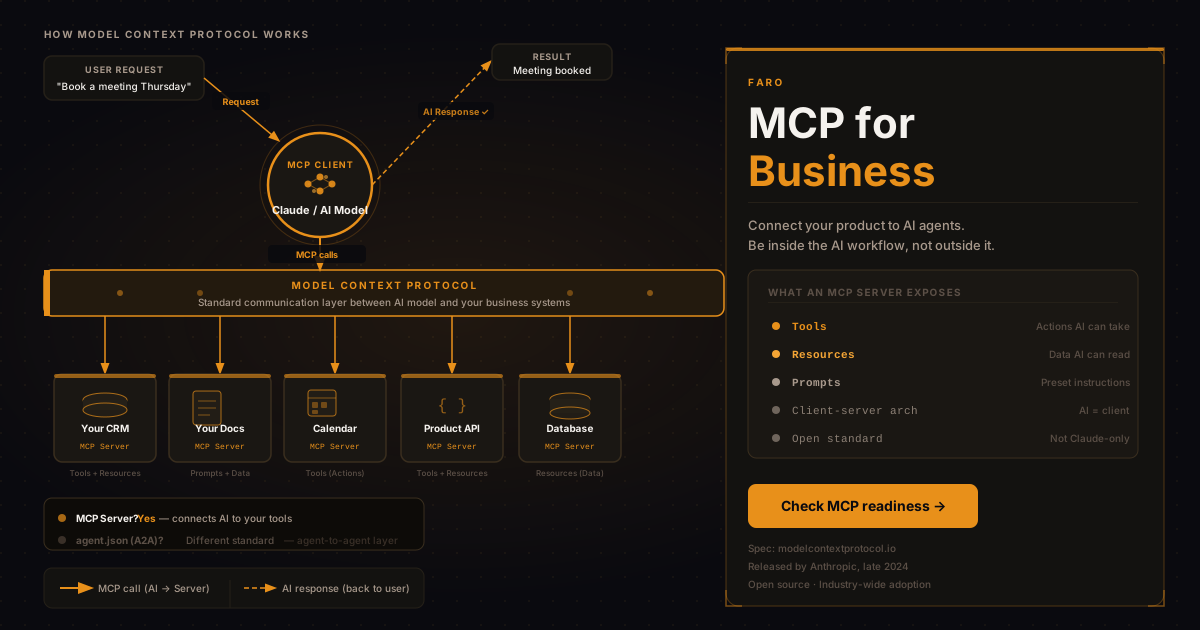
Most explanations of Model Context Protocol lead with code. Server setup, JSON schemas, authentication flows. That framing makes sense if you are building the integration, but it misses the more important question for founders and marketers: what does this mean for how your business gets found, used, and recommended by AI?
The short answer is this: MCP is a distribution decision. Publishing an MCP server puts your product inside the AI's native workflow, where users are already working, rather than requiring them to leave the AI, visit your site, click around, and return. For B2B software companies especially, that shift in where the interaction happens is significant.
AI-driven traffic grew roughly 10x in the past 12 months. Understanding how AI models access and use products is no longer an engineering-team conversation. It belongs in every go-to-market discussion.
What is MCP, in plain terms?
Model Context Protocol (MCP) was released by Anthropic as an open standard in late 2024. It is now open source and supported broadly across the AI industry. The official specification defines a standard way for AI models to connect to external data sources and tools. The specification also changes over time: the July 2026 MCP spec deprecated four features, including Roots, Sampling and Logging.
The simplest non-technical description: MCP is a standard protocol so AI models can use your product as a tool. Just as a browser uses HTTP to talk to web servers, an AI model uses MCP to talk to the systems around it. Your business can publish an MCP server, and AI models that support MCP can then connect to that server and take actions inside your product on behalf of users.
Think of it this way. A user working inside Claude asks: "Book a meeting for Thursday at 2pm with Sarah." Without MCP, Claude can only suggest that the user go open their calendar app and do it manually. With an MCP server for your calendar product, Claude can call your server directly, check availability, and create the booking, all without the user switching context. The user's request resolves inside the AI.
That is the business implication: being inside the AI workflow versus being one more app the user has to visit separately.
MCP Servers vs. Traditional APIs: A Side-by-Side View
MCP uses a client-server architecture. The AI model is the client; your MCP server is the host. This differs from a traditional REST API in ways that matter for discoverability and usage.
| Dimension | Traditional API | MCP Server |
|---|---|---|
| Who uses it | Developers building integrations | AI models (Claude, etc.) acting on behalf of users |
| How it's discovered | Developer finds and reads documentation | AI client discovers server capabilities at connection time |
| What it exposes | Endpoints defined by developer contract | Tools (actions), Resources (data), Prompts (preset instructions) |
| Authentication | API keys, OAuth, custom token schemes | Standard auth methods declared in the MCP server manifest |
| Example use case | Zapier pulls your CRM data on a schedule | Claude queries your CRM in real time during a user conversation |
| Human in the loop | Usually yes, developer configures the integration | AI decides which tools to call based on user's natural language request |
What MCP Exposes: Tools, Resources, and Prompts
An MCP server can expose three types of capabilities to the AI model connecting to it. Understanding these in plain terms helps you think about what your business would actually publish.
Tools are actions the AI can take inside your product. Creating a record, sending a message, placing an order, booking a slot. Tools are the core of what makes MCP useful for business: they turn your product into something an AI can operate on behalf of a user.
Resources are data the AI can read. Your knowledge base, a customer's account history, product catalog data, recent activity. Resources let the AI work with your actual data rather than relying on what it learned during training.
Prompts are preset instruction templates your server provides. These guide the AI toward specific, well-structured interactions with your product. A support-oriented prompt might shape how the AI handles a troubleshooting workflow. A sales prompt might frame how the AI retrieves and presents pricing.
For most businesses thinking about MCP for the first time, Tools and Resources are where the value is. If your product can do something, Tools let the AI do it. If your product holds data users want to work with, Resources make that data accessible in context.
See how your site scores on agent-facing technical readiness
Faro's AI Visibility Checker now checks for MCP endpoint signals as part of the full audit. Run a scan in under 30 seconds to see where your site stands on MCP, structured schema, crawler policies, and 30+ other AI visibility signals.
Which businesses should think about MCP first?
B2B SaaS companies, data providers, productivity tools and service businesses with digital booking should think about MCP first. Each of these 4 categories holds actions or data that users already ask for in natural language, so an MCP server lets an AI model complete the request inside your product instead of sending the user to your site.
MCP is not equally urgent for every business. The categories where it will have the earliest and most direct commercial impact are:
B2B SaaS companies are in the highest-priority tier. If your product is a CRM, a project management tool, a data platform, or any software that users interact with throughout their workday, those users are increasingly working inside AI assistants. Publishing an MCP server means Claude and other MCP-compatible AI models can act directly inside your product on a user's behalf, reducing the friction of context-switching and making your product the one that fits inside the AI workflow rather than sitting outside it.
Data providers have a natural fit with MCP's Resources layer. If your business holds data that other people's workflows depend on, an MCP server lets AI models query that data in real time during a user's conversation. That real-time access is qualitatively different from a one-time export or scheduled sync.
Productivity tools with bookable actions, calendar management, task creation, document generation, or communication features are exactly the category MCP was designed for. If your product performs actions that users ask about in natural language, MCP is a direct path to making those actions available inside the AI environment where that natural language happens.
Service businesses with digital booking are worth noting. Appointment booking, consultation scheduling, and service intake flows can all be exposed as MCP tools. When a user asks Claude to find and book a time with a specific type of service provider, the providers with MCP servers are the ones the AI can actually complete the action for.
Brands that AI recommends first are 389% more likely to be Googled by the user afterward. That dynamic applies here: being the product the AI can actually use is a compounding advantage.
How do AI agents find your MCP server?
Publishing an MCP server is step one. Step two is making sure AI models can find it. This is an evolving space, but the current paths to discoverability follow a familiar pattern.
Faro's own scans point the same way: of the 2,495 sites in the Faro Registry with a result for this check (scanned August 2026 to October 2026), 13% have an MCP server. The registry is the set of sites Faro has scanned, not a random sample of the web. If you publish one now, you are still early.
MCP server directories and registries are emerging as the discovery layer. Claude Desktop, for example, connects to MCP servers that users or administrators configure. Enterprise deployments connect AI models to approved MCP servers as part of a managed setup. The Anthropic documentation at Anthropic's MCP announcement covers how Claude connects to MCP servers.
Beyond directories, your website's own agent-facing signals play a role. Structured schema on your product pages helps AI systems understand what your business does and what kinds of actions it supports. Your robots.txt and crawler policies determine whether AI systems can index your content at all. And your overall technical readiness profile shapes how confidently AI systems can represent your product.
Faro's AI Visibility Checker checks for MCP endpoint signals as part of a full audit that covers structured data, crawler accessibility, and agent-facing technical infrastructure. You can also check your structured schema coverage separately with Faro's AI Schema tool, and verify that your crawler policies are aligned with AI agent access using the Robots.txt Analyzer. For the facts an agent needs before it ever calls a tool, such as pricing, offerings, and company details, Faro's OKF Generator builds a structured Open Knowledge Format file agents can read directly.
What is the difference between MCP and A2A?
MCP connects a single AI model to tools and data, while A2A connects AI agents to other AI agents. MCP, from Anthropic, is the access layer for what an AI model can do and see. A2A, from Google, is the coordination layer for how agents divide work. The 2 protocols work alongside each other rather than competing.
Two major agent protocols are active in 2026: MCP (from Anthropic) and A2A (from Google). They solve different problems and operate at different layers.
MCP connects a single AI model to tools and data. When Claude needs to read your CRM, query your database, or create a calendar event, it uses MCP to reach those systems. MCP is the access layer: what can this AI model do and see from where it sits?
A2A connects AI agents to other AI agents. When one agent needs to delegate a subtask to another agent or a business endpoint, A2A is the communication standard for that agent-to-agent handoff. A2A is the coordination layer: how do agents divide work and share results?
For most businesses, MCP is the nearer-term priority. If you want your product to be usable inside AI assistants, MCP is the path. If you want your service endpoint to be callable by AI agents acting autonomously on behalf of buyers, A2A becomes relevant too. The two protocols work alongside each other rather than competing. For a full treatment of A2A, see our guide to Google's A2A protocol.
In Short
Model Context Protocol (MCP) is Anthropic's open standard for connecting AI models to external tools, data, and actions. An MCP server exposes your business capabilities as Tools (things the AI can do), Resources (data it can read), and Prompts (preset instruction templates). Publishing an MCP server is a distribution decision: it puts your product inside the AI's native workflow rather than requiring users to leave the AI and visit your site separately. The highest-priority categories for early MCP investment are B2B SaaS, data providers, productivity tools, and service businesses with bookable actions. MCP and A2A solve different problems at different layers and are complementary standards, not alternatives.
See how your site scores on agent-facing technical readiness, including MCP endpoint signals, structured schema, crawler policies, and more, at Faro's AI Visibility Checker.
Frequently Asked Questions
Do I need to be technical to publish an MCP server?
Publishing a production MCP server requires engineering work, but the decision to invest in one is a business decision. As a founder or marketer, your job is to understand what MCP makes possible and where it fits your go-to-market strategy. The implementation is a project to hand to your engineering team with clear business framing: this is a new distribution channel, not just an API feature.
Is MCP only for Claude? Will it work with other AI models?
MCP was created by Anthropic but is an open standard. Claude was the first model to support it natively, and other AI systems have begun adopting the protocol. The goal of an open standard is precisely to avoid lock-in: a business that publishes an MCP server can be accessible to any AI client that implements the protocol, not only Claude.
How is MCP different from a plugin or a Zapier integration?
Plugins and workflow tools like Zapier are configured by humans, run on schedules or triggers, and move data between systems according to preset rules. MCP is different because the AI model decides in real time which tools to call based on what the user is asking for in natural language. The AI reads the available tools, understands the user's intent, and calls the right tool with the right parameters, without a human setting up each connection in advance.
How do I check whether my site already has MCP signals?
Faro's AI Visibility Checker checks for MCP endpoint signals as part of a full audit of your site's agent-facing technical infrastructure. You can also check your structured data coverage with the AI Schema tool. For agencies managing multiple client sites, Faro's agency tools let you run and compare AI visibility audits across your entire portfolio.