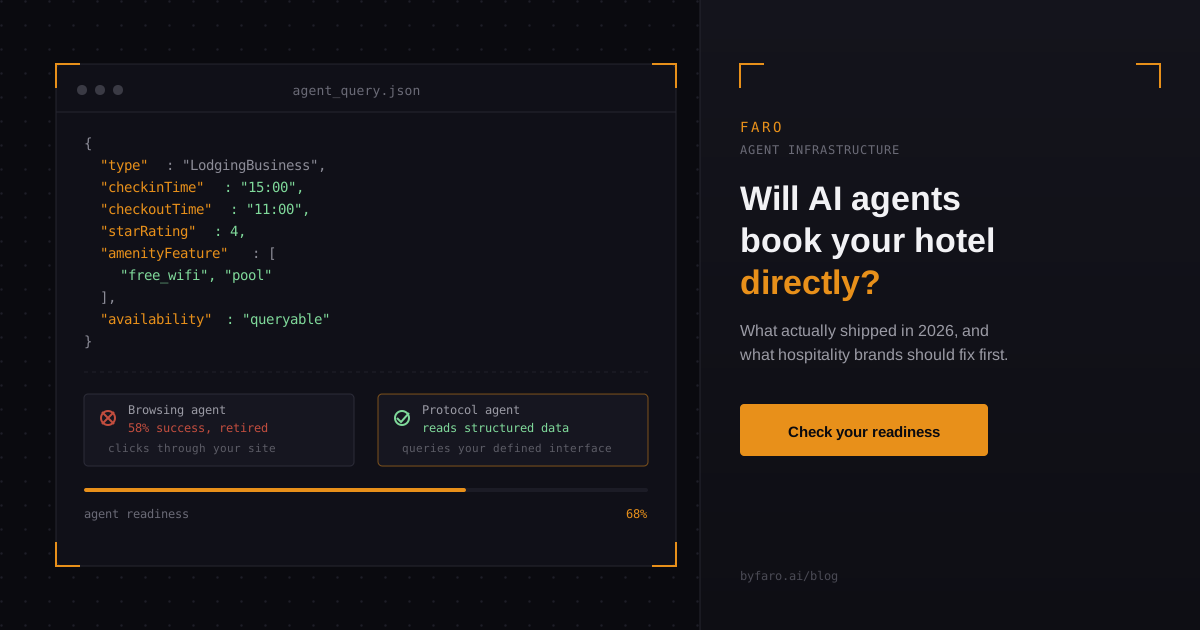
You have probably seen the headlines: AI agents booking your hotel room while you sleep, ChatGPT closing the sale before you have finished your coffee. The reality in September 2026 is narrower and more useful to know. No mainstream AI agent can browse to your booking engine and complete a reservation reliably today. What is real, and moving fast, is the plumbing underneath: structured protocols that let agents read your rates, availability, and policies directly, without guessing their way through a web form.
That distinction matters for every hotel, vacation rental operator, and hospitality brand deciding where to spend the next quarter's web budget. Chasing "AI agent bookings" as a feature you switch on is premature. Making sure an agent can find, parse, and trust your property's data when it does arrive is not premature at all. This is the checklist for getting that part right.
What this article covers
- Can ChatGPT or Gemini book a hotel room right now?
- What actually happened to OpenAI's Operator?
- What is the Agentic Commerce Protocol, and does it cover hotels yet?
- How are agents actually reading availability and rates today?
- What structured data does a lodging listing actually need?
- What should a hospitality brand fix first?
- FAQ
- In short
Key takeaways
- No consumer AI agent completes hotel bookings autonomously and reliably as of September 2026. OpenAI's Operator, the closest attempt, was discontinued on August 31, 2025 after topping out around 58% success on web tasks.
- The Agentic Commerce Protocol from Stripe and OpenAI is live and real, but its current scope is goods checkout through Etsy and Shopify merchants, not hotel reservations.
- The more relevant near-term rail for hospitality is the Model Context Protocol (MCP), which lets an agent query your data and take actions through a defined interface instead of clicking through your site like a person.
- Google already requires specific structured data (VacationRental, LodgingBusiness) with strict fields like check-in time, image counts, and geo-precision before it will surface rich listing details.
- The highest-value move right now is machine-readable readiness: schema, an accessible rates and availability path, and a clear agent-facing entry point, not a rush to "enable AI booking."
Can ChatGPT or Gemini book a hotel room right now?
Not reliably, and not the way the coverage implies. A consumer using ChatGPT or Gemini today can get trip ideas, compare destinations, and in some flows get routed into a partner app to complete a booking, but the agent itself is not filling out your reservation form and confirming a room unattended. The browsing-agent approach that would have made this possible, OpenAI's Operator, was retired in 2025 after its own benchmarks showed it succeeding on barely more than half of web-based tasks. What has replaced that ambition is a push toward structured, protocol-based access: agents that read a defined interface instead of a rendered page. For hospitality brands, the practical question is not "can an agent book my room" but "can an agent find and trust my rates, availability, and policies well enough to recommend or route a booking my way." That second question you can answer today, and it is the one worth acting on.
| Approach | How it works | Current reliability |
|---|---|---|
| Browsing agent (Operator-style) | Agent clicks, types, and navigates a normal web page like a human | Retired by OpenAI; topped out near 58% success on web tasks |
| Checkout protocol (ACP-style) | Merchant exposes a defined checkout endpoint; agent completes payment through a shared token | Live for goods (Etsy, Shopify); not yet extended to hotel reservations |
| Data protocol (MCP-style) | Agent queries a structured interface for availability, rates, and policies | Actively expanding across data sources and tools; the likelier near-term path for lodging |
What actually happened to OpenAI's Operator?
Operator was OpenAI's attempt at a general-purpose browsing agent, announced January 23, 2025 and released to ChatGPT Pro subscribers in the US on February 1 that year. It was built to fill out forms, place online orders, and complete other repetitive browser tasks autonomously, the exact skill set a "book my hotel" agent would need. It did not hold up. According to Operator's own published benchmarks, it hit 38.1% success on OS-level tasks and 58.1% on web-based interactions, with OpenAI itself noting it struggled on intricate interfaces and long workflows. It was discontinued on August 31, 2025, folded into other product efforts rather than scaled up.
The lesson for hospitality is not "agents can't book travel." It is that the browser-emulation approach, an agent guessing its way through your site the way a confused human might, was the wrong bet. The industry's response has been to build defined interfaces instead of asking agents to reverse-engineer a booking widget. That shift is why the rest of this article focuses on protocols and structured data rather than on chatbot polish.
What is the Agentic Commerce Protocol, and does it cover hotels yet?
The Agentic Commerce Protocol (ACP) is a real, live standard, and it is worth understanding even though it does not touch hotel bookings today. Stripe and OpenAI codeveloped it as an open standard so a merchant can plug into one checkout interface instead of building a separate integration for every AI platform. The mechanism is a Shared Payment Token, scoped to a specific merchant and cart total, that lets ChatGPT initiate a payment without ever seeing the buyer's card details. The merchant keeps full control: they can accept or decline the order, calculate tax, and handle fulfillment exactly as they do today. At launch, ACP-powered Instant Checkout covered US-based Etsy sellers and was expanding to Shopify merchants selling physical goods. Reservations, cancellation windows, and multi-night stays are a different transaction shape than a single cart checkout, and nothing in the public protocol documentation extends ACP to lodging yet. Watch this space, but do not build a 2026 roadmap around agent-native hotel checkout arriving through ACP specifically.
How are agents actually reading availability and rates today?
Through structured data and defined interfaces, not through a browser. The Model Context Protocol matters here because it is the connective layer AI applications increasingly use to reach outside systems. MCP's own documentation describes it as an open standard for connecting AI applications to external data sources, tools, and workflows, comparing it to a USB-C port: one standardized connection instead of a custom integration for every AI client. Claude, ChatGPT, and a growing list of developer tools already support it. For a hospitality brand, the practical implication is that "agent readiness" increasingly means having a defined, queryable interface for your inventory, whether that is an MCP endpoint, a clean structured-data feed, or both, rather than hoping an agent can parse your booking widget's JavaScript. This is the same shift agent readiness work has already forced on B2B software and ecommerce sites, applied to a category, travel and hospitality, that runs on especially messy, JavaScript-heavy booking flows.
The pattern to notice: every serious agent-commerce effort this year, ACP included, has moved away from "let the agent click around" and toward "give the agent a defined interface." That is good news for hospitality operators. It means the work is concrete and front-loaded: fix your data layer once, rather than chasing every AI platform's browsing quirks forever.
What structured data does a lodging listing actually need?
More than most hospitality sites currently ship, and Google has already made the requirements explicit for the piece it controls. Schema.org defines LodgingBusiness as a type covering hotels, motels, inns, and their more specific subtypes such as Hotel, Resort, BedAndBreakfast, and VacationRental, with properties including checkinTime, checkoutTime, starRating, numberOfRooms, petsAllowed, and amenityFeature. For vacation rentals specifically, Google's own documentation goes further: to show richer listing details, Google requires the VacationRental schema type with at least 8 images spanning bedroom, bathroom, and common areas, latitude and longitude accurate to 5 decimal places, a stable unique identifier per listing, and a maximum occupancy value. That is a search engine, not an AI agent, setting a bar for machine-readable completeness, and it is a useful preview of what agent-facing systems will expect once they standardize further: precise, structured, unambiguous facts rather than marketing copy an agent has to interpret.
Most independent hotel and vacation rental sites are still built for a human scanning a page, not a system parsing one. Amenities live in a bulleted list with no amenityFeature markup behind them. Check-in and check-out times sit in a paragraph rather than a checkinTime property. Star ratings appear as a row of icons with no starRating value an agent could extract. None of this is expensive to fix. It is largely a markup exercise on top of information you already publish, which is exactly why it belongs at the top of your list before you spend a dollar chasing agent-checkout hype.
What should a hospitality brand fix first?
Start with the things that are true today and stay true regardless of which protocol wins.
- Schema first. Add LodgingBusiness or the more specific Hotel, Resort, or VacationRental type, with checkinTime, checkoutTime, amenityFeature, and starRating populated accurately, not just present.
- Rates and availability an agent can actually reach. If your live pricing only renders after a multi-step JavaScript widget fires, an agent, and a search crawler, may never see it.
- A clean, unblocked crawl path. Confirm your robots.txt is not accidentally blocking the AI crawlers that feed today's answer engines and tomorrow's agent data layer.
- One canonical source of truth per property. Conflicting rates or availability across your direct site, OTAs, and metasearch listings is the fastest way for an agent, or a person, to lose trust in all of them.
- A machine-readable summary of your property. A structured, agent-facing bundle of who you are, what you offer, and how to book gives any future agent protocol something reliable to work from instead of a page it has to guess at.
You can run a hospitality-specific AI readiness review to see which of these your property is missing before you spend on anything more ambitious.
If your team is still deciding where to start, generate an Open Knowledge Format bundle for your property first. It packages the facts above, amenities, policies, rates structure, location, into a single machine-readable file any agent or crawler can read cleanly, which solves the "an agent can't parse my page" problem directly rather than waiting on a protocol that does not cover hotels yet.
Frequently asked questions
Will AI agents replace OTAs for hotel bookings?
Not in the near term, and the industry's own moves suggest otherwise. The Agentic Commerce Protocol was built specifically so an agent-native checkout could route through existing merchant infrastructure rather than bypass it. Expect agents to influence discovery and shortlisting well before they influence transaction completion for anything as multi-variable as a hotel stay.
Do I need a WebMCP endpoint for my hotel today?
Not urgently, but it is worth understanding what WebMCP does before you decide. It is a young protocol for letting agents take structured actions on a website rather than simulate clicks. Read the full explainer on what WebMCP actually is and how it differs from MCP before committing engineering time to it.
Is structured data enough, or do I need an actual API?
Structured data solves the "can an agent understand my property" problem. An API or protocol endpoint solves the "can an agent take an action" problem. Most hospitality brands are missing the first one entirely, so that is where the return on effort is highest right now.
What is the difference between ACP and MCP?
ACP is a checkout protocol: it moves payment for a completed purchase decision. MCP is a data and action protocol: it lets an agent query information and, where enabled, take a broader range of actions. For hospitality today, MCP-style structured access to your inventory data matters more than ACP, since ACP has not been extended to reservations.
How is this different from general agent commerce readiness?
Our broader guide to agent commerce readiness covers the fundamentals across industries. This article applies that same framework specifically to the booking flows, multi-night pricing, and availability calendars that make hospitality a harder case than a single-SKU ecommerce checkout.
In short
No mainstream AI agent reliably books a hotel room today. OpenAI's Operator, the most direct attempt, was retired in August 2025 after middling results. The Agentic Commerce Protocol is real and live but currently scoped to goods, not reservations. What hospitality brands can and should act on now is machine readability: proper LodgingBusiness or VacationRental schema, an accessible rates and availability path, and a clean crawl for AI systems. That work pays off regardless of which agent protocol eventually wins the booking layer, and it is the same foundation Google already requires for its own richer listing features.
Run the AI Schema Creator against your property page to see exactly which LodgingBusiness properties you are missing, in about the time it takes to read this article twice.
Ready to see where your property actually stands with agents today? Check your WebMCP and agent readiness and get a concrete list of what to fix before the booking layer catches up to the data layer.