A prospective client asks ChatGPT which family law attorney to call in Austin. A marketing director at a personal injury firm asks Perplexity why a competitor keeps showing up in AI answers and their own firm never does. Both are running into the same wall: AI search does not treat a law firm's website the way it treats a coffee shop's or a SaaS tool's landing page.
Legal content sits squarely inside a category Google calls "Your Money or Your Life," and the AI systems built on top of search inherit the same caution. If your firm's AI visibility work has stalled at the same schema-and-meta-tags checklist you would run for any local business, that is likely why. This piece covers what actually changes for law firms, what does not, and where to put your effort first.
Key takeaways
- Legal content falls under Google's YMYL category, so AI systems weight trust signals more heavily than they do for most other business types, per Google Search Central.
- Google states plainly that AI Overviews and AI Mode need no special schema markup to appear, per Google's own AI features documentation. Structured data still matters for a different reason: making your credentials machine-readable to agents that do not crawl at Google's scale.
- The Attorney schema type is deprecated in favor of the broader LegalService type, per Schema.org, and a lot of legal marketing advice online has not caught up.
- Google Business Profile explicitly allows credential suffixes like JD and Esq. in a practitioner's name field, per Google Business Profile Help, which affects how consistently your name appears across the sources AI systems cross-reference.
- The fixes that move the needle are mostly editorial: author credentials, case outcome disclosures, and review consistency, not a new file dropped into your site's root directory.
Why AI search treats law firms differently
AI search treats a law firm's content with more scrutiny than most businesses because legal advice can affect someone's finances, freedom, or safety, and Google explicitly designed its ranking systems around that risk.
AI search treats law firms with more scrutiny than most businesses because legal content falls under what Google calls "Your Money or Your Life," or YMYL. Google's own documentation states that its systems "give even more weight to content that aligns with strong E-E-A-T for topics that could significantly impact the health, financial stability, or safety of people, or the welfare or well-being of society," a definition pulled directly from Google Search Central's helpful content guidance. A custody dispute, a personal injury claim, or a business dissolution all fit that description. The same logic carries into how large language models weigh sources when answering a question like "do I need a lawyer for this." A blog post about kitchen renovation trends does not carry the same downside risk if it turns out to be wrong. A page recommending how to handle a DUI charge does. That asymmetry is why your firm's content gets held to a standard a plumbing company's never will.
This is not new, and it is not unique to Faro's read of the market. It has been true since Google first published its Search Quality Rater Guidelines. What is new is that the same trust hierarchy now shapes what ChatGPT, Claude, Perplexity, and Gemini choose to cite when someone asks for a recommendation, because those systems are trained and grounded on a web that already ranks content this way.
What YMYL means for your firm's content
YMYL is not a label attached to your homepage. It applies page by page, to any content that could influence a reader's legal rights, finances, health, or safety, which for a law firm is nearly every practice area page and blog post you publish.
A firm's marketing pages usually split into two buckets: pages that describe the firm (about, attorney bios, contact) and pages that give legal information (practice area explainers, "what to do after X" guides, FAQ content). Both buckets matter, but for different reasons. The descriptive pages establish who is behind the advice, which is the "experience" and "expertise" half of E-E-A-T. The informational pages are where accuracy risk lives, and where a vague or generic explainer written to rank for a keyword, rather than to actually answer the reader's legal question, tends to get passed over by both Google's ranking systems and the retrieval layers behind AI answers. Depth and specificity beat volume here. A page written by a named associate with a bar number, citing the actual statute, will outperform five thin pages that repeat the same generic advice.
Does schema markup actually help you get cited by AI?
Not the way most legal marketing content claims. Google says plainly that its own AI Overviews and AI Mode require no special schema to appear, but that answer is about Google's index specifically, not about the wider field of AI agents now citing your firm.
Google's guidance is direct: "There's also no special schema.org structured data that you need to add" for AI Overviews or AI Mode, according to Google's AI features documentation. If your only goal is showing up in Google's own AI Overviews, structured data will not move that needle on its own. But most AI agents citing law firms today, including standalone chat assistants and browsing agents, do not have Google's crawl and rendering infrastructure behind them. For those systems, clean, current structured data is often the fastest way to hand over your credentials, service areas, and jurisdiction in a form a model can parse without guessing. Faro's OKF generator builds that machine-readable bundle for you, which matters here specifically because credentials and jurisdiction are exactly the kind of structured facts an agent needs to verify before it will cite a legal source with confidence.
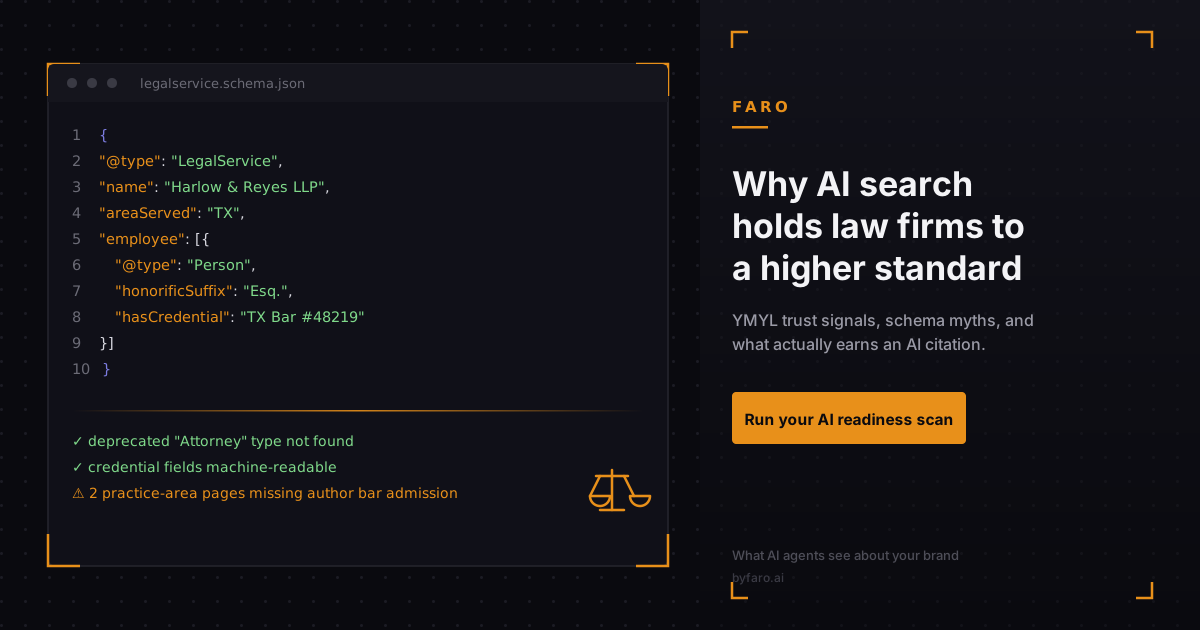
One correction worth making if your site still uses it: the Attorney type in schema.org is deprecated. Schema.org's own documentation now recommends LegalService instead, calling it "more inclusive and less ambiguous," with Attorney and Notary as its subtypes. If an agency built your markup a few years ago, check which type is actually on the page. Want a fast read on what your site is missing before you touch a line of code? Run Faro's AI schema audit first.
The trust signals that matter most for legal sites
For a YMYL site, the signals that matter most are the ones that let a reader, and a model, verify who is behind the advice and whether it held up. That is a narrower list than the usual SEO checklist, and it is worth treating as a priority order rather than a to-do list.
| Trust signal | Why it matters for AI citation | Quick fix |
|---|---|---|
| Author bio with bar admission and jurisdiction | Names a verifiable, licensed source behind the claim | Add full name, bar number, and admitting state to every byline |
| Case results with required disclaimers | Overclaiming reads as untrustworthy, and unqualified results can also raise bar advertising issues | Add the disclaimer language your jurisdiction requires next to any result |
| Consistent name, address, and credentials across directories | Cross-referenced by models checking whether a claim is real | Audit your Google Business Profile and top three legal directories for mismatches |
| Detailed, practice-area-specific reviews | Signals a real client experience rather than a generic testimonial | Ask closing clients to mention the specific matter type, not just a star rating |
| Links to primary legal sources | Demonstrates accuracy and reduces the chance a model treats your page as unverified | Link the actual statute or court page, not just a secondary explainer of it |
Source: signal categories drawn from Google Search Central's E-E-A-T and helpful content guidance.
Does your Google Business Profile affect AI recommendations?
Yes, more than most firms assume, because it is one of the few places your credentials, name, and reviews sit in a single structured record that both search and AI systems can check against everything else said about your firm online.
Google's own policy for Business Profiles confirms that "Business Profiles for practitioners may include title or degree certification (for example Dr., MD, JD, Esq., CFA)" for individual attorneys operating in a public-facing role, according to Google Business Profile Help. That detail matters because it is one more place your name and credentials can either match or contradict what your website says. A mismatch, a different suite number, an old managing partner's name still listed, a firm name that does not quite match your letterhead, is a small thing individually. Stacked across directories, it is exactly the kind of inconsistency that erodes the trust signal a YMYL business depends on. Thin or generic reviews compound the problem: a profile with three vague five-star reviews gives a model far less to work with than a competitor with forty reviews that mention specific practice areas and outcomes.
How this compares to fintech and healthcare
Legal is not the only vertical getting this treatment. Fintech and healthcare sites face the same YMYL scrutiny, for the same underlying reason: the content can affect someone's money, health, or legal standing, and AI systems inherit the caution search engines already apply.
The mechanism is identical across all three; only the specific risk changes. Faro's look at why AI agents are harder on fintech companies covers the same trust hierarchy applied to financial claims and regulatory language. If your firm handles a practice area that overlaps with regulated industries, such as securities litigation or healthcare compliance, both pieces are worth reading together. Faro's AI readiness for legal page breaks down the checklist specifically for firms, rather than the general YMYL framework covered here.
What to fix first
Start with the fixes that establish who is behind your content, not the ones that are easiest to implement. A perfectly formatted schema block on a page with no named author fixes nothing.
- Add a named author with bar admission details to every practice-area page and legal blog post.
- Fix NAP and credential mismatches across your Google Business Profile and top directories.
- Replace deprecated Attorney schema with LegalService, and make sure structured data matches what is actually on the page.
- Add or update required disclaimers next to any case result or outcome claim.
- Ask for reviews that name the specific matter type, not just a rating.
Faro's AI readiness scan checks most of this in one pass and tells you which of these five is doing the most damage on your specific site, rather than making you guess. For structured data specifically, Structured data for AI: the properties that actually matter goes deeper on which fields carry real weight. And once you have made changes, Faro's AI citation monitor tells you whether they actually moved your firm into the answers AI systems give, instead of leaving you to check ChatGPT by hand every week.
It also helps to understand the evaluation logic itself. Faro's piece on how Claude evaluates business websites for recommendations walks through the same kind of source-checking behavior from the model's side, which is useful context once you have the trust signals above in place.
FAQ
Does ChatGPT recommend law firms?
Yes, when a user asks for one, but ChatGPT and similar assistants only cite firms whose sites give them enough verifiable trust and expertise signals to answer with confidence. A generic, unattributed practice-area page is far less likely to get named than one with a credentialed author and consistent credentials elsewhere online.
Do I need LegalService schema for AI search?
Not for Google's own AI Overviews specifically, which Google says need no special schema. It still helps other AI agents parse your credentials and service areas accurately, and if your site uses the older Attorney type, switching to LegalService is a straightforward fix.
Is YMYL still a real category in 2026?
Yes. Google's developer documentation still defines and applies it, and the same risk-weighted logic has carried over into how AI systems evaluate sources for legal, financial, and health topics.
Will client reviews affect whether AI recommends my firm?
Yes. Detailed, practice-area-specific reviews are one of the trust signals both search ranking systems and the AI layers built on top of them reference when deciding which sources to surface.
How is AI search different for a law firm than for a typical local business?
The mechanism is the same search and AI infrastructure, but the bar is higher. A restaurant's AI visibility depends mostly on basic accuracy and reviews. A law firm's depends on demonstrable expertise, named credentials, and consistency across every place your firm is mentioned, because the downside of an AI system citing bad legal information is much higher.
In short
Law firms sit inside Google's YMYL category, and AI search systems inherited that same higher bar for trust. Schema markup alone will not fix this: Google says its own AI features need none, though structured data still helps other agents parse your credentials. What actually moves a firm into AI recommendations is named author expertise, consistent credentials and reviews across every listing, and accurate citations to primary legal sources. Fix those first, then use structured data to make them machine-readable.
Run Faro's AI readiness scan to see exactly which of these trust signals your firm's site is missing, before the next prospective client asks an AI agent instead of asking you.