A prospect asks Claude which project management platform is best for a 50-person agency. Claude names three. Your company is not one of them. The prospect books a demo with a competitor before your sales team gets a single inbound ping. That scenario is not hypothetical; it's playing out thousands of times a day across every B2B category. Understanding how Claude AI business recommendations actually form is now a commercial priority, not a technical curiosity.
AI-referred traffic to websites grew roughly 10x over the past 12 months, and that growth is accelerating. At the same time, Google AI Overviews reduce organic click-through rate by 58% on average, which means the search traffic you relied on is eroding fast. The winners over the next two years are the ones who understand AI citation mechanics now, while most competitors are still arguing about meta descriptions.
What does Claude actually read when it visits your site?
Claude does not read your site the way a human does. It skips your hero image and brand colors. What it reads is structure: the semantic hierarchy of your HTML, the clarity of your headings, the directness of your value proposition, and whether your factual claims hold up against sources it already trusts. A homepage opening with "We help businesses grow" gives Claude nothing to work with. A homepage opening with a specific statement about what you do, who you serve, and what outcome you produce gives Claude something to extract and use.
Beyond your homepage, Claude scans for consistent signals across multiple pages. Product pages, pricing pages, and case studies all contribute to the model's confidence that you're legitimate and category-relevant. Thin pages, duplicate boilerplate, and missing structured data reduce that confidence. Claude is not penalizing you consciously; it's pattern-matching against the sites it has seen that are highly cited and well-regarded.
Why is structured data so critical to Claude's evaluation?
Structured data is the clearest signal you can send to any AI model. Schema markup—particularly Organization, Product, FAQPage, and Review types—gives Claude machine-readable facts rather than marketing prose it has to interpret. A site with proper Organization schema tells Claude your legal name, founding date, industry, and location without ambiguity. A site without it forces Claude to guess, and Claude often defaults to better-structured competitors.
The gap between sites with and without structured data is widening. Models are trained on data that over-represents well-marked-up sources because those sources were easier to parse and index reliably. If you haven't audited your schema recently, Faro's AI Schema Creator generates the exact markup your pages need and flags gaps in what you already have. It takes under five minutes and the output is copy-paste ready. For the facts that sit above any single page, your business description, your offerings, and the audience you serve, the OKF Generator publishes them as one machine-readable file rather than leaving Claude to assemble them from prose.
Which schema types matter most for B2B recommendations?
Not all schema is equally valuable for AI citation. The table below ranks the most impactful types for B2B sites, based on how frequently AI models surface schema-driven data in their recommendation outputs.
| Schema Type | What It Tells Claude | Impact on Recommendations | Difficulty to Implement |
|---|---|---|---|
| Organization | Who you are, what category you belong to, how to verify you | Very High | Low |
| Product / SoftwareApplication | What you sell, key features, pricing range | Very High | Medium |
| FAQPage | Direct answers to buyer questions Claude may be fielding | High | Low |
| Review / AggregateRating | Third-party validation of your claims | High | Medium |
| HowTo | Process clarity that signals expertise | Medium | Medium |
| BreadcrumbList | Site structure and content hierarchy | Low-Medium | Low |
How does Claude decide which sources to trust?
Trust, for Claude, is largely a function of corroboration. If your site claims you're the leading platform for agency project management, Claude looks for evidence elsewhere: review sites, industry publications, forums, third-party content. Corroborating signals carry weight. Silence or contradicting signals gets ignored or downweighted.
This is where user-generated content gets uncomfortable. Researchers demonstrated that a single 13-word Reddit comment can poison what ChatGPT's deep-research agents report back to users. Claude operates on similar retrieval principles. More broadly, Reddit makes up 54 to 71 percent of all UGC URLs retrieved by deep-research agents. What people say about your brand on Reddit, whether positive, negative, or inaccurate, is a live input into Claude's recommendations. Your brand's reputation on that platform is no longer just a PR consideration; it's an AI visibility variable.
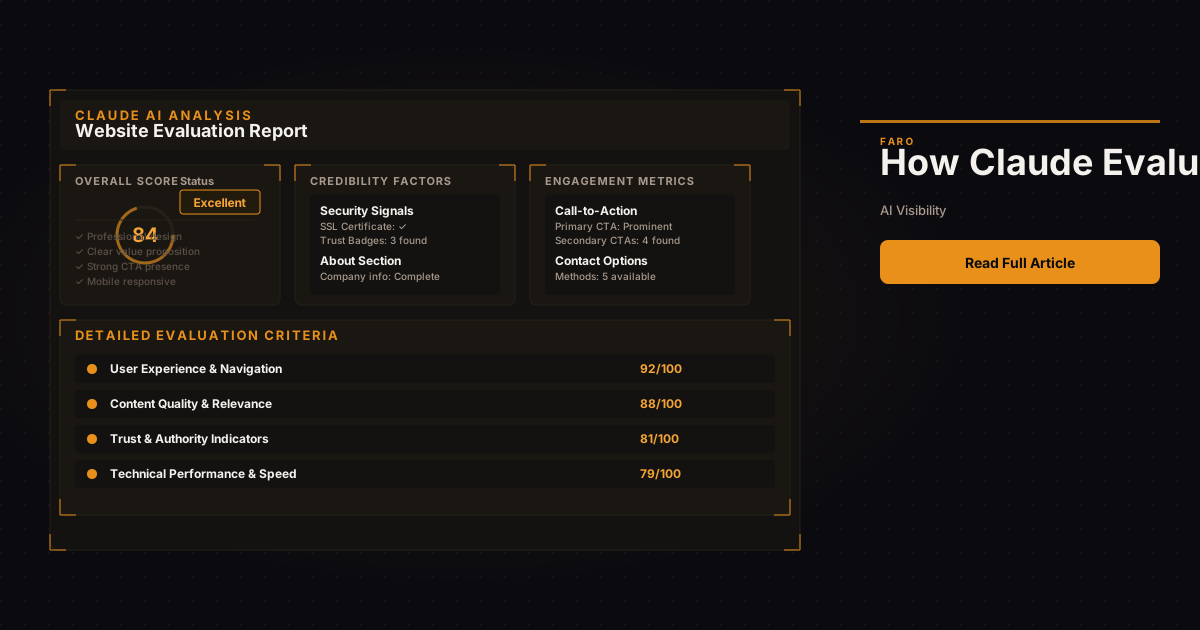
Not sure how your site currently scores across the signals Claude and other AI models check? Run a free AI Readiness Scan to get a scored report across 45 checks in 7 categories, including structured data, content clarity, and third-party signal strength.
What does your pricing page do to Claude's confidence?
Pricing pages are one of the most underestimated signals in AI evaluation. When a prospect asks Claude which tools in a category are transparent about pricing, Claude prefers sites that name their tiers, describe what each includes, and make that information easy to extract. A page that says "contact us for pricing" gives Claude nothing. It may still recommend you if other signals are strong, but you lose ground to a competitor whose pricing page is specific and well-structured.
This is not just about being AI-friendly; it's about being buyer-friendly. The two goals are now aligned. Faro's Pricing Clarity Auditor analyzes your pricing page against the patterns AI models prefer and gives you a scored breakdown of what to fix. Most sites have three or four high-impact changes they can make in a single afternoon.
How does your llms.txt file affect what Claude knows about you?
The llms.txt standard is the fastest-moving development in AI visibility right now. It's a plain-text file at your domain root that tells AI models how to read your site: which pages matter most, which should be ignored, and how your content is organized. Think of it as robots.txt for AI crawlers, but with the ability to include brief summaries of your most important content.
Claude and other frontier models increasingly use llms.txt as a first-pass signal when evaluating a site for credibility and relevance. Sites without one are not penalized outright, but sites with a well-structured llms.txt give the model a confident, curated view of who you are and what you do. Faro's llms.txt Generator builds this file automatically based on your sitemap and content structure, with no manual work required.
What is the cost of doing nothing here?
Be direct about this. If your site is not structured for AI evaluation, you're already losing deals. You're not losing them dramatically, with a clear paper trail; you're losing them quietly, in the moment when a buyer asks an AI assistant for a shortlist and your name does not appear. That buyer never searches for you. They never see your ads. They never land on your homepage. They simply go elsewhere.
The compounding effect matters too. AI models update their training data and retrieval indexes regularly. Sites that establish strong AI visibility signals now get cited repeatedly, which makes them appear more credible to future model evaluations. Sites that wait are playing catch-up against competitors already embedded in the model's preference patterns. The cost of inaction is not a one-time missed opportunity; it's a widening gap that gets harder to close every quarter.
In short
Claude forms business recommendations by reading structured data, extracting factual claims, and corroborating those claims against third-party sources including Reddit and review platforms. Sites with clear schema markup, specific value propositions, transparent pricing, and an llms.txt file consistently outperform sites that rely on traditional SEO alone. AI-referred traffic has grown 10x in the past year, running alongside a 58% drop in organic CTR from AI Overviews. Marketers who audit and fix their AI readiness signals now are building a compounding advantage; those who wait are ceding ground that will become increasingly expensive to recover.
Get your AI readiness score in minutes. Run a free AI Readiness Scan and see exactly where your site stands across the 45 signals Claude and other AI models use when forming recommendations. No setup required.
Frequently Asked Questions
Does Claude crawl my website in real time when someone asks about my business?
It depends on whether the user has web search enabled. In that mode, Claude can retrieve live pages. Without web search, Claude draws on its training data and cached knowledge. Either way, your site's structure, schema markup, and content quality determine what Claude finds and trusts.
Is llms.txt an official standard or is it optional?
It's a widely-adopted convention rather than a formal W3C standard, but adoption among AI systems has grown quickly. Treating it as optional is fine today, but sites that implement it now will have an established signal when models make it a stronger ranking factor. The implementation cost is low and the upside is asymmetric.
How does what people say about my brand on Reddit affect Claude's recommendations?
Significantly. Research shows Reddit accounts for 54 to 71 percent of all UGC URLs that deep-research AI agents retrieve. A single negative or inaccurate comment can shape what Claude reports to users. Monitoring and, where possible, seeding accurate information in relevant Reddit communities is now part of AI visibility strategy, not just community management.
My site ranks well on Google. Does that mean Claude will also recommend me?
Not automatically. Google ranking and AI model citation share some underlying signals, like domain authority and content quality, but they diverge on specifics. Claude weights structured data, factual specificity, and third-party corroboration in ways that don't map directly to traditional SEO ranking factors. A site can rank on page one and still be invisible to Claude if its schema is weak or its content is vague.
How often should I audit my site for AI readiness?
Quarterly at minimum, and after any major site change. AI models update their retrieval and training pipelines regularly, and the signals they weight can shift. A site that scored well six months ago may have gaps today if new schema types have become relevant or if competitor sites have improved their own signals. Faro's AI Readiness Scan is free to run as often as you need.