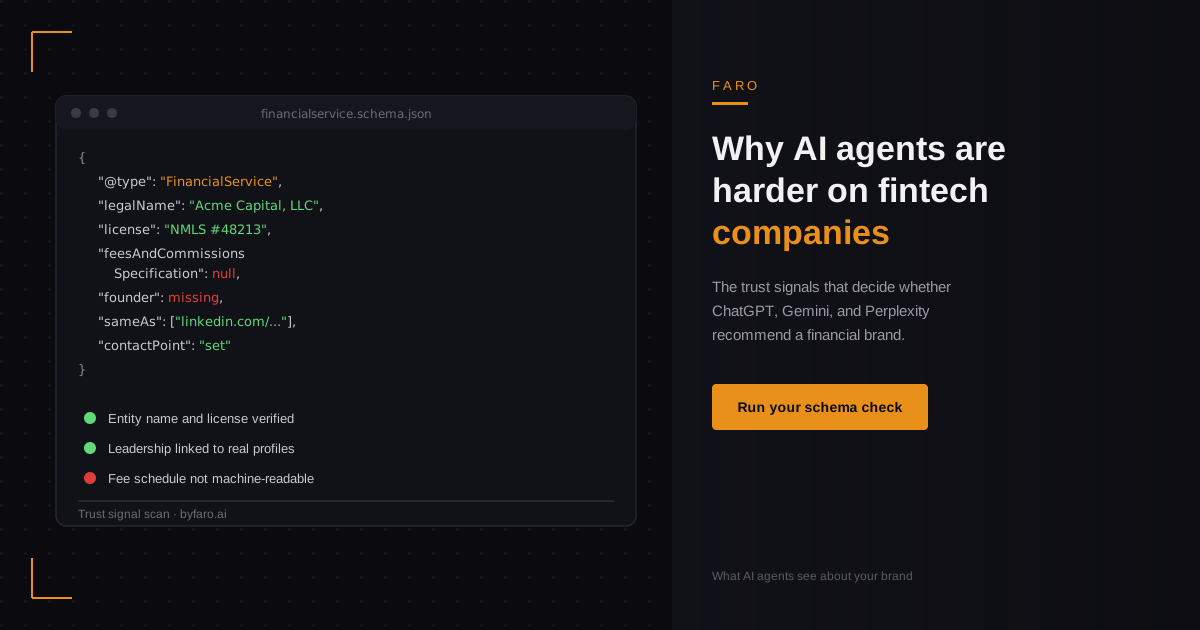
Your fintech company passes every SEO audit you run. Rankings look fine. Then someone asks ChatGPT, Gemini, or Perplexity for a recommendation in your category, and your name does not come up. A competitor with a thinner site does. This is not a fluke, and it is not because AI agents dislike finance companies. It is because AI visibility for fintech companies runs into the same heightened trust bar that Google has applied to financial search results for over a decade, and most fintech marketing sites are not built to clear it.
Money touches people's financial stability, so the systems recommending brands, both traditional search and the AI agents layered on top of it, look for stronger proof before they vouch for you. The fixes are concrete, not mysterious. Most fintech sites are missing the same handful of things, and once you know what they are, you can fix them without touching your product.
Key takeaways
- Financial topics fall under Google's "Your Money or Your Life" (YMYL) standard, and AI agents built on the same web-quality signals inherit that same caution toward financial brands.
- Structured data does not persuade an AI to recommend you. It removes the ambiguity that makes a cautious system hesitate, things like licensing status, fee structure, and who actually runs the company.
- Fintech-specific fraud has made the classification problem worse: suspected digital fraud attempts in financial services rose 39% from 2019 to 2022, so legitimate fintechs now have to overcommunicate legitimacy rather than assume it is obvious.
- Schema.org's FinancialService type has a property built for exactly this:
feesAndCommissionsSpecification, one of the first things worth adding if you have not already. - Fixing this is a content and markup project, not a product rebuild: named leadership, license numbers, fee transparency, and machine-readable company facts move the needle fastest.
Why do AI agents treat financial brands differently?
AI agents apply more scrutiny to financial brands because they are built on the same web-quality signals search engines have refined for years, and those signals already treat financial content as higher stakes. Google calls this category "Your Money or Your Life," or YMYL: topics that could affect a person's financial stability, health, or safety get judged against a stricter trust bar than a recipe blog or a project management tool ever would. Google's own guidance puts it directly: its ranking systems "give even more weight to content that aligns with strong E-E-A-T for topics that could significantly impact the health, financial stability, or safety of people, or the welfare or well-being of society" (Google Search Central). An AI agent answering "what's a good app for automating small business invoicing" is drawing on the same underlying quality signals, so a fintech brand that would need extra proof to rank well in classic search needs that same proof to get named in a chatbot answer. The gap you are seeing is not a glitch in one platform. It is the trust bar showing up one layer further downstream, in a place most fintech marketing teams never think to check.
What specific things does a financial brand need to prove?
A financial brand needs to prove who is legally responsible for the money it touches, what it actually charges, and that a real, licensed entity stands behind the product, because those are the exact facts that separate a legitimate fintech from a lookalike. That means named leadership with real credentials instead of an anonymous "our team" page, visible license numbers or regulatory registration where they apply, a clear fee schedule instead of "contact us for pricing," and a security or data-handling page that says what actually happens to a customer's financial information. Schema.org built a type for financial businesses specifically, FinancialService, which sits under both Organization and LocalBusiness and adds a property most sites never touch: feesAndCommissionsSpecification, meant to describe exactly the terms applied to a financial product or service. None of these facts are secret. They usually exist somewhere on a fintech site already, just buried in a PDF, a support article, or a paragraph three scrolls down a pricing page, which is functionally invisible to a system trying to parse a page quickly.
Does adding schema markup actually change whether AI recommends you?
Structured data does not persuade an AI agent to recommend you the way a testimonial might persuade a person; it works by removing the ambiguity that makes a cautious system hesitate in the first place. When your regulatory status, entity name, and fee terms are only sitting in prose, an agent has to infer them, and inference is exactly where a system erring on the side of caution chooses not to vouch for you at all. When those same facts sit in FinancialService or Organization markup, there is nothing left to infer. This is the same argument Faro has made about which structured data properties actually move AI citations, and it holds even more tightly for finance, where the cost of a wrong inference is higher. It also connects to how models evaluate a business page in general, covered in more depth in how Claude evaluates business websites before recommending them. If your fintech site's machine-readable facts do not exist yet, Faro's OKF generator builds the structured, agent-readable version of your company facts from what is already on your site, and Faro's schema tool handles the FinancialService and Organization markup itself.
Why does fraud risk make this harder for fintech marketing teams?
Fraud risk makes this harder because it raises the cost of a false positive for any system deciding whether to vouch for a financial brand, which pushes both search engines and AI agents toward more caution with the entire category, legitimate players included. Suspected digital fraud attempts in financial services rose 39% from 2019 to 2022, driven in part by the volume of customer data that circulates through fintech ecosystems (Stripe). That volume of fraud attempts means a real, licensed fintech now looks more similar, on the surface, to a scam clone than it did five years ago, and a cautious classification system responds by demanding more proof before it treats either one as trustworthy. Regulatory requirements exist for the same reason: to protect consumer data and reduce fraud, with real consequences for violations. The practical result for your marketing site is that "trust us" copy does less work than it used to, and verifiable, structured facts do more.
What should a fintech marketing team fix first?
Fix the facts that are easiest for a cautious system to check first: named leadership, license status, fee transparency, security disclosures, and a machine-readable version of all of it. The table below orders these roughly by effort versus impact.
| Trust signal | Why it matters to AI trust | Where to add it |
|---|---|---|
| Named leadership with real credentials | Ties expertise and authoritativeness to an accountable person, not just a brand name | About page copy, plus founder/employee and sameAs in Organization schema |
| License numbers and regulatory status | The single fact that most reliably separates a licensed fintech from a lookalike | Footer disclosure, plus legalName and identifiers in FinancialService schema |
| Fee and pricing transparency | Matches feesAndCommissionsSpecification, the exact property a schema parser looks for | Pricing page copy, plus FinancialService schema |
| Security and data-handling disclosures | Financial data handling is explicitly a YMYL concern, not a footnote | A dedicated security or trust page, linked from the main nav |
| Machine-readable company facts | Lets an agent parse who you are and what you charge without guessing | An OKF file or llms.txt alongside your existing schema |
Source: schema.org FinancialService documentation; Google Search Central, "Creating helpful, reliable, people-first content."
If you are choosing where to start, run a free AI readiness scan first. It will tell you which of these five gaps are actually missing on your site rather than having you guess.
How do you know if any of this is working?
You know it is working when your brand starts showing up in AI answers where it previously did not, and the only reliable way to see that is to track citations over time rather than check once and move on. A single audit tells you your current gaps. A recurring check tells you whether closing them actually changed anything, which is the question a fintech marketing team actually needs answered before investing further. Faro's citation monitor tracks whether ChatGPT, Claude, Gemini, and Perplexity mention your brand over time, so you can connect a specific fix, like adding FinancialService schema or publishing license numbers, to a specific change in whether you get cited. For fintech specifically, Faro's fintech AI readiness page breaks down the checks that matter most for regulated financial brands rather than generic AI-readiness advice.
Frequently asked questions
Does Google's YMYL standard apply to ChatGPT and Gemini answers, not just search results?
Not as an official policy from OpenAI or Google's Gemini team, but functionally, yes. AI agents that answer questions about financial products are drawing on the same web-quality signals and training data shaped by years of search engines treating financial content as higher-stakes. A brand that would need extra proof to rank for a YMYL search term tends to need the same proof to get named confidently in an AI answer.
Do I need FinancialService schema if I run a fintech SaaS tool, not a bank?
If you touch payments, lending, insurance, investing, or any product where a mistake costs a customer real money, yes. FinancialService sits under both LocalBusiness and Organization in schema.org's hierarchy, so a fintech SaaS company without a physical branch can still use it, along with more specific subtypes like AccountingService where they apply.
Will blocking AI crawlers protect a fintech brand from being misrepresented?
No. Blocking crawlers just means an AI agent has less accurate information about you to work from, not that it stops answering questions about your category. A cautious agent working from thin or outdated information is more likely to under-recommend you or repeat stale facts, not less.
What's the fastest fix for fintech AI visibility?
Publish your fee structure and license status in plain text somewhere a crawler can read it, then add FinancialService and Organization schema markup around those same facts. Those two moves close the biggest gap on most fintech sites within a day.
Can a small or early-stage fintech compete with big banks for AI recommendations?
Yes, on specificity. A large bank's site is often broad and generic; a focused fintech with clear, well-marked-up facts about exactly what it does and who regulates it can out-clarify a much bigger, vaguer competitor for a narrow query.
In short
Fintech brands face a higher trust bar with AI agents because financial topics inherit Google's YMYL standard, and AI systems built on the same web signals inherit that same caution. The fix is not a product change; it is making facts you likely already have, like licensing status, fee structure, and named leadership, both visible and machine-readable through FinancialService and Organization schema. Rising fraud across financial services has made cautious systems even less willing to guess, which means specificity now beats generic trust copy. Track citations over time rather than checking once, so you know whether a fix actually changed anything.
Ready to see exactly which of these gaps your site has? Run Faro's schema tool and get FinancialService and Organization markup mapped to your actual pricing and licensing pages, not a generic template.