A couple is preparing to make an offer in a competitive suburban market. Before they call anyone, one of them asks ChatGPT to compare the top-rated agents in their zip code. The model does not read the local newspaper or drive by the yard signs. It reads whatever text sits on agent websites, brokerage pages, and syndicated listing feeds, and it recommends whoever that text makes look most credible and current.
Real estate carries one of the highest average transaction values of any local business category, and buyers already research it more than almost anything else before committing. That combination makes it a natural target for AI-assisted shortlisting, and a poor fit for the generic local-business SEO advice most agents still follow. This piece covers what AI systems actually check before naming an agent or a listing, why the copy they read is often not the one on your own site, and where to put your effort first.
Key takeaways
- RealEstateListing, the schema.org type built for property listings, sits in what Schema.org calls the "new" usage tier, with an estimated 10,000 to 100,000 domains using it as of Google's July 2026 web index aggregation, per Schema.org. Most agent and brokerage sites have not adopted it yet.
- Local business structured data can trigger a Google knowledge panel or place a business inside a search carousel, per Google Search Central, but only if the underlying facts, such as hours, service area, and reviews, are accurate and current.
- Most of the listing data an AI system finds is not hosted on the listing agent's own site. It moves through the multiple listing service and gets redistributed to consumer sites through Internet Data Exchange feeds, per Wikipedia's entry on multiple listing services, so a model can be reading a stale or third-party copy of your listing without you knowing it.
- RealEstateAgent inherits properties from both Organization and Place through LocalBusiness, per Schema.org, so an agent's structured data has to double as a business record and a location record at once.
- Cloudflare's AI Crawl Control tooling now breaks down crawler traffic by named operator, including OpenAI, Anthropic, Google, Microsoft, ByteDance, and Meta, per Cloudflare's developer documentation, so you no longer have to guess which bots are reading your listings.
Why is AI visibility a harder problem for real estate than most local businesses?
Real estate is harder because the purchase is too large and too infrequent for anyone to decide from a single AI answer, so buyers spend far longer verifying an agent than they would a restaurant or a retailer. A buyer might spend months comparing agents, neighborhoods, and financing options, and increasingly some of that research happens inside a chat interface instead of a traditional search results page. That changes what visibility actually means for the category. A restaurant only needs to look appealing enough to get chosen once, for a single meal. A real estate agent has to survive a buyer or seller cross-checking claims across several sessions, several AI tools, and several third-party listing sites, any one of which can contradict what the agent's own website says. High-consideration categories such as real estate, legal, and financial services get this scrutiny because the cost of a bad recommendation is high enough that AI systems weigh trust and consistency more heavily before naming a source.
That is also why generic local-business SEO advice underperforms here. A used bookstore can get away with a thin Google Business Profile and a handful of reviews. A real estate agent competing for the same AI-generated shortlist as three other agents in the same zip code needs every public record of who they are to agree with every other record, because that agreement is exactly what a model is checking for before it commits to a name.
What does AI actually check before naming a real estate agent?
AI systems check the same three things for a real estate agent that they check for any local business: who you are, what you do, and whether other sources agree with what you say about yourself. For an agent, that means your name, brokerage, license number, and service area need to match across your own site, your brokerage's site, your Google Business Profile, and any portal profile on Zillow, Redfin, or realtor.com. A model deciding whether to name you is effectively running a background check across all of those sources at once, and it is looking for verifiable credentials and consistency more than polished copy. An agent bio with a specific license number, named service areas, and recent, detailed reviews gives a model something concrete to cite. A generic "trusted local expert" bio with no license number or verifiable specifics gives it nothing to check, which makes it a weak candidate for a citation even when the writing reads well.
This evaluation logic is not unique to real estate. Faro's look at how Claude evaluates business websites for recommendations and the companion piece on how Gemini decides which businesses to recommend both cover the same source-checking behavior from the model's side. Real estate simply raises the stakes: the specifics an agent needs to get right, such as license status, brokerage affiliation, and current listings, change more often than most business details, so the consistency check has to happen continuously, not once.
Why the listing AI reads might not be the one you control
The listing an AI system reads is frequently not the one on the agent's own site. It is often a copy pulled from the multiple listing service and redistributed to consumer platforms through an Internet Data Exchange feed, and that copy can lag behind, misattribute the listing agent, or simply disagree with what is posted elsewhere. A multiple listing service, in Wikipedia's description, is an organization real estate brokers use to share property information and coordinate compensation for cooperating on a sale, and the National Association of Realtors permits brokers to display a limited version of that shared data on their own sites through IDX, per Wikipedia. From there, some of that data gets syndicated even further, onto large consumer portals with their own crawl priority and their own editorial judgment about what to show. By the time an AI agent reads a version of your listing, it may be three platforms removed from the version you actually wrote, with your name spelled differently or the status still marked active weeks after it went under contract.
This is the real estate-specific version of a problem every local business faces to some degree: the record an AI system trusts is not always the one you control directly. The fix is not to fight syndication, which exists for good reasons, but to make sure the version you do control, your own site, your Google Business Profile, and your brokerage page, is unambiguous enough to win any disagreement a model has to resolve.
Does structured data actually help you get recommended?
Structured data helps, but adoption in this category is still low enough that doing it properly is a real differentiator rather than table stakes. Schema.org's RealEstateListing type, built specifically for property listings, sits in what Schema.org itself calls the "new" usage tier, with an estimated 10,000 to 100,000 domains using it as of Google's July 2026 web index aggregation. That is a small fraction of active listing sites. Google's own structured data documentation confirms that local business markup can surface a knowledge panel or place a business inside a search carousel, and that the same markup lets you communicate hours, service areas, and reviews in a form search systems can parse directly instead of inferring from prose, per Google Search Central. For an agent, the practical value is narrower and more specific than ranking: it hands an AI agent your license number, brokerage affiliation, and service area as discrete fields instead of a sentence a model has to interpret.
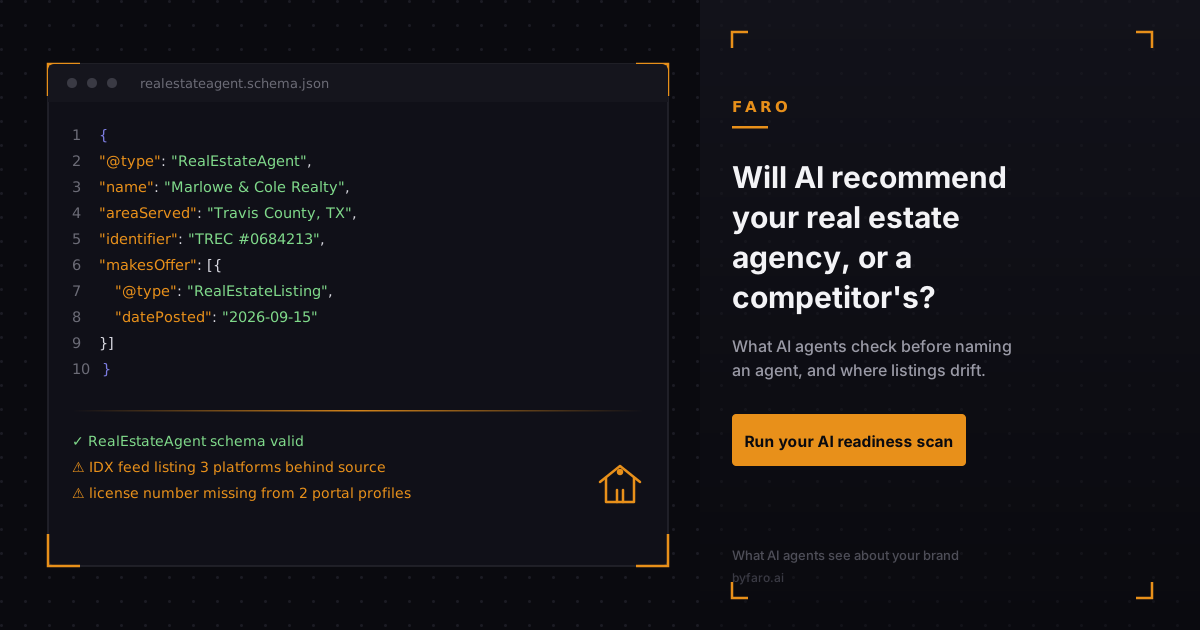
RealEstateAgent, the companion type for the agent or brokerage itself, inherits from both Organization and Place through LocalBusiness, per Schema.org, which means it has to double as a business record and a location record in the same markup. Getting both halves right by hand is tedious. Faro's AI schema tool generates the combined markup from your existing site content, and the OKF generator bundles your credentials, service area, and listing data into the machine-readable format that agents without Google's crawl infrastructure rely on to verify a source before citing it.
How does this compare to other high-trust local businesses?
Real estate sits closer to legal and financial services than it does to most other local business categories, because all three involve high-dollar decisions made infrequently, with real consequences for getting the choice wrong. AI systems apply more scrutiny to sources in these categories for the same reason search engines have long treated them as sensitive: a bad recommendation costs more than a mediocre restaurant meal. Faro's piece on why AI search holds law firms to a higher standard covers the same underlying trust mechanism applied to legal content, and the comparison is useful here because the fixes rhyme: named credentials, consistent records across every place you are mentioned, and specific detail over generic claims. What changes for real estate is the added syndication layer described above, which legal and financial services generally do not deal with in the same way.
Faro's AI readiness for real estate page breaks the checklist down specifically for agents and brokerages, rather than the general high-trust framework covered here.
What should real estate agents fix first?
Start with consistency across the records you do not fully control before spending time on anything else, because a perfectly optimized website does not help if your Google Business Profile lists a different brokerage or your Zillow profile shows an old license number.
- Confirm your name, brokerage, license number, and service area match exactly across your site, your brokerage's site, Google Business Profile, and every portal profile you appear on.
- Add RealEstateAgent and RealEstateListing structured data with current, specific fields, not placeholder values.
- Check your MLS and IDX feed for stale listings, incorrect agent attribution, or outdated status, since that is often the copy an AI system actually reads.
- Replace generic bio language with specific, verifiable detail: named neighborhoods, transaction counts, and credentials a model can check rather than take on faith.
- Ask closed clients for reviews that mention the specific neighborhood or property type, not just a star rating.
Faro's AI readiness scan checks most of this in one pass and tells you which of these five is doing the most damage on your specific site, rather than making you guess.
FAQ
Can ChatGPT or Gemini actually recommend a real estate agent?
Yes, when someone asks for one directly, but both tend to name agents whose public records, meaning their own site, brokerage page, Google Business Profile, and portal listings, agree with each other and include verifiable specifics like a license number and service area.
Does my listing need to be on my own website for AI to find it?
Not exclusively, and often it is not the copy an AI system reads at all. Listings move through the MLS and get redistributed through IDX feeds to other consumer sites, so the version a model sees may be several platforms removed from your own.
Do I need RealEstateAgent or RealEstateListing schema for AI search?
It is not required to appear in search, but adoption is still low across the category, which makes clean structured data a real differentiator. It also hands agents without large-scale crawl infrastructure your credentials and service area in a form they can parse directly.
Will my Zillow or Redfin profile affect what AI says about me?
Yes. Any portal profile that lists your name, brokerage, or license number is one more record an AI system can cross-check, and a mismatch between that profile and your own site is exactly the kind of inconsistency that weakens a citation.
How is AI visibility different for real estate than for a typical local business?
The underlying mechanism is the same, but the bar is higher and the syndication layer is more complex. A retail store mostly needs accuracy and reviews. A real estate agent needs the same things plus consistency across a wider web of third-party listing platforms that redistribute their data without direct control.
In short
Real estate is a high-consideration category, so AI systems apply the same trust scrutiny to agents that they apply to legal and financial services. Structured data helps, but adoption is still low enough that it is a genuine differentiator, not table stakes. The bigger issue for most agents is that the listing and profile data an AI system actually reads is often syndicated through the MLS and various portals, several steps removed from the copy on the agent's own site. Fix consistency across every public record first, then use structured data to make your credentials and service area unambiguous.
Run Faro's AI readiness scan to see which of these gaps is costing you the most before the next buyer asks an AI agent instead of asking you.