Agentic commerce optimization is the work of making your products easy for AI shopping agents to find, understand, trust, recommend and buy: complete product data, prices and stock in machine-readable form, answers to the questions shoppers actually ask, third-party proof, and a checkout an agent can complete. It is SEO for a buyer that reads your catalogue instead of your homepage design.
Most stores are further behind than they think. Our page on AI visibility for ecommerce shows where online stores usually fall short, and this guide gives you the order of work, the standards that matter in 2026, a 30-day plan and a checklist you can copy.
Key takeaways
- AI shopping agents in ChatGPT, Gemini and Google's AI Mode compare products on structured facts: price, stock, specs, reviews and policies. Missing data means you are skipped, not ranked lower.
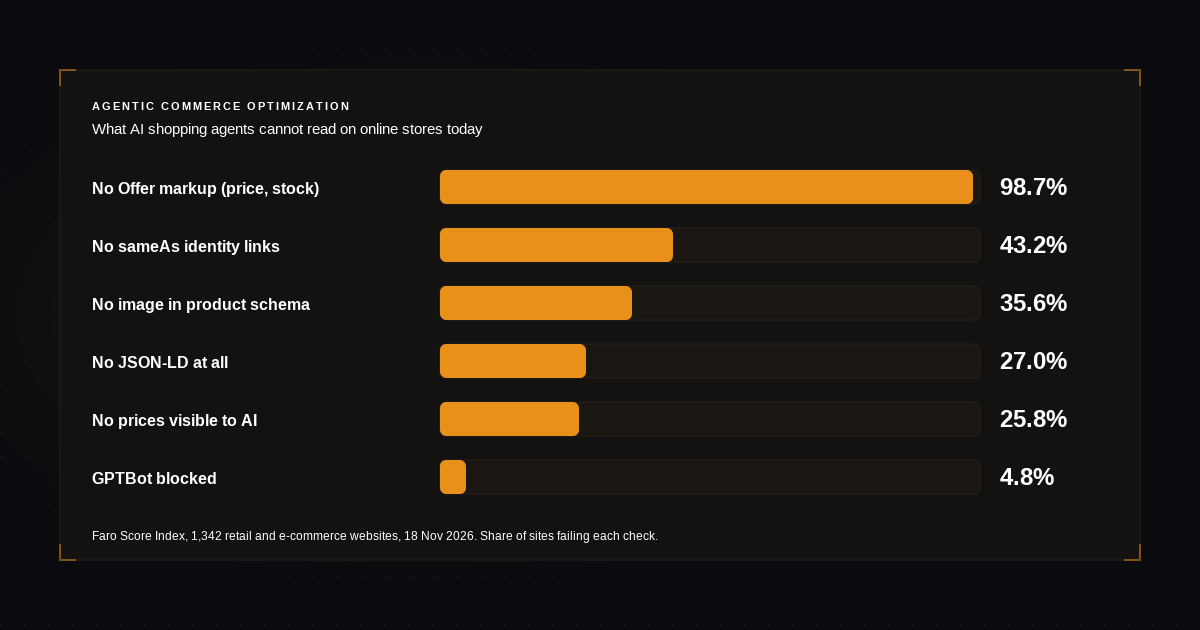
- In the Faro Score Index (1,342 retail and e-commerce sites, 18 Nov 2026), 98.7% have no homepage Offer markup with price and availability, and 43.2% have no sameAs links that confirm who they are.
- The two buying rails to know are OpenAI's product feed and checkout specs, and Google's Universal Commerce Protocol (UCP), which runs on your Merchant Center feed.
- Do the work in order: let agents in, describe products completely, prove it with third parties, then make checkout possible.
- Measure with a fixed list of shopping prompts, checked weekly, not with page rankings.
What is agentic commerce optimization?
Agentic commerce optimization (ACO) is the practice of preparing a store so AI agents can discover its products, judge them against a shopper's request, recommend them and complete the purchase. It covers product data, structured markup, content that answers buying questions, off-site reputation and agent-ready checkout. The goal is to be the product an agent picks.
The shift is in who does the comparing. A shopper asks, "Which running shoes are best for long runs, under 150, wide fit?" and the agent does the browsing: it reads product pages and feeds, checks reviews and other sources, filters on price and size, and returns two or three picks. Stripe's agentic commerce documentation describes the end state plainly: buyers can browse products, get recommendations and complete purchases without leaving the conversation.
So the store that wins is not always the one with the best photos or the most ad spend. It is the one whose facts the agent can read, confirm and act on. If you want the wider picture first, our explainer on the agentic web covers how agents are changing websites in general.
How is ACO different from SEO and GEO?
SEO gets your pages ranked in a list of links for a person to click. GEO gets your brand named in an AI answer. ACO goes one step further for stores: it gets a specific product chosen, with the right price and variant, and then bought by an agent. Each layer builds on the one before it.
| SEO | GEO | ACO | |
|---|---|---|---|
| Who reads your site | Search crawlers, then people | AI crawlers and answer engines | Shopping agents acting for a buyer |
| What you win | A ranking and a click | A mention or citation | A product pick and an order |
| Main inputs | Pages, links, keywords | Clear answers, entity signals, citations | Product data, feeds, offers, reviews, checkout |
| Unit of work | A page | A brand and its answers | A product and each variant |
| Typical failure | Not ranking | Not mentioned | Wrong price or stock, so the agent skips you |
If you have not worked on the middle layer yet, a GEO audit is a sensible first step, because the crawler access and entity fixes it finds are prerequisites for ACO.
How ready are online stores for AI shopping agents?
Most online stores are open to AI crawlers but hard for agents to read. In the Faro Score Index of 1,342 retail and e-commerce sites, checked on 18 November 2026, only 4.8% block GPTBot, yet 98.7% have no homepage Offer markup with price and availability, and 25.8% show no prices an AI can read.
| Check (Faro Score Index, 1,342 retail and e-commerce sites, 18 Nov 2026) | Sites failing |
|---|---|
| No Offer markup with price and availability on the homepage | 98.7% |
| No sameAs links confirming the business identity | 43.2% |
| No image in Product or Organization schema | 35.6% |
| No JSON-LD structured data at all | 27.0% |
| No prices visible to AI | 25.8% |
| No Organization or Product schema type | 25.0% |
| Main content needs JavaScript to appear | 8.0% |
| GPTBot blocked in robots.txt | 4.8% |
| No MCP server for agents to call | 89.9% |
The pattern is the opposite of what many store owners fear. Blocking is rare. The gap is description: agents get in, then find prices in images, stock status in scripts and product facts spread across tabs. The average Score Index result for these stores is 62.5 out of 100. You can see your own store's version of this table with the free AI visibility checker.
The six areas of agentic commerce optimization
Agentic commerce optimization covers six areas: completeness of product data, context that answers real shopping questions, citations from other sites, correctness of what AI already says, a checkout an agent can use, and measurement that ties visibility to revenue. Most guides stop at five and skip the checkout, which is where the sale happens.
- Completeness. Every attribute a shopper might filter on: size, material, dimensions, compatibility, pack size, price, stock, shipping time and returns. A request with three constraints fails if one attribute is missing.
- Context. Shoppers describe needs, not product names. "What helps with dry skin in winter" needs a page that connects that need to your product in plain words, not just a spec sheet.
- Citations. Agents look beyond your site before they recommend: reviews, editorial roundups, forums and marketplaces. Your own claims count for less than what other people say.
- Correctness. AI answers confuse variants and repeat old prices. Check what ChatGPT, Gemini and Perplexity say about your top products and fix the sources of any error.
- Checkout. Can an agent complete the order? That means a supported protocol or feed integration, forms with labelled fields, and no steps that need a human to read an image.
- Measurement. Track how often you are recommended for a fixed set of shopping prompts, and which of those mentions turn into orders.
Which standards do AI shopping agents use?
AI shopping agents mostly read four things: schema.org markup on your product pages, a product feed (Google Merchant Center or OpenAI's feed specification), a checkout protocol such as Google's UCP or OpenAI's checkout integration, and payment rails like Stripe's agentic commerce tools. You do not need all four on day one; you need the first two done well.
| Standard | What it does | Where it shows up | Start here |
|---|---|---|---|
| schema.org Product and Offer | Describes product, price, currency and availability on the page | Any agent or crawler that reads your site | schema.org Offer, plus Google's product structured data guide |
| OpenAI product feed | A file of every purchasable item, with nine required basic fields plus country fields | ChatGPT shopping, ads and checkout integrations | OpenAI's product feed spec |
| Universal Commerce Protocol (UCP) | An open standard for agentic buying; you stay merchant of record | AI Mode in Google Search and Gemini, starting with direct buying | Google's UCP guide and ucp.dev |
| Agentic payments | Lets agents pay with a buyer-controlled wallet | Agents built on Stripe and its partners | Stripe's agentic commerce docs |
Google's UCP page says the protocol works from your existing Merchant Center shopping feeds and that you keep your customer data and relationships. The UCP site lists Google, Shopify, Etsy, Wayfair, Target and Walmart among the companies behind it, and says it supports MCP and Agent2Agent. OpenAI's feed spec adds a practical rule: start with discovery data, then add the fields your ads or checkout integration needs. For the OpenAI side in more depth, see our explainer on the Agentic Commerce Protocol.
How do you start agentic commerce optimization in 30 days?
Start agentic commerce optimization with access and data, not protocols. In week one, confirm agents can reach and read your product pages. In week two, fix structured data on your best sellers. In week three, clean your product feed. In week four, set up prompt tracking and decide on a checkout integration.
| Week | Do this | Done when |
|---|---|---|
| 1. Access | Check robots.txt and your CDN for AI crawlers; make sure product, price and stock render without JavaScript | GPTBot, OAI-SearchBot, Google and Perplexity crawlers all get a 200 and see the price in the HTML |
| 2. Description | Add Product and Offer markup with price, currency, availability, image, brand and identifiers to your top 20 products; add sameAs to your Organization markup | Markup validates and matches what the page shows |
| 3. Feed | Complete every required feed field; fix titles, variants and out-of-stock items; add shipping and returns | No warnings in Merchant Center; feed matches site prices |
| 4. Proof and measurement | List 20 shopping prompts, record who agents recommend today, chase two review or editorial sources; choose UCP or OpenAI checkout if eligible | A baseline you can re-check weekly |
The free AI schema generator writes the Product and Offer markup for week two, and our guide to structured data for AI agents explains which properties matter most.
An agentic commerce optimization checklist you can copy
Use this checklist on your top products first, then roll it across the catalogue. Each line is something an AI shopping agent checks or needs before it will recommend or buy. If a line fails, the agent either skips the product or gets it wrong, and both cost you the sale.
- [ ] AI crawlers are allowed in robots.txt and not blocked by the CDN or firewall.
- [ ] Price, currency and stock are in the page HTML, in text, not only in images or scripts.
- [ ] Every product page has Product and Offer markup that matches the visible price and availability.
- [ ] Variants (size, colour, pack) each have their own price, stock and identifier.
- [ ] Shipping cost, delivery time and returns policy are stated on the product page or linked from it.
- [ ] Organization markup includes sameAs links to your official profiles.
- [ ] Your Merchant Center feed and any OpenAI feed carry the same prices as the site.
- [ ] Each top product has a short answer to the two or three questions buyers ask most.
- [ ] Reviews are visible on the page and present on at least one independent site.
- [ ] Checkout forms have labelled fields, and no step depends on reading an image.
- [ ] You track a fixed list of shopping prompts weekly.
Pricing pages get their own treatment in our guide to pricing pages AI agents can read, and the WebMCP readiness check tests whether a browser agent can use your forms.
How do you measure agentic commerce?
Measure agentic commerce by tracking a fixed set of shopping prompts across ChatGPT, Gemini, Google AI Mode and Perplexity each week, recording whether your products are recommended, at what price, and next to which competitors. Then connect those mentions to referral traffic and orders from AI sources in your analytics.
| What to track | Where | How often |
|---|---|---|
| Share of shopping prompts where you are recommended | A prompt tracker across AI engines | Weekly |
| Accuracy: right price, right variant, in stock | The same prompt answers | Weekly |
| Referral sessions and orders from AI sources | Your analytics, by referrer | Monthly |
| Feed and markup errors | Merchant Center and a schema validator | After every catalogue change |
The AI rank tracker runs your shopping prompts across engines on a schedule, so you see the week your products start, or stop, being recommended.
Frequently Asked Questions
What is agentic commerce optimization?
Agentic commerce optimization is preparing an online store so AI shopping agents can find, understand, trust, recommend and buy its products. It covers complete product data, structured markup, product feeds, content that answers buying questions, third-party reviews and a checkout an agent can complete.
How is agentic commerce optimization different from SEO?
SEO aims for a ranking in a list of links that a person clicks. Agentic commerce optimization aims for a product to be chosen and bought by an AI agent acting for the shopper. It relies more on structured product facts, feeds and checkout support, and less on page rankings.
Do I need to join ChatGPT checkout or Google UCP?
Not to start. Agents can recommend products from well-marked-up pages and feeds without a checkout integration. Joining Google's UCP or OpenAI's checkout lets agents complete the purchase in the conversation, which matters once you are being recommended. Fix data first, then add a buying rail.
What product data do AI shopping agents need?
AI shopping agents need a clear title, description, brand, price, currency, availability, images, identifiers such as GTIN, variant details, shipping and returns. OpenAI's product feed lists nine required basic fields, and schema.org Offer markup carries price and availability on the page itself.
How do I know if AI agents recommend my products?
Ask them, systematically. Write 20 or so shopping prompts your customers would use, run them in ChatGPT, Gemini, Google AI Mode and Perplexity, and record which products are named and at what price. Repeat weekly, or use a prompt tracker to do it automatically.
What to do next
Run the 30-day plan on your 20 best-selling products before you touch the rest of the catalogue. Access and product data come first, because no protocol or checkout integration helps a product an agent cannot read. Then add proof, prompts and a buying rail.
To see where your store stands today, start with our page on AI visibility for ecommerce, then run your homepage and a product page through the free AI visibility checker. It flags the crawler, markup and pricing gaps from the checklist above in one report. For a complete machine-readable bundle of your pricing, products and policies, the free OKF generator builds one in minutes. Our guide to which online stores AI agents can buy from shows what the stores that are ahead have done.