If you run a startup with no reviews yet, no backlink history, and a brand name nobody has typed into a search bar before, you have probably noticed something: ChatGPT, Gemini, and Perplexity rarely mention you when someone asks for a recommendation in your category. That is not a ranking problem in the traditional sense. It is a candidate-pool problem, and new research on how these systems actually retrieve information explains exactly why.
- AI recommendation engines cannot recommend what they never retrieve. New companies are systematically under-retrieved, independent of quality.
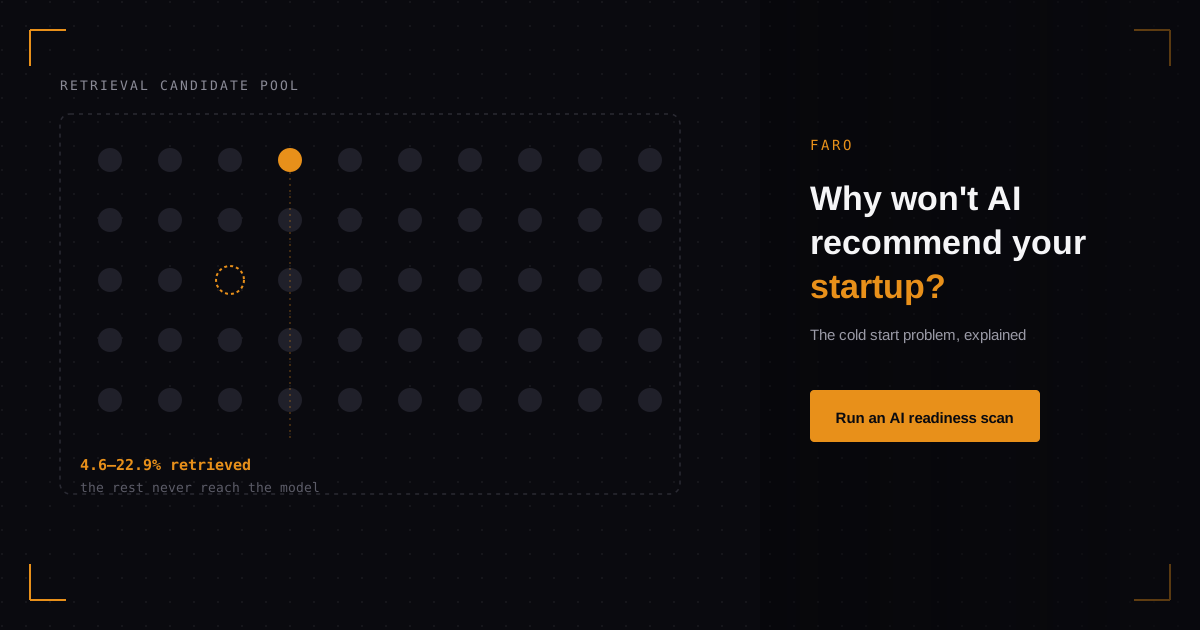
- A 2026 retrieval study found standard retrievers surface the correct (target) item in only 4.6 to 22.9 percent of realistic cold-start cases, and new items make up 32 to 91 percent of the test cases across five domains.
- Better prompting or a smarter model does not fix this. The paper's own conclusion is that the fix lives in retrieval and candidate generation, not in reranking.
- For a startup, the practical version of "retrieval and candidate generation" is machine-readable facts about who you are, what you do, and why you are credible, published somewhere an AI system's retrieval step can actually find and parse.
- This is a distinct problem from classic SEO, and it responds to a distinct set of fixes.
Why doesn't AI recommend brand-new startups?
Because most AI answer systems work in two stages, retrieval and then reasoning, and a brand-new company usually never survives the first stage. Before a chatbot writes a single word of its answer, it (or the search layer behind it) pulls a shortlist of candidate businesses, pages, or products from an index. Only that shortlist ever reaches the reasoning step. If your company is not on the shortlist, no amount of model intelligence, page-level optimization, or clever phrasing on your own site changes the outcome, because the system never considered you in the first place.
This is uncomfortable for founders because it feels like it should be solvable with better content. It usually is not, at least not with content alone. A startup's problem is rarely "the AI read my page and judged it unfavorably." It is "the AI's retrieval step never pulled my page, or any fact about my company, into the pool it was choosing from at all."
What is the cold start problem, and why does it explain most of this?
The cold start problem is a well-documented limitation in recommendation and retrieval systems: an item with little or no prior interaction history is structurally hard for a system to surface, no matter how relevant it actually is. It is not new to AI. Recommender systems researchers have studied it for years in contexts like e-commerce and streaming. What is new is how directly it now applies to whether an AI agent recommends your company at all.
A 2026 study on retrieval-augmented, LLM-based recommendation systems put numbers on the problem in a way most marketing content never does. Testing across five domains, the researchers found that standard single retrievers surfaced the correct target item in only 4.6 to 22.9 percent of realistic cold-start cases, meaning the right item simply was not in the candidate pool the model went on to reason over roughly four out of five times. Brand-new items with zero prior interaction history made up between 32 and 91 percent of the test targets, depending on the domain, which means "new" is closer to the norm than the exception.
The researchers' conclusion is the part worth sitting with: scaling up the model from 8 billion to 32 billion parameters narrowed the gap but did not close it, and the paper states plainly that the opportunity to fix cold start "lives at retrieval and candidate generation, not at the final LLM reranking stage."
Translated for a founder: a bigger, smarter model behind ChatGPT or Gemini does not solve your visibility problem, because the model never gets the chance to consider you. The fix has to happen earlier, at the point where the system decides who is even eligible to be discussed.
This is not the same problem as bad SEO
No, and treating it as an SEO problem is the most common mistake early-stage teams make. Traditional SEO is largely about ranking higher among candidates that are already in the index. Cold-start AI visibility is about getting into the candidate pool in the first place, which depends more on whether your company's facts exist somewhere structured, current, and machine-parsable than on keyword density or backlink count.
| Traditional SEO problem | Cold-start AI visibility problem |
|---|---|
| You rank on page 3 instead of page 1 | You are not in the candidate pool the model reasons over at all |
| Fixed with keywords, backlinks, page speed | Fixed with structured, verifiable facts a retrieval system can find and trust |
| Competing against pages that already rank | Competing against companies that already have interaction or citation history |
| Improves gradually as authority builds | Can improve in a single indexing cycle once the facts exist and are discoverable |
It helps to separate what Faro calls grounding from shaping. Grounding is verifiable evidence an AI system can actually inspect: structured data, a clear description of what your company does, real facts it can check. Shaping is how you position that evidence. A startup with zero grounding signal has nothing for an AI system to shape, no matter how good the positioning copy is. Grounding has to exist before shaping can do anything.
Run an AI readiness scan to see, concretely, what an AI system's retrieval step currently finds when it looks for your company. Most first-time scans for brand-new companies come back nearly empty, and that emptiness is the diagnosis, not a bug in the scanner.
What can a startup with no track record actually do about it?
Manufacture grounding signal deliberately, because you cannot manufacture interaction history overnight and waiting for it is not a strategy. The fastest lever a pre-revenue or early-revenue company has is publishing clear, structured, machine-readable facts about the business in places a retrieval system can actually reach and parse, rather than only in marketing copy written for human skimming.
| Action | Why it helps a new company specifically |
|---|---|
| Publish Organization structured data (JSON-LD) | Gives retrieval systems a discrete, parsable fact set (name, category, location, offerings) instead of forcing them to infer from prose |
| Write a plain-language "what we do" page with no jargon | Retrieval systems weight explicit, unambiguous claims over marketing language they have to interpret |
| Confirm AI crawlers can actually reach your site | A blocked or misconfigured robots.txt keeps you out of the index before content quality is even evaluated |
| Earn a small number of real third-party mentions | Independent confirmation is one of the few substitutes for interaction history a brand-new company can get quickly |
| Keep pricing and offering details current and explicit | Vague or missing specifics are treated as low-confidence signal and get deprioritized in the candidate pool |
Structured data specifically deserves attention here. Schema.org's Organization type defines the exact fields (name, url, logo, sameAs, and more) that let a machine identify who you are without guessing, and Google's own documentation on structured data makes the same point from the search side: explicit markup removes ambiguity that a system would otherwise have to resolve on its own, and ambiguous entities are exactly the ones that get filtered out of a small candidate pool. The OKF generator builds this structured, agent-readable version of your site's facts directly, which is the fastest way for a startup with nothing published yet to close the gap. For the properties that carry the most weight in practice, see our breakdown of which structured data properties actually matter.
None of this replaces earning genuine traction over time. It closes the specific, mechanical gap that keeps a legitimately good company out of the retrieval pool before anyone, human or AI, ever gets a chance to judge it on its merits.
How AI visibility differs by engine
ChatGPT, Gemini, Perplexity, and Claude do not all source their candidate pools the same way, so a fix that helps on one engine will not automatically help on another. Perplexity leans heavily on live web retrieval for most queries, which means a startup with a clean, crawlable, well-structured site can appear relatively quickly once that site exists and is indexed. Google's Gemini draws on Google's own search index and knowledge graph, so a business's presence, or absence, in Google's structured data and Business Profile ecosystem carries real weight.
ChatGPT blends a trained knowledge base with browsing and plugin-style retrieval depending on the query and mode, which means a brand-new company can be invisible in a non-browsing answer and still surface once ChatGPT's retrieval layer is triggered. Claude's answers depend heavily on what is actually retrievable and well-structured at the moment of the query rather than on brand recognition baked into training data, which works in a new company's favor once the groundwork is in place.
The practical implication is that a single fix rarely covers every engine. A startup chasing AI visibility needs its foundational facts (structured data, a crawlable site, clear positioning) in place everywhere, because that foundation is what every engine's retrieval step depends on, even though each one sources and weights it a little differently. See our related piece on how to get your business cited by ChatGPT, Claude, and Perplexity for engine-specific detail.
The realistic timeline for results
Faster than traditional SEO authority-building, but not instantly, and anyone promising same-week results is overselling. Once structured data and a clear, crawlable description of your business exist, the earliest realistic signal is a new AI readiness or grounding score improving within one indexing cycle, typically days rather than months. Actually showing up inside an AI-generated answer for a competitive query takes longer, because it also depends on the query itself, how narrow or broad it is, and how much genuine third-party confirmation exists elsewhere.
Set the right expectation internally before you start: the first milestone is "does an AI readiness check now find real facts about us," not "does ChatGPT recommend us for a broad category query." The second milestone follows the first, not the other way around, and treating them as the same thing is how teams conclude a fix "did not work" when it was actually working exactly on schedule.
FAQ
- Why doesn't ChatGPT know about my startup even though my website is live?
- Because a live website is not the same as a retrievable, machine-readable one. If your site lacks structured data and AI crawlers can reach it but find only marketing prose, retrieval systems often cannot extract discrete facts to add to their candidate pool, even though a human visiting the same page understands it fine.
- Does having zero reviews actually hurt AI visibility?
- It removes one of the few substitutes a new company has for interaction history. It does not disqualify you, but it means structured data and clear factual claims have to carry more of the weight that reviews and citation history would otherwise carry.
- Should a pre-launch startup worry about this at all?
- It is worth fixing the foundational, one-time items (structured data, crawlable robots.txt, a clear plain-language description) before launch, since they take little effort to set up correctly from day one and are far more annoying to retrofit later across a growing site.
- Is this the same as "AEO" or generic AI SEO advice?
- Not exactly. Most AEO advice assumes you already have some visibility to optimize. The cold-start problem is a layer earlier: getting into the candidate pool at all, before optimization for ranking or answer position is even relevant.
- Can a startup benchmark where it stands right now?
- Yes. An AI readiness scan shows what current retrieval systems can actually find about your company today, which is the honest starting point before investing effort in fixes.
In short
AI recommendation engines cannot recommend a company they never retrieve, and new companies are structurally under-retrieved by default, independent of quality. A 2026 study found the correct item missing from the candidate pool in roughly 77 to 95 percent of realistic cold-start cases, and concluded the fix belongs in retrieval and candidate generation, not in a smarter model. For a startup, that translates into a concrete, achievable task: publish structured, verifiable, plain-language facts about who you are and what you do somewhere AI systems can actually find and parse them. That is a different job than traditional SEO, it can move faster than traditional authority-building, and it is one of the few AI-visibility fixes a company with zero track record can execute entirely on its own.
Ready to see what AI systems currently find, or fail to find, about your company? Run a free AI readiness scan and get a concrete list of what to fix first. Startups have a specific set of gaps worth checking systematically; see Faro's AI readiness guide for startups for the full picture, and if you want the fastest single fix, start with the OKF generator to publish machine-readable facts about your business today. For a broader view of what a healthy baseline looks like, our guide on what an AI readiness score actually measures is a useful next read.