ChatGPT and Gemini skip your B2B software because they recommend what they can verify. When your product pages carry no structured facts about what you are, what you cost and how you are rated, a model falls back on the category leader it has seen named most often. Structured facts on your own pages give it something else to compare.
Ask ChatGPT or Gemini to name the best project management tool, the best CRM for a 50-person sales team, or the best observability platform, and you will usually get the same two or three names back: the category leader and whatever else dominates the review sites. That is not AI "liking" the market leader. It is a structural problem: most B2B software sites give a model almost nothing concrete to work with, so it falls back on whichever brand it has seen named the most, the most consistently, and the most unambiguously. Fix the signal, and you give the model something to work with besides brand frequency.
Key takeaways
- AI models default to the category leader when a software brand's own pages give them no structured, verifiable facts to compare against.
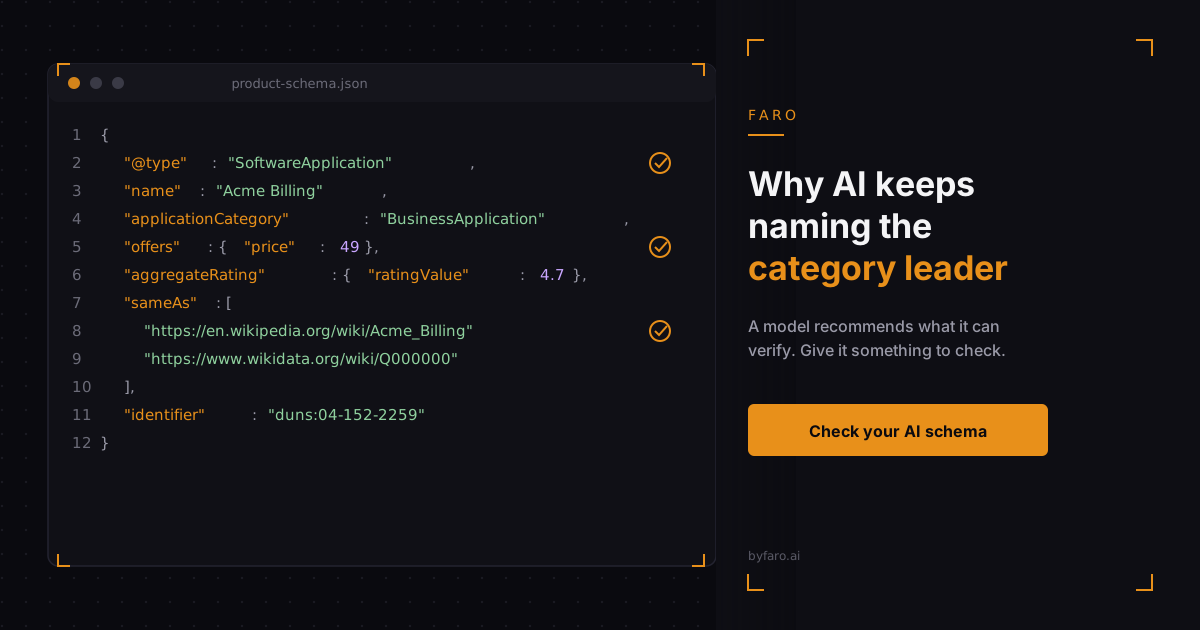
- Schema.org's SoftwareApplication type needs a name, a price (even if the price is 0), and either a rating or a review to qualify for rich results, and those same fields are what an agent reads to compare products.
- Organization markup, especially the
sameAsand identifier properties, is what tells a model your brand is a distinct, verifiable entity and not a smaller mention of the leader. - Structured data does not replace being cited elsewhere. It makes the citations you already have easier for a model to attach to the right brand.
- Checking what AI agents currently say about your category is the only way to know if any of this is working.
Why does AI name the category leader instead of you?
Because the category leader is the only brand in the category with a clean, unambiguous entity signal: it is mentioned the most often, in the most consistent way, across the sources a model has trained on or can retrieve from. Your product might be just as capable. If a model cannot confirm what you are, what you cost, what you are rated, and that you are not a different company with a similar name, it reaches for the brand it can confirm instead.
This is the same logic Faro applies to how AI agents treat any business: a model will cite what it can verify over what it merely finds. Faro calls the verifiable part of this grounding: facts a model can inspect and confirm, as opposed to shaping, which is AI-facing positioning language with nothing behind it. A category leader usually has years of grounding signal (press coverage, analyst reports, review site data, structured pages) that a newer or smaller competitor has not built yet. The fix is not to out-market the leader. It is to give the model the same kind of verifiable material the leader already has, on your own pages, in a form it can parse directly.
What actually changes which software gets named?
Three things change it: how often you are cited elsewhere, how cleanly your brand can be disambiguated from similarly named entities, and whether your own pages carry structured facts a model can check instead of inferring. Marketing content changes perception with humans; it does little for a model unless the claims in it are backed by something structured and checkable.
Citation frequency is the slow lever. You earn it through docs, review sites, analyst coverage, and other people's pages linking back to yours, and it builds over months, not days. Disambiguation and structured facts are the fast lever: you control both directly, on your own site, this week. A B2B software brand that fixes its own structured data before it has built citation volume is not skipping a step. It is making sure that when a citation does land, the model can actually attach it to the right entity.
What should SoftwareApplication schema actually include?
At minimum: a name, a price under offers.price (set it to 0 for free products), and either an aggregateRating or a review. Those three are what Google's own software-app guidelines require before a rich result will even consider the page, and they double as the first three facts a model checks when comparing products in a category. Everything past that minimum is what actually helps a comparison go your way.
| Property | What it tells an agent | Why it matters for comparison |
|---|---|---|
applicationCategory | The type of software (e.g. BusinessApplication) | Places you in the right category instead of a generic bucket |
offers.price / priceCurrency | What it costs and in what currency | Lets a model compare price directly instead of guessing from marketing copy |
aggregateRating or review | A real rating or a real review | Required for rich results; also the easiest signal for a model to quote |
featureList | The specific features or modules you ship | Gives a model something concrete to set against a competitor's feature list |
operatingSystem / runtimePlatform | Where and how it runs | Rules you in or out of a buyer's technical shortlist automatically |
provider / softwareVersion | Who makes it and which version this page describes | Confirms the page is current and attributable to a real company |
Source: schema.org/SoftwareApplication and Google Search Central's software-app documentation.
None of this works if the markup does not match what is actually on the page. Google's own structured data quality guidelines are blunt about it: the markup "must be a true representation of the page content," reviews have to come from real users, and information has to stay current. The same rule protects you with a model reading the markup directly. Fabricated ratings or a stale feature list get cross-checked against the visible page and the rest of the web; they do not survive the comparison any better than they survive a Google manual action.
Want every one of these properties checked in one pass instead of hunting through your templates? Faro's OKF generator builds the structured bundle for you, covering the software and organization fields a model actually reads.
Does Organization markup help agents tell you apart from the leader?
Yes, and it is the piece most B2B software sites skip entirely. Schema.org's Organization type includes a sameAs property built exactly for this: it links your entity to pages that "unambiguously indicate the item's identity," such as your Wikipedia or Wikidata entry, your official LinkedIn page, or your own primary domain. Wikidata runs on the same idea at a database level: it connects an entity to external identifiers in other sources so systems can confirm they are pointing at the same thing. Without a sameAs doing that job on your own pages, a model has to guess whether "Acme" the software company is the same "Acme" mentioned in a different context, and when it is unsure, it defaults to the entity it is already confident about: the leader.
Identifier properties go further than most marketing teams expect a schema type to go: duns for a Dun & Bradstreet number, leiCode for a legal entity identifier, naics for your industry classification code. These exist for financial and regulatory systems, but a model treats them the same way it treats any other verifiable fact: as a reason to trust the rest of the page. Add legalName and alternateName alongside your display name, and you close off the "is this the same company" ambiguity that otherwise pushes a model toward the brand it already recognizes without question.
Does this replace content and PR, or work alongside it?
Alongside, not instead of. Structured data fixes a disambiguation problem; it does not manufacture citation volume you have not earned yet. A category leader's advantage is still partly a function of being cited more often, in more places, by more people who are not you. That part takes real coverage: docs other people link to, review-site profiles that are actually filled in, analyst briefings, integrations partners write about. Schema does not substitute for any of that.
What it does is make every citation you already have easier for a model to attach correctly, instead of letting it blur into the leader's entity or drop out as unverifiable. If you want to see which companies are currently getting named instead of you for your own category's queries, that is a trackable thing, not a guess; Faro's own research into AI visibility covers the mechanics in tracking which companies AI recommends instead of you, and Faro's competitor intelligence tool runs that check against your actual category.
How do you check whether your software is set up to be compared fairly?
You check whether your B2B software is set up to be compared fairly in 2 steps. First, ask ChatGPT, Gemini and Perplexity about your category the way a buyer would and read the answers. Then audit your product pages against the SoftwareApplication and Organization properties above, fix the gaps and recheck in a few weeks.
Start by asking the models directly: put your product category into ChatGPT, Gemini, and Perplexity the way a buyer would, and read what comes back. If your brand is missing entirely, that is a visibility problem before it is a schema problem. If your brand appears but with a wrong price, a wrong feature, or no rating at all, that is almost always a structured data gap, not a model error. From there, audit your product pages against the SoftwareApplication and Organization properties above, fix what is missing, and recheck in a few weeks rather than a few days; models do not reindex a page the moment you ship a change.
The deeper background on structured data for AI, beyond software products specifically, is in structured data for AI: the properties that actually matter. If you want the fixes specific to B2B software rather than general AI-readiness advice, Faro's B2B software readiness page walks through the category's specific failure points.
Run Faro's AI schema check against your own product pages to see exactly which SoftwareApplication and Organization properties are missing before a buyer's AI agent fills in the gap with the category leader's name instead of yours.
FAQ
Why does ChatGPT always recommend the same software brand for my category?
Because that brand has the clearest, most consistent entity signal available to the model: frequent mentions, structured data that confirms what it is and what it costs, and little ambiguity about which company is being described. It is a signal gap on your side more often than it is favoritism on the model's side.
Does adding schema markup guarantee AI will recommend my software?
No. It removes the disambiguation and missing-fact problems that push a model toward a brand it can already verify. It does not manufacture citation volume or reviews you have not earned, and a model still weighs those alongside the structured facts.
What's the difference between SoftwareApplication and Product schema for a SaaS tool?
SoftwareApplication inherits from CreativeWork and is purpose-built for apps: operating system, runtime platform, software version, and feature list. Many SaaS teams also add a secondary Product type for commerce-style properties like SKU and detailed offer terms; the two are not mutually exclusive on the same page.
How long does it take for structured data changes to affect AI answers?
There is no fixed timeline, and models do not recrawl or reindex the moment you publish a change. Treat it the way you would any other technical SEO fix: make the change, then recheck your category's queries across the major AI engines a few weeks later rather than the next day.
Can a challenger brand ever outrank the category leader in AI answers?
Yes, in narrower slices of a category where the leader's signal is thinner, such as a specific use case, region, or buyer size the leader does not target directly. Winning the broadest possible query against an entrenched leader is harder and slower; winning the specific one your actual buyers ask is realistic with clean structured data and real citations.
In short
AI models recommend the B2B software brand they can verify, not necessarily the one that fits best. The category leader usually has that verification already built up through years of mentions and coverage; most challenger brands have not given a model anything structured to check at all. Fixing your SoftwareApplication and Organization schema will not replace the work of earning citations, but it does make sure the citations you already have, and the ones you earn next, land on the right entity. Check what AI currently says about your category, fix the structured gaps, and recheck later rather than assuming one pass settles it.