Gartner has forecast that AI agents will be involved in 90% of B2B purchasing activity by 2028, a shift worth roughly $15 trillion in transaction volume. Agencies are squarely inside that shift today, not in 2028. When a prospective client asks ChatGPT, Claude, or Gemini to "find me a marketing agency that handles paid social for a mid-size retailer," that agent is already reading, comparing, and shortlisting real agency websites right now. The question isn't whether AI agents research vendors. It's whether your agency's site gives one anything to work with.
Key takeaways
- Clients increasingly ask AI tools to shortlist agencies before they ever visit a site directly, during the research and comparison stage agents already handle well.
- Most agency sites are built to impress a human scrolling through case studies, not to hand a parsing agent clear facts about services, clients, and specialties.
- Content that loads client-side in JavaScript, with no server-rendered fallback, is often invisible to the crawlers behind AI answers.
- Schema.org markup for Organization, Service, and reviews gives an agent verifiable facts instead of marketing copy it has to interpret.
- A short, practical checklist can close most of the gap without a site rebuild.
Are AI agents actually part of how clients find marketing agencies today?
Yes. Agents are already active in the research and shortlisting stage of vendor selection, which is exactly where agencies compete. Gartner's $15 trillion forecast for 2028 describes agents handling full purchase workflows, but the earlier, lower-stakes step, gathering candidates and comparing them, is already happening inside tools marketers use every day.
That earlier step matters more for agencies than the eventual contract signature. A client doesn't let an AI agent sign a retainer. But a client's ops lead, increasingly, does ask an AI tool to pull together a first list of agencies that specialize in, say, lifecycle email for DTC brands, before anyone picks up a phone. If your agency doesn't surface in that list, the deal was lost before a human saw your pitch deck.
This is the same dynamic Faro has documented across other vertical markets: AI agents are already heavily used for discovery and comparison, well before they're trusted with autonomous purchasing decisions. Agencies sit in an unusually exposed part of that funnel, because agency selection is itself a research-heavy, comparison-driven purchase, the kind of decision B2B buyers were already turning to AI tools to shortcut.
What does an AI agent actually see when it opens your agency's homepage?
Often, much less than a human visitor sees. Many agency sites are built on animation-heavy frameworks like Webflow or Framer, with case studies, client logos, and results loaded or revealed through client-side JavaScript after the initial page load. Google's own crawling documentation is direct about the consequence: not every crawler executes JavaScript the way Googlebot does, which is why Google's JavaScript SEO guidance recommends server-side or pre-rendering regardless, "because it makes your website faster for users and crawlers."
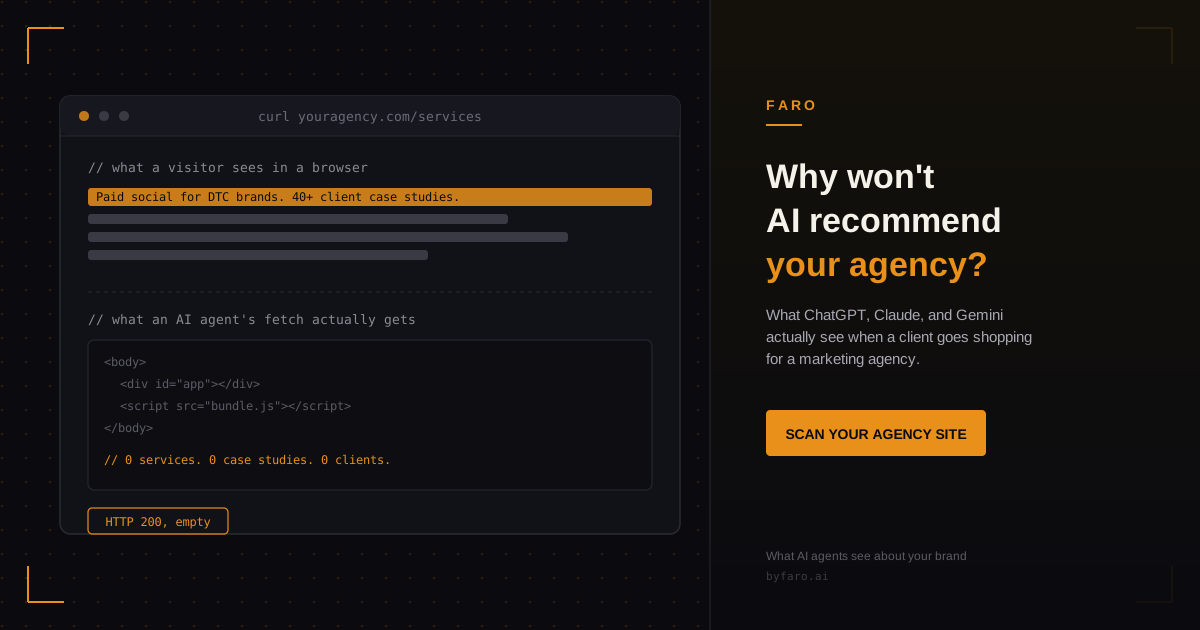
AI crawlers are a more extreme case of the same problem. The bots behind ChatGPT, Claude, and Gemini's answer and research modes are typically simpler fetchers than Googlebot. They request a URL, read the HTML that comes back, and move on. If your services page, team bios, or client results only render after a script runs in a browser, an agent that doesn't run that script sees an empty shell: a nav bar, a hero headline, and not much else.
The fastest way to check this yourself takes under a minute. Right-click your agency's services page and choose "View Page Source," or run curl https://youragency.com/services from a terminal. If the case studies, specialties, and client names you're proud of aren't in that raw response, no agent reading your site sees them either, regardless of how good they look in a browser.
Why your case studies and client logos don't count as evidence to an agent
Even when an agent can read your case studies, a wall of persuasive prose isn't the same thing as evidence it can act on. A paragraph claiming "we grew a DTC skincare brand's revenue 3x in six months" reads as a claim, not a fact, unless it's attached to something an agent can verify or at least parse cleanly: a named client, a date range, a specific service category, a measurable outcome.
This is the gap structured data is built to close. Marked-up facts (which industries you serve, which services you offer, who your named clients are, what a client said in a review) give an agent something closer to a database record than a sales pitch. An agent comparing five agencies for a shortlist is pattern-matching against stated capabilities and specialties; the agency that states them in a form the agent can extract cleanly has a real edge over the one that only implies them through tone and design.
The structured data gap: what schema.org actually gives an AI agent
Schema.org is the shared vocabulary that lets a site state facts in a form machines can parse reliably, rather than forcing an agent to infer them from prose and layout. The Organization type alone covers fields like name, address, and sameAs (linking your verified social and directory profiles), and related types extend to specific services, service areas, and reviews. The underlying format most sites use to express this, JSON-LD, is itself a W3C-standardized way of serializing linked data, not a Google-specific trick: the W3C JSON-LD specification defines it as "a JSON-based format to serialize Linked Data," with no dependency on any one search engine or AI vendor choosing to support it.
For an agency site, the highest-value fields are rarely exotic: your services as a list an agent can enumerate, the industries or verticals you specialize in, your service area if location matters, and reviews or testimonials marked up so a rating is a data point, not just styled text. Faro's OKF generator builds this kind of machine-readable bundle automatically from your existing site content, which matters because most agencies will never hand-write JSON-LD for every service page and keep it current as the roster of clients changes.
How to check what ChatGPT, Claude, and Gemini can actually read on your site
You don't need to guess. Three checks, in order of effort, tell you most of what you need to know. First, view source or curl your three most important pages (homepage, services, case studies) and confirm your actual selling points appear in the raw HTML, not just after JavaScript runs. Second, check your robots.txt for a wildcard rule that accidentally blocks search-and-answer crawlers alongside training crawlers; agencies that locked down GPTBot to protect content from AI training sometimes blocked the very bots that would have surfaced them in an AI answer. Third, run a structured-data check against your key pages to see whether an agent would find clean Organization and Service markup or nothing at all.
A free AI readiness scan runs all three of these checks in one pass and flags exactly which pages are rendering empty for non-JavaScript crawlers, which is usually the single biggest, fastest fix available to an agency that hasn't looked at this before.
The AI visibility checklist for agency websites
| Check | Why it matters for an agency | Typical fix |
|---|---|---|
| Core copy renders without JavaScript | Services, specialties, and case study results must exist in the raw HTML response | Server-side rendering or pre-rendering for key pages |
| Organization and Service schema present | Turns "we do paid social" from a claim into a structured, parseable fact | Add JSON-LD via a generator or template, keep it in sync with real services |
| robots.txt allows AI search/answer bots | Blocking training crawlers can accidentally block the bots behind AI answers | Separate rules for training bots vs. search/answer bots |
| Client names and results are specific | Vague case studies give an agent nothing concrete to compare | Name clients where permitted, attach dates and service categories |
| Reviews/testimonials are marked up | A styled quote is just text; a Review schema entry is a data point | Add Review/AggregateRating markup where you have real, attributable reviews |
Faro, 2026.
One more thing worth doing before any of the above: see where you currently stand against other agencies competing for the same clients. Faro's vertical leaderboard shows how agency sites in your category compare on exactly these signals, so you know whether you're fixing a real gap or a minor one.
If this is the kind of audit you'd rather run for clients than just yourself, agencies are already packaging AI visibility audits as a standalone paid service, and the checklist above is most of the deliverable.
Frequently asked questions
Do AI agents actually recommend specific marketing agencies by name?
Increasingly, yes, inside research and comparison answers where a user asks for options rather than a single best pick. The agent pulls from what it can read across agency sites and any third-party pages mentioning them, then presents a shortlist rather than one verdict, which is exactly why appearing in that shortlist with clear, parseable facts matters.
Will a full website redesign fix this?
Usually not, and it's rarely the first thing to do. Most of the gap is fixable without touching design: making sure key content renders without JavaScript, adding structured data, and checking robots.txt rules. A redesign that keeps the same JavaScript-only rendering pattern doesn't change anything for an agent.
Does blocking AI training crawlers hurt my agency's visibility?
It can, if the robots.txt rule is broader than intended. Training crawlers like GPTBot and ClaudeBot are distinct from the search and answer crawlers that power live AI responses; a single wildcard disallow rule can block both at once without anyone realizing it until traffic from AI referrals drops.
How is this different from normal SEO for agencies?
Traditional SEO optimizes for ranking in a list of blue links a human scans. This is about whether a non-human reader, one that doesn't scroll, doesn't notice design, and can't run your animations, can extract the same facts a human would. The content overlaps; the delivery requirements don't.
What's the fastest single fix for an agency with limited developer time?
Confirming your services and case study results actually appear in the raw HTML response, not just after JavaScript runs. It takes minutes to check and, when it's broken, fixing it typically produces the biggest jump in what agents can see.
In short
AI agents are already part of how clients shortlist marketing agencies, well before Gartner's 2028 horizon for full agentic B2B purchasing. Most agency sites aren't built for that reader: case studies and client logos often load behind JavaScript an agent never runs, and the facts behind the pitch rarely exist as structured data an agent can extract. The fix is narrower than a redesign: confirm your core content renders without JavaScript, add Organization and Service schema, and check that robots.txt isn't blocking the wrong bots. None of it requires guessing what AI agents want; it requires giving them the same facts your best human prospects already get.
Curious whether your own client list would find you right now? Faro's AI readiness scan checks all of this on your agency's site in a couple of minutes, and the agencies page breaks down the specific signals that matter most for vendor-selection searches. If you're tracking who else is showing up in those shortlists instead of you, Faro's competitor-tracking tool is built for exactly that question.