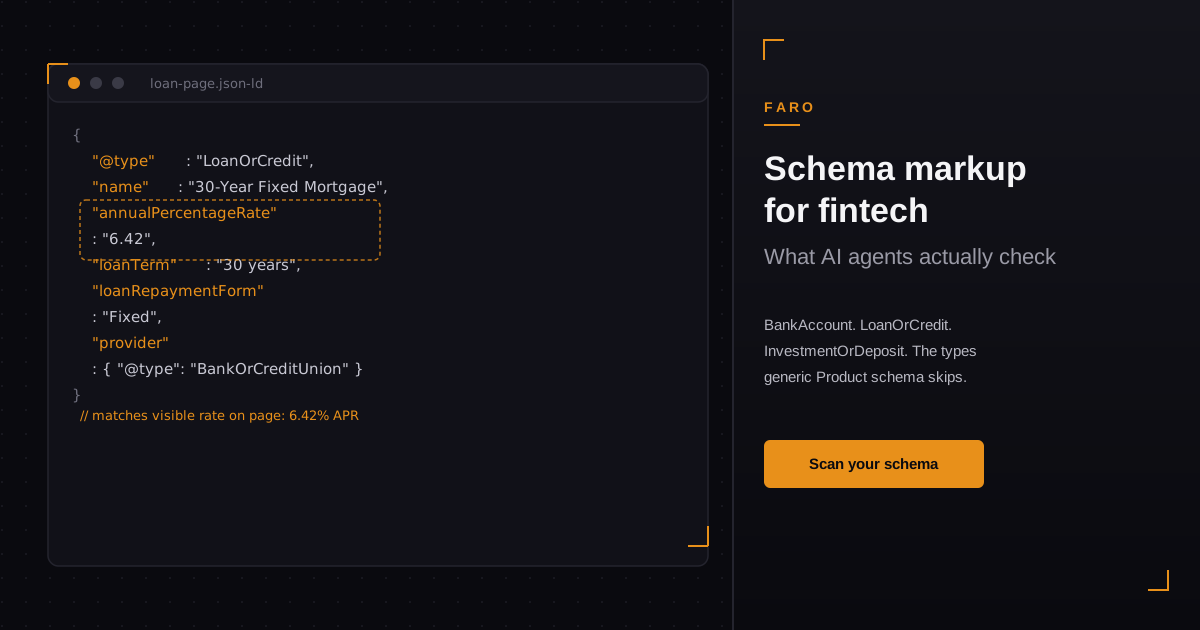
Most fintech sites run the same schema markup as every other SaaS product: Organization, Product, maybe a Review block borrowed from a plugin. None of it describes what the business actually sells. A loan isn't a product with a price. A brokerage account isn't a software subscription. When an AI agent or a search crawler reads markup that doesn't match what the page actually is, it either ignores the markup or, worse, treats the page as less trustworthy than a competitor's page that got the types right.
This matters more for fintech than almost any other category. Google already holds financial content to a higher accuracy bar than a recipe blog or a SaaS landing page. The schema types built specifically for banks and financial products exist for exactly this reason, and almost nobody outside the largest banks uses them.
Key takeaways
- Generic Product and Review schema doesn't describe loans, accounts, or investment products, and Google's own guidance says markup must be a true representation of the page.
- Schema.org's financial extension defines FinancialProduct, BankOrCreditUnion, LoanOrCredit, and InvestmentOrDeposit specifically for this category, with properties like interestRate and annualPercentageRate that generic Product schema has no field for.
- Google treats trust as the most important part of E-E-A-T, and gives YMYL topics, including anything financial, extra scrutiny on accuracy.
- The most common fintech structured data mistake isn't a missing field. It's markup that describes a rate, term, or fee the visible page text doesn't show.
- Adding the right financial schema is a content and JSON-LD change, not a backend rebuild.
Jump to:
- Why generic schema markup falls short for fintech
- What schema types actually describe a financial product
- Why financial content gets held to a higher bar
- How structured data signals trust to AI agents, not just Google
- The structured data mistake that shows up most on fintech sites
- How to add this without a two-week engineering sprint
- FAQ
Why does generic schema markup fall short for fintech sites?
Generic schema markup falls short because Product, Service, and Review types were built to describe things with a single price and a star rating, not a financial product with a rate, a term, and eligibility rules. A savings account isn't "in stock." A mortgage doesn't have a SKU. When a fintech site forces a loan page into Product schema, it either leaves out the fields that actually matter to a reader (the rate, the fee structure, the repayment term) or invents fields that don't apply, and both outcomes weaken the page.
Google's structured data policy is explicit that markup has to match the page: "Your structured data must be a true representation of the page content," and content that's hidden from the user or misrepresented can lose rich-result eligibility entirely (Google's structured data guidelines). A mismatch between what the markup claims and what the page shows isn't a minor technical gap on a financial page; it's the exact kind of signal that makes a page look unreliable to anything reading it, human or automated.
What schema types actually describe a financial product?
Schema.org maintains a financial extension built specifically for banks and financial products, and almost no fintech company outside the largest banks uses it. The extension defines a FinancialProduct type as the parent for the products that actually appear on a fintech site, along with a BankOrCreditUnion type for the institution itself (schema.org's markup guide for banks and financial institutions).
| Schema type | What it describes | Properties worth using |
|---|---|---|
| BankAccount | Checking, savings, or deposit accounts | interestRate, accountMinimumInflow, accountOverdraftLimit |
| LoanOrCredit | Loans, mortgages, and credit lines | loanTerm, annualPercentageRate, loanRepaymentForm, gracePeriod |
| InvestmentOrDeposit | Brokerage accounts, investment funds, deposits | amount, currency, feesAndCommissionsSpecification |
| PaymentCard | Credit and debit cards | annualPercentageRate, cashBack, contactlessPayment |
| PaymentService | Money transfer and payment products | availableChannel, feesAndCommissionsSpecification |
| BankOrCreditUnion | The institution itself, not a single product | leiCode, address, availableChannel |
Source: schema.org's financial markup extension.
These types nest the way you'd expect: MortgageLoan and CreditCard sit under LoanOrCredit, BrokerageAccount and InvestmentFund sit under InvestmentOrDeposit. The schema.org documentation describes the goal as "simplicity and practicality," built around "the most important objects, as seen from the retail banking perspective," rather than an attempt to model every financial instrument that exists. That's a reasonable trade-off for a fintech marketing or product page. You don't need to model derivatives trading to markup a savings account correctly.
Why does financial content get held to a higher bar than other industries?
Financial content gets held to a higher bar because Google explicitly weighs topics that affect someone's money or financial stability as "Your Money or Your Life," and gives those topics extra scrutiny on accuracy and trust. Google's own guidance on helpful content states that for YMYL topics, "the content must be highly accurate and consistent with established expert consensus" (Google's guidance on creating helpful, people-first content).
That same guidance calls trust the most important piece of E-E-A-T (experience, expertise, authoritativeness, trustworthiness): "Of these aspects, trust is most important." A fintech page earns that trust partly through content (clear sourcing, visible authorship, accurate numbers) and partly through structure. Markup that correctly identifies a page as a BankOrCreditUnion with a real legal entity identifier, rather than a generic Organization, is one of the few signals a page can send that it's a real financial institution and not a landing page assembled to rank for "best savings account."
How does structured data signal trust to AI agents, not just Google?
Structured data signals trust to AI agents the same way it signals relevance to Google: it gives a machine-readable answer to "what is this, exactly," without forcing the agent to infer it from prose. An AI agent comparing savings accounts for a user doesn't want to parse a paragraph to find the APY; it wants a field called interestRate with a number in it. A page that provides that field directly is easier to cite accurately and harder to misquote than one the agent has to summarize from marketing copy.
This is also where generic Product schema actively hurts a fintech page. If an agent reads Product markup with a "price" field on what is actually a loan, it may surface that number as if it were the loan amount, the monthly payment, or the rate, depending on how the page author filled the field. The ambiguity doesn't just confuse a reader; it gives an agent a wrong number to repeat with confidence. Correctly typed financial schema removes that ambiguity at the source.
Faro's own look at why AI agents are harder on fintech companies covers the trust gap from the content side: disclosures, compliance language, and the scrutiny financial claims get generally. Structured data is the technical half of that same problem. Neither fixes the trust gap alone.
If you want to see where your own site's markup stands against this, Faro's schema checker reads what's actually on the page and flags where the types don't match the content, rather than just confirming markup is present.
What's the structured data mistake that shows up most on fintech sites?
The mistake that shows up most isn't a missing field. It's markup that states a rate, fee, or term that the visible page text doesn't actually show anywhere a reader can see it. Google's structured data policy is direct about this: "Don't mark up content that is not visible to readers of the page," and markup is expected to describe the same thing a person sees on the page, not a backend value that never made it into the copy.
This happens constantly on fintech sites because the rate or fee often lives in a backend pricing table that feeds the page dynamically, while the visible copy says "rates starting at" or links out to a separate rate sheet. The structured data then states a specific APR that no human reader of the page can actually find. That's not a hypothetical penalty risk; it's a direct mismatch between what the page claims and what it shows, and it's the single easiest thing to audit and fix once you know to look for it.
A close second: marking up every product variant on a page (every loan term, every card tier) but only linking one, which creates the same kind of mismatch at smaller scale. The schema.org guidance's own advice to keep the model to "the most important objects" cuts both ways here. Don't model more variants in markup than you're willing to show and maintain in visible copy.
How do you add this without a two-week engineering sprint?
You add financial schema the same way any JSON-LD markup gets added: a script tag in the page head, generated from the same data that already feeds the visible rate, term, and fee fields on the page. JSON-LD itself is a W3C-standardized format, described in the spec as "a lightweight syntax to serialize Linked Data in JSON" (the W3C JSON-LD 1.1 recommendation), which is why it drops into most CMS and app frameworks without a schema-specific backend change.
The practical sequence: identify which FinancialProduct subtype actually matches each page (loan page gets LoanOrCredit, account page gets BankAccount), pull the properties that already exist as visible copy on the page (rate, term, fees), and generate the JSON-LD from that same source so the markup can't drift out of sync with what a reader sees. Faro's OKF generator builds this kind of structured JSON output directly from a site's own content, which is the same principle: markup generated from the visible page rather than typed in separately and left to go stale.
For more on how structured data performs across page types generally, not just finance, see Faro's breakdown of the properties that actually matter and the companion piece on what schema markup actually does for AI citations, which covers the broader myth that schema alone moves rankings. Fintech teams building out a vertical content plan around this should also see Faro's AI visibility guide for fintech companies.
FAQ
Does adding financial schema markup improve search rankings on its own?
No. Structured data makes a page's content machine-readable and eligible for certain rich results; it doesn't substitute for accurate, well-sourced content. Google's own policy treats markup as a description of existing content, not a ranking input by itself.
Can a fintech startup use FinancialProduct schema without being a licensed bank?
Yes. The schema type describes the product being shown on the page (a loan, a card, an investment account), not the regulatory status of the company offering it. A BankOrCreditUnion type is for the institution; a FinancialProduct subtype is for the product itself.
What's the difference between FinancialProduct and generic Product schema?
Generic Product schema is built around items with a price and availability. FinancialProduct subtypes carry properties specific to financial terms, such as interestRate, annualPercentageRate, and loanTerm, that Product schema has no field for.
Do AI agents actually read schema markup, or just Google?
Agents that fetch a page's HTML can read any JSON-LD present the same way a search crawler does. Correctly typed markup gives an agent a direct, unambiguous field to cite instead of forcing it to infer a number from prose, which is exactly where ambiguity turns into a misquoted rate.
Where do I find real examples of financial schema markup?
Schema.org's own documentation for banks and financial institutions includes worked JSON-LD examples for BrokerageAccount, InvestmentFund, MortgageLoan, CreditCard, and MoneyTransfer.
In short
Fintech sites lose trust signal when they describe loans, accounts, and investment products with schema built for generic software products. Schema.org's financial extension exists specifically to close that gap, and Google's own guidance treats accuracy and trust as the deciding factor for anything that touches someone's money. The fix isn't a backend rebuild: it's typing each product page correctly and generating the markup from the same data that already drives the visible rate, term, and fee copy. Get the type right and both Google and AI agents have one less reason to guess.
Ready to see where your own pages stand? Run Faro's schema checker against a live fintech page and see which financial properties are missing, mismatched, or generated from the wrong type entirely.