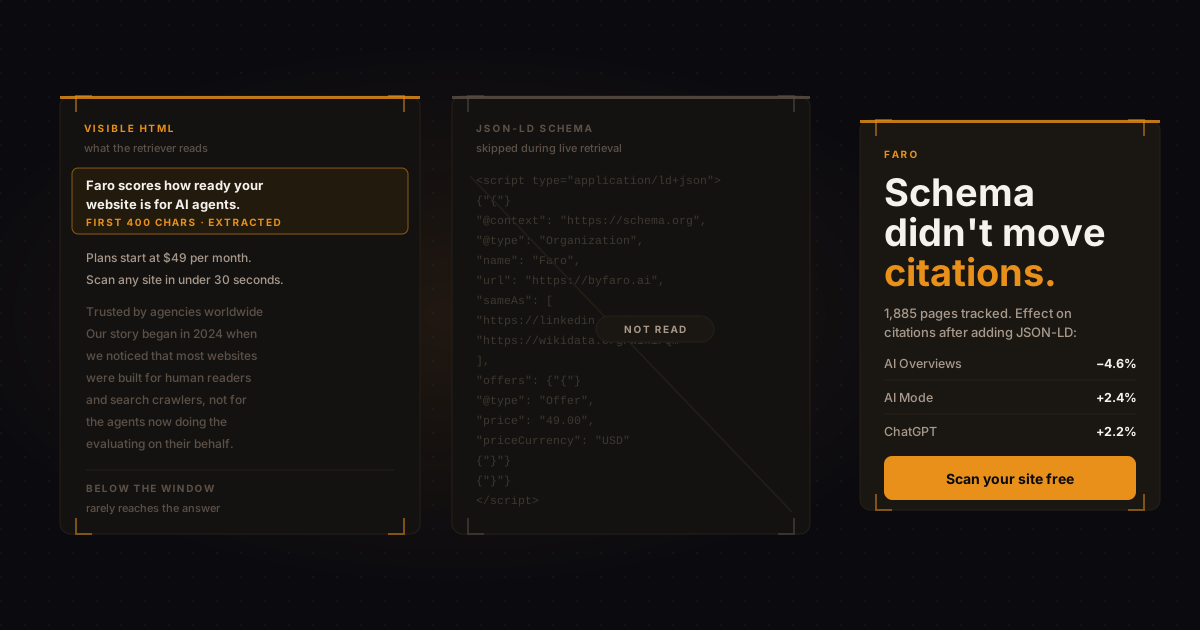
Adding schema markup to a page that AI already cites does not get it cited more. That is the finding from a controlled study of 1,885 pages, and it contradicts a claim that has been repeated in conference decks for two years.
The more useful finding came from a second, smaller experiment: when the major AI systems fetch a page in real time, they read the visible HTML and skip the structured data entirely. Not deprioritize it. Skip it.
Both results point the same direction, and it is not the direction most structured data advice assumes. Here is what the data says, what schema is genuinely for, and where the effort is better spent.
What did the schema study actually measure?
Ahrefs tracked 1,885 pages that added JSON-LD between August 2025 and March 2026, matched each against three control pages with similar prior citation levels, and measured the change across Google AI Overviews, AI Mode, and ChatGPT. The matching matters: AI Mode citations grew 43% in raw terms during the period, but control pages grew almost as much, so nearly all of that was platform growth rather than schema.
| AI surface | Effect of adding schema | Reading |
|---|---|---|
| Google AI Overviews | −4.6% | Small decline, statistically significant, cause unexplained |
| Google AI Mode | +2.4% | Indistinguishable from zero |
| ChatGPT | +2.2% | Indistinguishable from zero |
Source: Ahrefs, difference-in-differences analysis of 1,885 treated pages against 4,000 controls.
Four separate statistical tests produced the same answer. The honest summary is that nothing much happened.
Why do 53% of AI-cited pages have schema then?
Because schema travels with everything else that earns citations. Pages cited by AI were almost three times more likely to carry JSON-LD than uncited pages, which is the correlation that launched a thousand LinkedIn carousels. But sites that bother with structured data also maintain their pages, publish with authority, fix their technical debt, and rank in classic search. Strip the schema out and the rest of those signals still carry the page.
This is the same reasoning error as noticing that fast-loading sites rank well and concluding that compression writes good content. The correlation is real. The causal claim built on top of it was never tested until now.
Do AI systems read structured data at all?
During live retrieval, apparently not. A recent industry experiment tested what five systems actually extract when fetching a page: ChatGPT, Claude, Perplexity, Gemini, and Google AI Mode. Every one of them pulled visible HTML content only. JSON-LD, hidden Microdata, and hidden RDFa were all ignored.
That finding reframes the whole category. If a model is reading your rendered text and nothing else at the moment it decides what to quote, then the placement and clarity of your visible copy is doing the work that people have been attributing to their markup.
It also explains the null result cleanly. You cannot get a citation lift from a block the retriever never opens.
So is schema worth publishing?
Yes, for reasons that have nothing to do with citation counts. Structured data is a comprehension and distribution layer:
- Accuracy. Organization and Product markup fix your category, your pricing, and your identity in a machine-readable form, so systems that do parse it are less likely to describe you wrongly.
- Entity resolution. A sameAs array connecting your Wikidata, LinkedIn, and Crunchbase entries is how knowledge graphs confirm that three mentions of your brand are one company.
- Agent transactions. Product and Offer markup exposes price and availability in a queryable format, which matters as agent checkout standards mature. Our guide to agent commerce readiness covers where that path breaks today.
- Classic rich results. Still supported by Google Search, still worth having, and unrelated to LLM citation behavior.
That list covers why schema is worth publishing at all. For the broader question of which structured data properties actually influence how AI systems understand and cite a page, see our breakdown of the properties that actually matter.
What schema is not: a ranking trick, a citation lever, or a substitute for saying something worth quoting. Two specific claims are now dead and should be scrubbed from anyone's pitch deck. Google retired the sitelinks search box in November 2024, so the WebSite SearchAction property does nothing. And FAQ markup no longer produces the rich result it was built for.
If you want the markup itself generated correctly, the Faro AI Schema Creator builds Organization, Product, and WebSite blocks for your business type. Just hold the right expectation for what it buys you. If you want the full machine-readable picture rather than just the schema blocks, Faro's Open Knowledge Format generator packages your site's structured facts into a single file built for agents to consume directly.
What moves citations instead?
Put the answer at the top of the page. That sounds obvious enough to skip, so here is why it is the specific thing to fix.
Retrieval is passage-level. A model pulls a chunk of your page, and the chunk it reaches for first is the opening of the visible body text. If those first few hundred characters are a navigation menu and a slogan, that is your submission to the model. Everything good you wrote in section four was never in the running.
That result makes this concrete. If every system tested extracted visible content only, then the question "what does my page say to a model?" has a literal answer: whatever text appears first in your rendered document. Not your markup. Not your design intent. The text.
This is also the failure mode nobody instruments. A model can trust your domain, retrieve a page, find no clear answer in the part it read, and quote someone else. Nothing in your analytics records that, which is why it goes unfixed for months.
Two pages are worth auditing this week:
- Your homepage. The first sentence of body copy should state what you do and who it is for. "Faro scores how ready your website is for AI agents" is a definition. "Reimagine what's possible" is not.
- Your pricing page. Put a real number in the opening paragraph, above the comparison table. An extractor that reads 400 characters may never reach a table that starts below the fold. If your pricing transparency depends on a component that renders late, an agent sees a page with no prices on it.
Check this in your rendered HTML, not your design. Source order is what the retriever sees, and a visually prominent hero can sit hundreds of characters into the document.
How should structured data sit in a wider plan?
Treat it as hygiene you complete once and stop thinking about. It belongs in the same tier as a valid sitemap and correct canonical tags: absence causes problems, presence buys correctness rather than advantage.
| Work | What it buys | Effort profile |
|---|---|---|
| JSON-LD schema | Accurate machine parsing, entity resolution | One-time setup |
| Crawler permissions | Eligibility to be read at all | One-time, then monitored |
| Answer-first page structure | What actually gets extracted and quoted | Per page, ongoing |
| Original evidence in content | A reason to be cited over the consensus page | Per page, ongoing |
The bottom two rows are where the remaining effort belongs, and they are the rows most teams have not started. Before you spend another quarter on markup, confirm the crawlers can reach you at all: our robots.txt analyzer checks whether GPTBot, ClaudeBot, and PerplexityBot are permitted, which is the one structural failure that makes every other optimization irrelevant.
One caveat worth stating plainly
The Ahrefs study looked exclusively at pages that were already heavily cited. Every page in the sample had 100 or more AI Overview citations before schema was added. Those pages were already inside the consideration set.
The study cannot tell you what schema does for a page nobody has found yet, and the authors say so directly. There remains a plausible case that structured data helps a new or obscure page get crawled, parsed, and understood in the first place. Nobody has run that test yet. Anyone claiming certainty in either direction on that specific question is guessing.
Which is a reasonable argument for keeping your markup: the downside is a one-time implementation, and the unmeasured upside sits precisely where most sites live.
Frequently asked questions
Should I remove schema from my site?
No. The study found no meaningful benefit for already-cited pages, not a penalty worth acting on. The small AI Overviews decline was unexplained and could reflect other changes made at the same time. Removing working markup costs you rich results and entity signals for no gain.
Does FAQ schema still do anything?
It structures question and answer pairs so a parser gets the whole unit rather than a fragment. What it no longer does is produce the FAQ rich result in Google, and the citation data gives no reason to expect a visibility lift from it.
Do different schema types perform differently?
Unknown. The study pooled Article, FAQ, Product, HowTo, and Organization together, and the authors flag type-level analysis as untested. Treat any confident claim about a specific type outperforming another as unsupported.
If AI ignores JSON-LD at retrieval, why does anything structured matter?
Because retrieval is not the only moment that counts. Training corpora, knowledge graph construction, and Google's classic rich result pipeline all consume structured data. That test measured one specific moment: a live fetch in response to a prompt.
How do I know if my pages are answer-first?
View the rendered HTML and read the first 400 characters of body text. If that window is navigation labels and a tagline, an extractor is judging you on that. Faro checks this automatically across your homepage and pricing page, and agencies running it across a client portfolio can compare the pattern in bulk.
In short
A controlled test of 1,885 pages found that adding JSON-LD produced no citation lift on ChatGPT or AI Mode and a small unexplained decline in AI Overviews. A separate retrieval test found five major AI systems read only visible HTML and ignore structured data during live fetches. Schema remains worth publishing for accuracy, entity resolution, and agent transactions, but it is not a citation lever and was never tested as one until this year. The effort that moves the needle is putting your answer in the first lines of visible text, on the pages you most want quoted.
Worth knowing which of these your own site already gets right. Run a free scan and see where your pages put their answers.