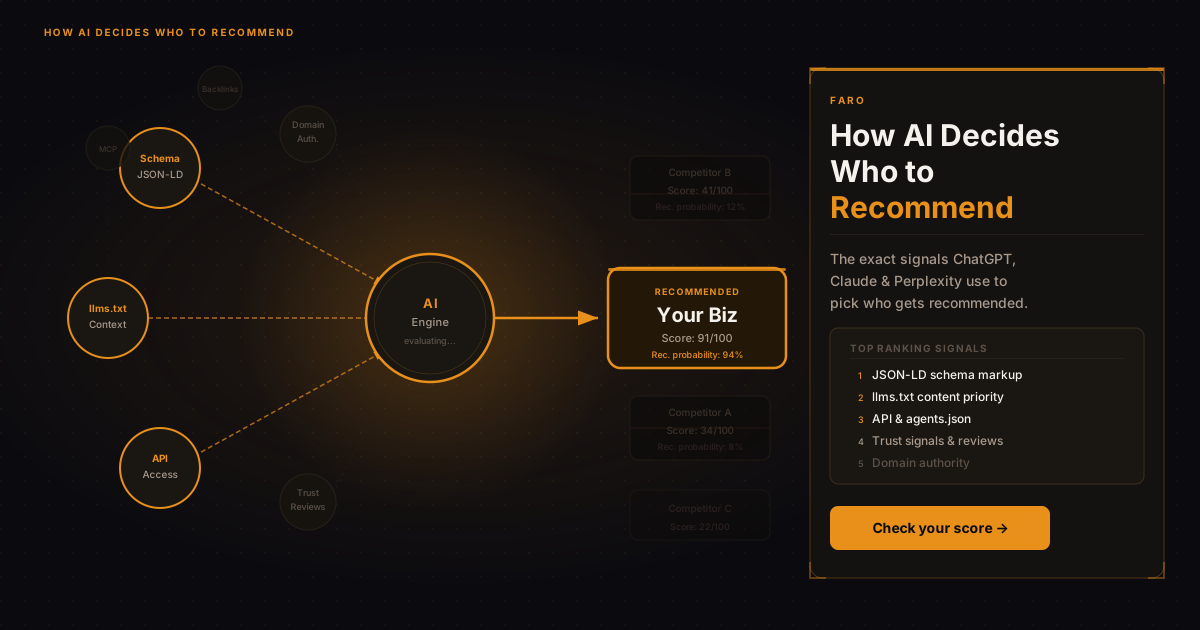
When someone asks ChatGPT “what's the best project management tool for agencies?” the model doesn't spin up a search engine. It draws on what it learned during training, what it can access in real time (for models with web access), and a set of structural signals about how well a given business is documented and verified across the web. The businesses that get recommended aren't always the biggest or the best-funded. They're the most legible to AI.
This article breaks down exactly how recommendation decisions happen across ChatGPT (OpenAI), Claude (Anthropic), and Perplexity, and what your business can do to appear more often. For the fundamentals, see what AI visibility actually means.
Why AI Models Surface Specific Businesses
Large language models learn from text. During training, they absorb patterns about which companies are discussed, how they're described, what problems they solve, and how credible those descriptions are. After training, many models (particularly those with retrieval or web search) can pull in live data to supplement what they know.
The result is a recommendation engine that weighs several factors simultaneously: brand recognition in training data, structured signals on your website, third-party verification, and whether your content is formatted in a way AI can parse efficiently.
The Four Signals AI Uses to Evaluate Your Business
1. Training data density
If your business has been written about extensively, cited in reputable publications, and discussed in forums and communities over many years, you're more likely to appear in model outputs. This is passive reputation. You can't directly add yourself to a model's training data, but you can increase the signal through consistent publishing, press coverage, and being cited by others in your space.
2. Structured data on your website
AI models that access your website (during training crawls or real-time retrieval) read structured data first. JSON-LD schema tells a model your business name, category, URL, description, and related entities in a machine-readable format. Without it, the model has to infer these facts from unstructured HTML, which introduces errors and gaps. Faro's AI Schema Creator generates this markup for you.
The most important structured data signals are:
- Organization or SoftwareApplication schema with a clear description
- sameAs links pointing to LinkedIn, Crunchbase, Wikidata, and Twitter/X
- Product or Offer schema if you have pricing
- FAQPage schema for common questions
3. llms.txt and AI-specific discovery files
The llms.txt standard (analogous to robots.txt but for language models) lets you tell AI systems directly what your business does, who you serve, what pages matter, and how you want to be described. It's a direct communication channel between your site and AI models that access it. Faro's llms.txt Generator builds a compliant file from your existing site content.
Fewer than 5% of websites have published an llms.txt file. That's a significant gap: most businesses are relying entirely on AI models to infer their identity from unstructured content, when they could be stating it explicitly.
4. Entity verification across the web
AI models are more likely to confidently recommend a business they can verify across multiple independent sources. A Wikidata entry, a LinkedIn company page, a Crunchbase profile, and mentions in industry publications all reinforce each other. When a model can cross-reference your identity across sources, it treats you as a resolved entity rather than an ambiguous reference.
The sameAs property in your JSON-LD schema links your website directly to these external profiles, making it far easier for models to verify who you are.
Check your AI discoverability score
Faro's AI Visibility Checker checks all four signal categories above and tells you exactly which gaps are costing you recommendations. Most sites fail two or more categories.
How Each AI Platform Makes Recommendation Decisions
ChatGPT (OpenAI)
ChatGPT uses a combination of training data and, in its browsing-enabled modes, live web retrieval. For category queries (“best tools for X”), it typically draws on what appears frequently in its training corpus: review sites, comparison posts, Reddit discussions, and editorial content. Businesses that appear repeatedly in credible contexts during training have a significant advantage.
ChatGPT also has a Shopping mode that pulls structured product data. For e-commerce businesses, having structured Product and Offer schema is particularly important for appearing in shopping-oriented queries.
Claude (Anthropic)
Claude tends to be more cautious about specific brand recommendations without citations. It's more likely to recommend businesses it can verify through structured information and it frequently qualifies recommendations with phrases like “based on publicly available information.” Structured data and clear entity documentation help more with Claude than with some other models because the model uses that structure to assess confidence.
Perplexity
Perplexity is fundamentally different from ChatGPT and Claude in that it runs live web searches for almost every query. What matters most for Perplexity is whether your site appears in the search results that Perplexity queries, and whether your content can be parsed quickly and accurately. llms.txt, structured data, and clean content formatting all directly affect whether Perplexity includes you in its answers.
Perplexity also shows citations prominently, so businesses that appear in Perplexity answers get visible brand mentions with links, making Perplexity one of the highest-ROI channels for AI-driven discoverability right now.
What Blocks AI from Recommending You
Blocked AI crawlers
If your robots.txt blocks GPTBot, ClaudeBot, PerplexityBot, or Google-Extended, those models cannot access your content for real-time retrieval. This is a common misconfiguration, particularly on sites that added broad crawler blocks as a security measure without distinguishing AI agents from malicious bots. Check yours with Faro's robots.txt Analyzer.
No structured schema
A site with no JSON-LD schema forces AI models to guess your business category, name, and description from unstructured HTML. Models make errors in this inference, sometimes misclassifying businesses or omitting them from relevant categories entirely.
Weak entity presence
A business with no Wikidata entry, no LinkedIn company page, and minimal third-party mentions is difficult for AI models to verify. When a model can't resolve your identity confidently, it tends to skip you in favor of businesses it can verify.
No llms.txt
Without an llms.txt file, you have no direct channel to tell AI models what you do, who you serve, or how you want to be described. You're dependent entirely on inference from your existing content.
The Practical Fix Sequence
If you want to increase your likelihood of appearing in AI recommendations, the most efficient sequence is:
- Unblock AI crawlers in robots.txt. Allow GPTBot, ClaudeBot, PerplexityBot, and Google-Extended explicitly.
- Add Organization JSON-LD schema to your homepage. Include name, url, description, and logo at minimum.
- Add sameAs links. Link your schema to your LinkedIn, Crunchbase, and Wikidata profiles.
- Publish llms.txt. Write two to three paragraphs about what you do, who you serve, and what makes you different. Link to your key pages.
- Build external citations. Guest posts, press mentions, and being listed in industry roundups all build the training data signal over time.
The first four steps are technical and can be completed in a day. The fifth is ongoing. Use Faro's AI Visibility Checker to identify which of these are missing on your site before doing anything else.
How to Verify Whether AI Models Mention You
The most direct method is to ask the models yourself. Query ChatGPT, Claude, and Perplexity with category-level questions in your space ("what are the best tools for [your category]?") and brand-specific questions ("tell me about [your business name]"). Note whether you appear, how you're described, and whether the description is accurate. Faro's Score Index also benchmarks how your AI visibility score compares to others in your category.
Run these checks regularly. Model knowledge updates as new training data is incorporated, and your standing can change. Faro's AEO Citation Monitor automates this across four AI platforms and tracks your mention rate over time.
In Short
AI models recommend businesses based on training data density, structured signals on your website, entity verification across the web, and whether your crawlers are permitted. The businesses that get recommended most consistently aren't always the market leaders; they're the most legible to AI. Making your business legible requires structured schema, an llms.txt file, unblocked crawlers, and a presence on the third-party platforms AI models use for entity verification. These are technical steps with measurable outcomes, not brand work with ambiguous ROI.
Frequently Asked Questions
Do I need to pay to be included in AI recommendations?
No. AI model recommendations in conversational responses are not paid placements (as of mid-2026). They are based on the signals described above. This will likely evolve as AI advertising develops, but right now the opportunity is purely technical and content-based.
How quickly do changes to my site affect AI recommendations?
For models with live retrieval (like Perplexity), changes can take effect within days as crawlers index your updated content. For foundational training data in models like ChatGPT and Claude, changes are incorporated during model update cycles, which can take months. Prioritize the retrieval-accessible models first for faster feedback.
Is AI recommendation the same as SEO?
They overlap but are distinct. Traditional SEO optimizes for ranking in search result pages. AI recommendation optimization (AEO) targets appearing in conversational AI answers. Many of the technical foundations are shared: structured data, crawlability, clear content. But AEO also requires entity disambiguation, knowledge graph presence, and AI-specific discovery files that traditional SEO doesn't address.
What if AI models are describing my business inaccurately?
Inaccurate descriptions typically result from AI models inferring your identity from unstructured content without authoritative signals to override their inference. The fix is to provide authoritative signals: a clear llms.txt with explicit self-description, accurate JSON-LD schema, and consistent descriptions across your third-party profiles (LinkedIn, Crunchbase, Wikidata). Corrections in those sources feed back into model knowledge over time.
If you haven't checked how AI models describe your business yet, start with Faro's free scan. It takes 15 seconds and shows you exactly which signals are missing.