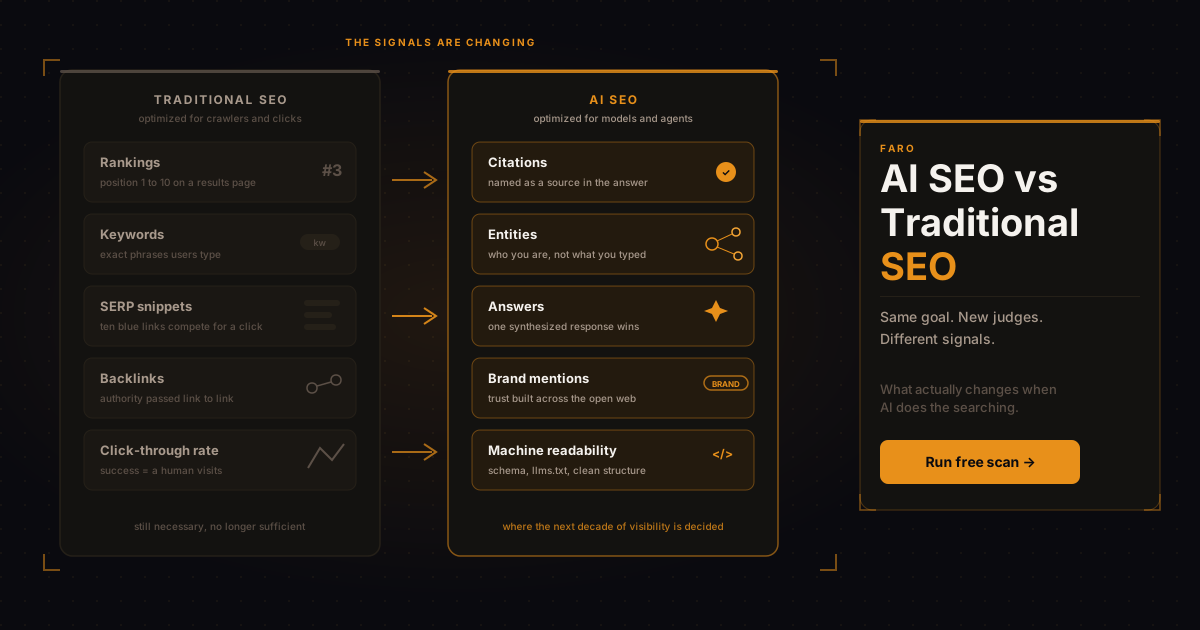
Your page ranks number one on Google. Organic traffic is healthy. Then, quietly, ChatGPT and Perplexity start fielding the questions your buyers used to type into a search bar — and your brand is nowhere in the answers. That is not a hypothetical. Ahrefs data shows AI traffic grew roughly 10x in the past 12 months, while AI Overviews alone reduce organic click-through rates by 58% on average. AI SEO is the discipline that determines whether your brand gets cited in those answers or disappears from the consideration set entirely.
What exactly is AI SEO?
AI SEO is the practice of optimizing your website, content, and structured data so that AI systems — including large language models, AI answer engines, and AI-powered search features — can accurately discover, parse, and cite your brand. It is not a replacement for traditional SEO, but a parallel layer of optimization that governs visibility in a fundamentally different class of discovery channel. Where traditional SEO targets crawlers that index pages for a ranked list, AI SEO targets inference systems that synthesize information into a direct answer and attribute it to a source.
How does AI SEO differ from traditional SEO?
The core difference is intent architecture. Traditional SEO optimizes for a ranked list that a human navigates; AI SEO optimizes for a synthesized response that an AI model delivers. That shift changes almost every signal that matters.
In traditional SEO, a page earns a ranking primarily through backlink authority, on-page keyword relevance, and technical crawlability. In AI SEO, what matters is whether an AI model can extract a confident, attributable answer from your content and whether it trusts your brand enough to cite it. Trust comes from structured data, consistent entity signals, explicit factual claims, and machine-readable context — not keyword density. The OKF Generator supplies that machine-readable context directly, as a structured file describing your business instead of prose a model has to interpret.
| Dimension | Traditional SEO | AI SEO |
|---|---|---|
| Primary goal | Rank in a list of blue links | Be cited in a synthesized AI answer |
| Key signal | Backlinks and keyword relevance | Structured data, entity clarity, factual density |
| Content format | Long-form keyword-matched pages | Answer-first, question-matched content blocks |
| Crawl target | Googlebot and Bingbot | AI agents, LLM crawlers, answer engine bots |
| robots.txt behavior | Controls Google/Bing crawl access | Controls GPTBot, ClaudeBot, PerplexityBot access separately |
| Schema importance | Helpful for rich results | Critical for AI context and attribution |
| Citation mechanism | User clicks to your page | AI quotes or names your brand in the answer |
| Measurement | Rankings, organic sessions, CTR | Brand citations, AI mention share, answer presence |
Which signals do AI systems actually use to choose a source?
AI models do not rank pages the way Google does. They synthesize information from their training data and, in retrieval-augmented systems, from live crawl results. The signals that increase the likelihood of your content being cited fall into three categories: credibility signals, machine-readability signals, and explicit access signals.
Credibility signals
AI systems weight sources that demonstrate topical authority through consistent, factual, attributed claims. Pages that state specific numbers, cite external sources, include author credentials, and publish on a predictable cadence score higher in the model's implicit trust hierarchy. A page full of hedged marketing language offers little for a model to confidently cite. Industry research shows that brands recommended first by AI are 389% more likely to be Googled — making first-citation status a genuine commercial asset, not a vanity metric.
Machine-readability signals come from structured data. Schema.org markup gives AI systems unambiguous context about what your organization does, what your products cost, who your team is, and what questions your content answers. Without schema, a model has to infer all of that from prose; inference introduces error and omission. Explicit access signals come from your robots.txt file. If you have not configured rules for AI crawlers like GPTBot, ClaudeBot, or PerplexityBot, you have no control over which parts of your site they index or ignore.
Not sure how your site scores across these three signal categories? Run a free AI Readiness Scan and get a scored report across 30+ checks in under two minutes.
Why does your robots.txt file matter more than it used to?
In 2024, a properly maintained robots.txt was largely about telling Google which pages not to crawl. In 2026, it functions as a primary access control layer for a growing list of AI agents. GPTBot, ClaudeBot, PerplexityBot, and a dozen other AI crawlers all check robots.txt before indexing your content. If your file still only references Googlebot and Bingbot, you are either blocking valuable AI crawlers by default or allowing them unrestricted access with no strategic intent behind that choice.
The stakes escalated significantly after research published in May 2025 showed that a 13-word Reddit comment can poison ChatGPT deep-research agents; uncontrolled content ingestion is not a neutral outcome. What AI systems read about your brand shapes what they say about it. You can audit your current robots.txt configuration with Faro's robots.txt Analyzer, which checks for missing AI crawler directives and flags conflicts that could suppress your content from the wrong systems.
What does AI-ready content actually look like?
AI-ready content is answer-first, not atmosphere-first. It opens with a direct statement that addresses a specific question, uses factual claims with attributable numbers, and structures information so that a model can extract a quotable passage without reading the entire page. That means short declarative sentences, explicit subject-entity relationships, and consistent terminology; your product name, your company name, and your category label should appear the same way on every page.
Your content also needs an explicit machine-readable layer. Google's structured data documentation describes how schema markup helps search systems understand page context, and the same logic applies to AI answer engines. An FAQ schema block, for example, signals to an AI model that a page is explicitly designed to answer questions, increasing the probability of citation in a conversational AI response. Faro's AI Schema Creator generates the correct markup for your page type without requiring a developer.
How should you measure AI SEO performance?
Traditional SEO performance is measured in rankings, sessions, and CTR — all of which assume a human clicked a link. AI SEO performance requires a different framework because the conversion path is different. When an AI recommends your brand in a response, the buyer may never click anything immediately; they store your name and search for you later. Industry research found that an AI recommendation makes someone 182% more likely to Google your brand and 117% more likely to visit your website — but that downstream behavior only shows up in direct and branded search traffic, not in referral sessions from the AI engine itself.
The metrics that matter for AI SEO are brand citation frequency (how often AI systems name your brand in relevant queries), answer presence rate (the percentage of target queries where your content appears as a cited source), and share of AI voice (your brand citations relative to competitors in your category). Tracking these requires monitoring AI outputs directly, not just analytics dashboards. Faro's AEO Citation Monitor, available on the Agency tier, tracks brand mention share across major AI answer engines and surfaces which competitors are being cited instead of you.
What is the fastest way to close the gap between traditional and AI SEO?
The fastest gains come from fixing the technical layer first: robots.txt configuration for AI crawlers, schema markup on your highest-traffic pages, and an llms.txt file that explicitly tells AI systems what your site contains and what you want them to know about your brand. The llms.txt standard is a lightweight protocol that gives AI agents a curated summary of your site's content and intent, reducing misrepresentation caused by AI systems inferring your positioning from unstructured prose. Faro's llms.txt Generator builds a correctly formatted file based on your site's existing content and structure.
After the technical layer, prioritize content that directly answers the questions your buyers ask AI systems. Use specific numbers, name your category explicitly, and include schema markup on every answer-oriented page. That combination of technical access, machine-readable context, and answer-first content separates brands that get cited from brands that get ignored. For the order to work through, the AI readiness checklist of ten things to fix before next week puts those fixes in sequence with the time each one takes.
In short
AI SEO is the practice of making your brand discoverable, citable, and trustworthy to AI systems — not just to Google's crawler. It differs from traditional SEO in its signals, its measurement, and its commercial mechanism: instead of earning a click from a ranked list, you earn a citation in a synthesized answer that shapes buyer intent before they ever visit your site. The technical foundations — robots.txt, schema markup, llms.txt, and structured content — are fixable today, and fixing them ahead of competitors creates a durable citation advantage. Brands that act now will be the ones AI systems have learned to recommend by the time buyers start asking.
Frequently Asked Questions
Is AI SEO just Answer Engine Optimization (AEO) rebranded?
They overlap significantly but are not identical. AEO focuses specifically on appearing in AI-generated answers and featured responses. AI SEO is broader: it includes AEO but also covers how AI crawlers access your site, how AI training data represents your brand, and how structured signals shape AI model behavior. AEO is a subset of AI SEO.
Does optimizing for AI search hurt traditional Google rankings?
No. The technical changes that improve AI SEO — schema markup, faster page load, clearer content structure, accurate robots.txt — align with Google's own quality signals. Optimizing for AI readiness typically lifts traditional SEO performance as a side effect, not a trade-off.
How quickly can AI SEO changes show results?
Technical changes like robots.txt updates and schema implementation can be reflected in AI crawler behavior within days of deployment. Changes to how AI models cite your brand in responses depend on retraining cycles and retrieval-augmented indexing schedules, which vary by platform. Expect to see measurable citation shifts within four to twelve weeks for retrieval-based systems like Perplexity.
Do I need separate content for AI SEO versus traditional SEO?
Not necessarily. Answer-first content that is factually dense, well-structured, and schema-marked up performs well in both channels. The main adjustment is leading with direct answers instead of introductory context, and ensuring every key claim is attributable and specific. One content strategy can serve both channels if built with AI readability as a design constraint from the start.
Which AI systems should I prioritize first?
Prioritize the systems your buyers actually use. For B2B audiences, ChatGPT and Perplexity dominate AI research workflows as of mid-2026. Google's AI Overviews matter for top-of-funnel query interception. If your audience is technical, Claude is increasingly used for in-depth research. Your robots.txt and schema should address all of them, but citation monitoring should focus on the two or three platforms your buyers use most.
AI SEO readiness is a scored, measurable condition — not a gut feeling. Run Faro's free AI Readiness Scan to see exactly where your site stands across 30+ checks, get a 0-to-100 score, and receive a prioritized fix list you can act on this week.