Marketing leaders spent a decade building playbooks around search. Content strategy, keyword targeting, link building, technical SEO, and conversion rate optimization all converged into a discipline that marketing teams own and measure against revenue. AI is doing to that playbook what mobile did to desktop web: not replacing it, but requiring a new layer that most organizations are unprepared for.
The question for CMOs in 2026 is not whether AI will affect brand discovery. It already is. The question is whether your organization is tracking it, and whether your team has the strategy and tools to improve it.
The Discovery Shift CMOs Need to Understand
For the past decade, the discovery funnel worked like this: user has a question, user types it into Google, Google returns ten blue links, user clicks a result. The brand's job was to be one of those links.
The 2026 version increasingly looks like this: user has a question, user asks ChatGPT, Claude, or Perplexity, AI gives a direct answer with two to five specific recommendations. The brand's job is to be one of those recommendations. If you're not in the AI answer, you don't exist in that user's consideration set.
For high-consideration B2B purchases, this shift is happening faster than in B2C. When a procurement team asks an AI assistant to identify the leading platforms for customer data management, they're getting a structured shortlist, not a list of links to evaluate. The brands on that shortlist win disproportionately.
What CMOs Should Be Measuring
AI mention rate
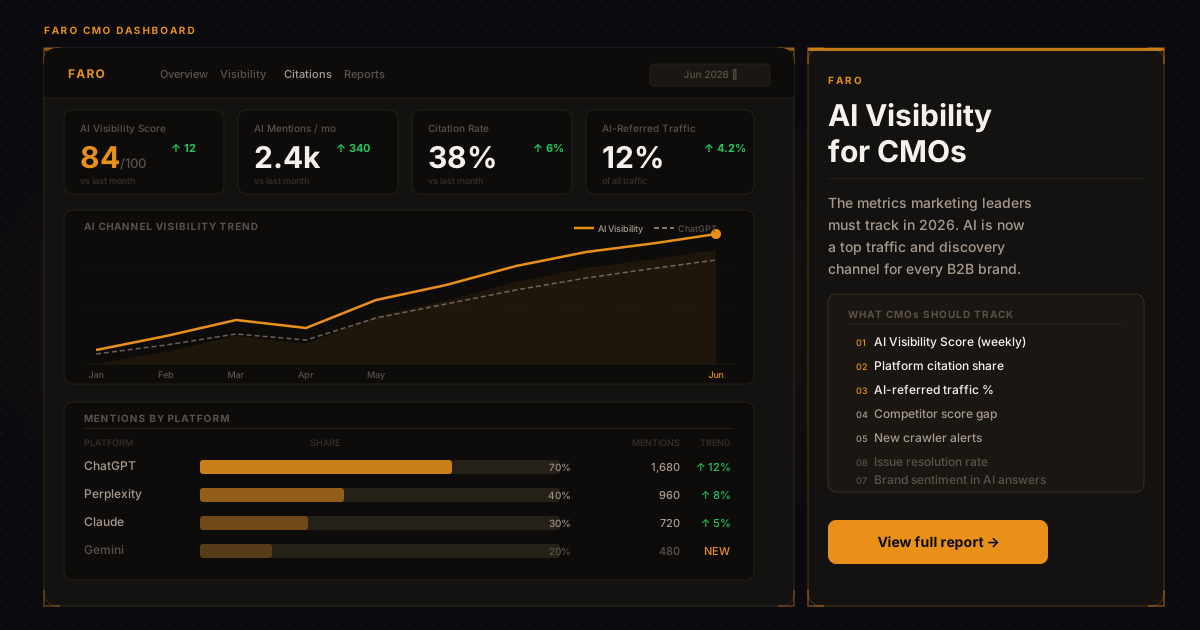
The mention rate is the percentage of relevant AI model queries in which your brand appears. It's the closest AI-era equivalent to organic search visibility. A brand with a 60% mention rate across category queries on ChatGPT, Claude, Perplexity, and Gemini is appearing in the majority of AI answers that a buyer in their category might receive. A brand with a 10% mention rate is nearly invisible to AI-mediated discovery.
Track mention rate by model (different AI platforms have different visibility profiles), by query type (brand queries vs. category queries vs. use case queries), and over time (trending up or down as model knowledge updates).
Share of voice in AI responses
Share of voice measures how often you appear relative to your competitors in the same category queries. If you appear in 40% of queries and your top competitor appears in 65%, the gap is 25 points. This is a number your board will understand intuitively because it mirrors how traditional share of voice has been reported for decades.
Faro's AEO Citation Monitor tracks this in the dashboard with a per-model breakdown and animated share-of-voice bars.
AI sentiment quality
Appearing in AI responses is necessary but not sufficient. The AI description of your brand affects buyer perception just as positioning in traditional media does. Track how AI models describe your brand: what attributes they associate with you, what qualifiers they use, and how your description compares to competitors.
Common sentiment signals to watch: is your brand described as a leader or as an alternative? Is pricing described as competitive or expensive? Is complexity mentioned? These patterns emerge consistently across models and can be shifted through the right content and positioning signals.
AI visibility score
The AI visibility score is a diagnostic metric that shows whether your technical foundation is in place to support AI visibility. It covers crawler access, structured data, llms.txt, agents.json, sameAs entity links, and content signal quality. A high AI visibility score doesn't guarantee high visibility (there's also a training data component that takes time), but a low AI visibility score is a ceiling on how visible you can be.
Think of the AI visibility score as a pre-condition metric: the score needs to be high before visibility improvements compound. Track it as a lagging indicator of technical hygiene.
Structuring Your Marketing Team for AI Visibility
Most marketing teams currently have no one who owns AI visibility. The technical signals (structured data, robots.txt, llms.txt) fall to engineering or SEO. The content strategy (what to publish to influence training data) falls to content teams with no mandate to optimize for AI. The competitive monitoring (who's getting mentioned and why) happens nowhere.
A functional structure assigns AI visibility as a domain within SEO or demand generation, with clear ownership of:
- Technical AI visibility (all the file-based signals)
- AI mention rate tracking (ongoing, automated measurement)
- Competitive benchmarking (quarterly)
- Content strategy for AI visibility (longer-form, authoritative content that becomes training data)
- Entity verification (keeping external profiles accurate and complete)
For most organizations, this is an expansion of the existing SEO role rather than a new hire. The skill set overlaps significantly; the tactics differ.
The Content Strategy Angle
AI models learn from text. The content that most influences what AI says about your brand falls into two categories:
Training data content is the authoritative, long-form content that exists on your site and in third-party publications. Comprehensive guides, comparison posts, industry analyses, and case studies that establish your brand's expertise and positioning become part of the model's knowledge over training cycles. This content needs to exist and be indexed before it can influence model outputs, and the lag time is significant, often 6 to 12 months.
Retrieval content is what AI models with live web access (like Perplexity) read when answering queries. This content needs to be structured, fast-loading, and accurately marked up. llms.txt is the most direct form of retrieval content, explicitly written for AI systems. Updates to retrieval content can affect AI responses within days.
CMOs should be funding both. The near-term wins come from retrieval content (llms.txt, structured schema, agents.json). The durable brand presence comes from the training data content strategy, which requires 12 to 18 months of consistent execution before results compound.
Get your AI visibility baseline
Before presenting an AI visibility strategy to leadership, run Faro's AI Visibility Checker on your site and your top three competitors. The score gives you a defensible starting point for the conversation.
How to Present AI Visibility to Leadership
Most CEOs and boards have not yet internalized AI discovery as a business metric. The framing that lands best is the parallel to early SEO:
In 2004, businesses that invested in SEO early built compounding advantages that took competitors years to close. In 2024, Google search traffic began declining measurably as AI answers displaced click-through results. The businesses positioned for this shift keep customers. The ones that didn't are losing share to brands they hadn't previously considered competitors.
The concrete numbers help: what is your current AI mention rate? What is your top competitor's? What are the technical gaps that explain the difference? What would it cost to close them? What's the expected improvement in mention rate from fixing the top three gaps?
This is the presentation structure: current state benchmark, gap analysis, investment required, projected improvement, timeline. It's the same structure as any traditional marketing channel report.
AI Visibility as a Brand Audit Trigger
Running AI visibility checks often surfaces something CMOs haven't considered: how AI models describe your brand is a proxy for how your brand is described in the content that exists about you online. If AI models consistently associate you with attributes you don't want (expensive, complex, old-fashioned), that's diagnostic information about your existing brand content and coverage.
AI visibility audits are becoming a standard trigger for brand content audits. The process is: run the AI mention rate check, review AI descriptions of your brand, identify gaps between desired positioning and AI description, trace those gaps to specific content signals, and develop a content strategy to correct them.
Timeline Expectations
CMOs who set realistic timelines will be better positioned with leadership. Here is a practical timeline for AI visibility improvement:
In the first 30 days, close technical gaps. Unblock AI crawlers, publish llms.txt, add Organization JSON-LD schema, and launch with agents.json if relevant. These changes affect retrieval-based AI models (Perplexity and ChatGPT with web browsing) within weeks.
In months 2 through 6, build retrieval content. Expand llms.txt, add FAQ schema, publish authoritative long-form content in your category. Track mention rate monthly. Expect 5 to 15 point improvements in mention rate on retrieval-based models.
In months 7 through 18, build training data presence. Earn press coverage, publication mentions, and third-party citations. Contribute to industry discussions and comparisons. This is the long game; it doesn't show immediate metric improvements but builds the foundation for durable AI visibility as model training cycles update.
In Short
AI discovery is a marketing metric that most organizations aren't tracking yet. CMOs who establish AI mention rate, share of voice, and AI visibility score as regular reporting metrics will be positioned to show clear ROI on AI visibility investments. The technical foundation is achievable in weeks. The content strategy that builds durable AI brand presence takes 12 to 18 months. Starting both now, with the technical foundation first, is the right sequence.
Begin with a scan. Faro's AI Visibility Checker gives you a baseline score and competitive gap analysis in under 60 seconds.
Frequently Asked Questions
Is AI visibility replacing SEO?
Not replacing, but supplementing and in some categories displacing. Search click-through rates are declining on queries where AI provides direct answers. Marketing teams that treat AI visibility as a parallel channel alongside SEO are better positioned than those who treat it as either irrelevant or as a complete replacement. The technical foundation is shared; the strategy differs.
How does AI visibility affect brand sentiment scores?
Directly, in two ways. First, by improving the quality of information AI models have about your brand, you can shift how they describe you toward your desired positioning. Second, by monitoring AI sentiment regularly, you get an early signal on brand perception issues that may also manifest in traditional channels.
What budget should a mid-size company allocate to AI visibility?
The technical work is mostly a one-time investment of engineering time: a few days to a week for a mid-size company to close all technical gaps. Ongoing cost is primarily the monitoring and content strategy. Faro's Pro plan covers continuous monitoring and scan access. The content strategy is typically absorbed into existing content marketing budgets with a realigned brief toward AI visibility goals.
Should AI visibility be owned by marketing or engineering?
Marketing should own the strategy and metrics. Engineering should own the technical implementation. The division mirrors the SEO operating model that most companies already have, where content and keyword strategy sits in marketing and the technical SEO implementation sits in engineering. What changes is that marketing needs to understand the technical signals well enough to write an informed brief for engineering.