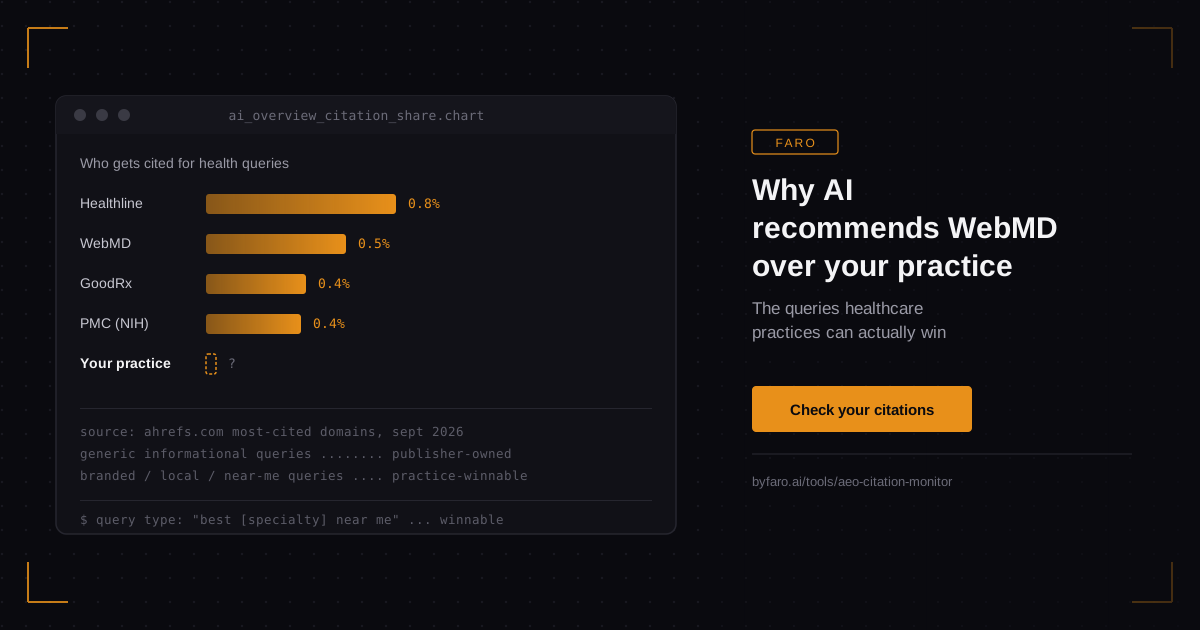
Ask ChatGPT, Gemini, or Perplexity a general health question and the answer almost always traces back to a handful of publishers: Healthline, WebMD, GoodRx, or a page hosted on the National Institutes of Health's own PMC archive. Not your practice, not the clinic two towns over, and not the specialist your patients actually see. The uncomfortable part for anyone building AI visibility for a healthcare practice is that generic informational queries, the "what are the symptoms of X" and "how does Y treatment work" searches, were never winnable against publishers with decades of content and domain authority. That fight is already decided. The real opportunity sits somewhere narrower: branded and local queries, where a patient is already looking for a specific provider rather than a diagnosis, and where AI agents pull from a different set of signals entirely.
Key takeaways
- A small group of publishers, led by YouTube and Reddit, capture the overwhelming majority of Google AI Overview citations; health-specific sites like Healthline and WebMD hold single-digit-percentage shares even within their own category.
- Individual healthcare practices almost never get cited for generic informational health queries. That battle belongs to large publishers, not local providers.
- Branded, local, and name-specific queries work on a different set of signals than informational ones, and those are the queries a practice can actually win.
- Schema.org's MedicalBusiness and Physician types exist specifically for this, but Google's own structured data documentation offers no healthcare-specific guidance, leaving most practices to figure it out alone.
- Knowing whether any of this is working requires tracking actual AI citations over time, not guessing from a single ChatGPT search.
Why does AI recommend WebMD instead of your practice?
Because citation share in AI answers is heavily concentrated, and healthcare practices are competing in the most concentrated part of it. According to Ahrefs' analysis of the most-cited domains in Google AI Overviews, updated September 2026, YouTube alone captures 22.9% of all citations and Reddit another 18.5%, together accounting for more than 41% of everything AI Overviews cites. Health-specific publishers place much further down the list: Healthline ranks 13th overall with a 0.8% mention share, WebMD sits at 22nd with roughly 0.5%, and GoodRx and the NIH's PMC archive each hold about 0.4% at positions 32 and 34. Those are the winners in the health category. A single-location practice, a regional clinic, or an independent specialist is not competing with the practice down the street for these citations; it is competing with publishers whose content libraries run into the hundreds of thousands of pages, and it is losing before the query is even typed.
Which AI queries can a healthcare practice actually win?
The queries a practice can win are the ones built around a name, a location, or a specific service, not a symptom or a general topic. "What causes lower back pain" belongs to Healthline and the Mayo Clinic. "Best orthopedic surgeon near [city]" and "is [practice name] accepting new patients" belong to a much smaller, much more local pool of sources, where a well-structured website, an accurate Google Business Profile, and consistent reviews carry real weight. The distinction matters because most healthcare AI-visibility advice treats "getting cited by AI" as one undifferentiated goal, when in practice it is two very different fights with two very different odds.
| Query type | Example | Who typically gets cited | What actually helps |
|---|---|---|---|
| Generic informational | "symptoms of plantar fasciitis" | Large health publishers, medical reference sites | Little a single practice can do; not a winnable fight |
| Branded | "is [practice name] any good" | The practice's own site, review platforms, directories | Consistent name, address, and review data across the web |
| Local / near-me | "best pediatric dentist in [city]" | Local business listings, practice sites with structured data | LocalBusiness and Physician schema, Google Business Profile accuracy |
| Comparison / shortlist | "[condition] specialists that take [insurance]" | Directories, aggregator sites, well-structured practice pages | Clear, machine-readable service and insurance data on the page itself |
Source: query pattern analysis based on Ahrefs' AI Overview citation research and Google Search Central's structured data documentation, cited throughout this article.
What structured data actually helps AI recognize your practice?
Schema.org built a category specifically for this: MedicalBusiness and its 24 subtypes, including Physician, Dentist, MedicalClinic, and specialty types like Dermatology and Pediatric. MedicalBusiness inherits from both Organization and Place through LocalBusiness, which is what lets a practice describe itself as a formal entity and a physical location at the same time; properties cover opening hours, accepted payment and insurance information, staff credentials, and address data. Google's own general guidance backs a narrower slice of that: its LocalBusiness structured data documentation lists only two required properties, name and address, with aggregateRating, geo coordinates, openingHoursSpecification, and telephone recommended on top. Notably, that same documentation offers no healthcare-specific examples at all; it references spas and health clubs, not clinics or practices. That gap is real, and it means most practices building out schema today are extending generic guidance rather than following a healthcare-specific playbook, which is exactly the kind of information gap Faro's structured data for AI breakdown and the AI schema tool are built to close. Once that markup exists, getting it into a machine-readable format AI agents can pull directly, rather than one they have to scrape and infer, is what Faro's OKF generator handles, turning a practice's site data into a structured file an agent can read without guessing.
How do AI agents decide which local provider to recommend?
For local and branded queries, an AI agent is not reading a single authoritative page the way it might for a medical topic; it is reconciling several sources at once, a practice's own website, its Google Business Profile, listings on insurance directories, and review platforms, and checking whether the name, address, phone number, and services described line up across all of them. Inconsistency is the most common failure mode here: a practice that moved offices two years ago and updated its own site but not three directories is telling an AI agent three different addresses, and the agent has no reliable way to know which one is current. This is the same grounding problem that runs through every AI-visibility question, whether the evidence an AI system can verify is clean, consistent, and current, or scattered and contradictory. A practice does not need to be the loudest source online; it needs to be the most internally consistent one, because consistency is what a model can actually check.
Reviews complicate this further, since they are the one signal that is both widely trusted and genuinely hard to keep consistent. A practice with 400 reviews on Google and 12 on a niche insurance directory is not sending a mixed signal by accident; it is telling an agent that the Google listing is the maintained one and the directory listing is an afterthought, and agents weigh accordingly. Fixing that does not require chasing every review platform equally. It requires picking the two or three that matter for your specialty and your region, and keeping those current, rather than spreading effort thin across a dozen sites an agent barely samples from anyway.
How do you know if any of this is working?
Fixing schema and cleaning up directory listings is only half the job; the other half is confirming it changed anything. Running a one-off search in ChatGPT and checking whether your practice comes up tells you almost nothing, since answers vary by session, by model version, and by how the question is phrased. What actually shows a trend is testing the same set of branded and local prompts on a fixed schedule and logging whether your practice appears, whether it is linked, and which page gets cited, the same discipline covered in Faro's guide to AI citation tracking across ChatGPT, Claude, and Perplexity. Faro's own AEO citation monitor runs that check continuously instead of whenever someone remembers to look, which matters more for a healthcare practice than most categories, since the baseline you are trying to beat is publishers who update constantly and a market that shifts every time a competing practice fixes its own listings.
Before chasing citations at all, it is worth confirming the basics are in place: is the site crawlable, indexed, and free of the kind of blocks that quietly keep AI agents out entirely. Faro's AI readiness page for healthcare practices walks through that baseline specifically for this industry, rather than treating a clinic the same as a SaaS company or an online retailer.
Frequently asked questions
Does ChatGPT recommend doctors or medical practices?
It cites sources rather than making personal recommendations, and for general health questions those sources are almost always large publishers like Healthline or WebMD, not individual practices. For a specific, named provider, or a "near me" style query, the sources shift toward local listings, review platforms, and the practice's own website, which is where a practice actually has a chance to appear.
Can a small clinic compete with WebMD or Healthline for AI visibility?
Not for generic informational queries; that fight belongs to publishers with far larger content libraries and decades of domain authority. A small clinic's realistic opportunity is branded and local queries, where the competition is other nearby providers and directories, not national publishers.
Do I need schema markup to get recommended by AI?
It is not a guarantee, but it removes ambiguity. Schema.org's MedicalBusiness and Physician types, combined with accurate LocalBusiness properties like name, address, and opening hours, give an AI agent a structured, verifiable version of information it would otherwise have to infer from unstructured text, and inference is where inconsistencies get introduced.
How is a branded AI query different from an informational one?
An informational query asks about a topic or symptom and gets answered from whichever publisher covers that topic most authoritatively. A branded or local query names a specific provider, service, or location, and gets answered from that provider's own site, its directory listings, and its reviews, an entirely different and much smaller competitive set.
How often should a healthcare practice check its AI visibility?
A weekly cadence against a fixed list of branded and local prompts is enough to catch a real trend without reacting to normal answer variability. A single check, run once and never repeated, will not tell you whether a schema or directory fix actually changed anything.
Does having more online reviews help a practice get recommended by AI?
Volume helps less than consistency. An agent weighing local recommendations checks whether review counts, ratings, and practice details agree across the platforms it samples, not just how many five-star reviews exist on one site. A practice with fewer reviews spread evenly across two or three consistently maintained platforms is a cleaner signal than one with hundreds on a single site and stale, contradictory listings everywhere else.
In short
AI answer engines cite a small, concentrated set of publishers for general health questions, and individual healthcare practices are not going to out-rank Healthline or WebMD for those queries. The winnable fight is branded, local, and service-specific queries, where structured MedicalBusiness and Physician data, consistent name-address-phone details across the web, and clean Google Business Profile listings genuinely move the needle. None of that work counts for much without a way to confirm it is working, tracked over time against real prompts rather than guessed from a single search.
Start with the baseline: run Faro's AI readiness checklist for healthcare practices to see where your structured data and crawlability stand today.
Then keep score. Faro's AEO citation monitor tracks the branded and local queries that actually matter for your practice, on a schedule, so you know whether the fixes worked instead of guessing.